Inger sur la plage
Edvard Munch · 1889
.jpg)
Munch's youngest sister sits on a granite rock in a white dress, holding her straw hat, while the sea behind her turns blue and violet in the Nordic summer night. Critics in 1889 called it gibberish.
The story behind the painting
In the summer of 1889 Munch rented a small house in Åsgårdstrand, a coastal town on the Oslofjord where many people from Kristiania, now Oslo, spent their summers, among them his friends Christian Krohg and Frits Thaulow. The place became central to his life: he returned for many summers, bought a house there in 1897, and painted many key works there. In that first summer he painted his youngest sister Inger, who had modelled for him before. First he made a series of studies between 9 and 11 at night to catch the light of the Norwegian summer night.
What to look for
Inger sits quietly on a large granite rock, a straw hat in her hands, her head in profile. Her bright white dress stands out against green mossy stones and the blues and purples of the water. There is almost no horizon between sky and sea. Only a few pots and a fishing boat hint at human life. Munch had used a similar pose in his 1884 interior Morning, of a girl on the edge of a bed. Note the stones: Munch later compared seaside rocks to living creatures, goblins and sea spirits, with fantastic tones in the night light.
Meaning and intent
For Reinhold Heller, the painting gives less a time of day than a mood, made by contours, the missing horizon and an almost monochrome blue. Ulrich Bischoff contrasts it with Munch's conventional 1884 portrait of a 14-year-old Inger in her confirmation dress; here Munch shows his repertoire for loneliness, melancholy and angst, and points toward the Frieze of Life. Tone Skedsmo links the quiet summer-night mood to Norwegian naturalists such as Harriet Backer and Kitty Kielland, while Munch's simplified forms add something modern, compared by Nicolay Stang to Gauguin.
Legacy
Titled Evening, it was shown a few months after completion at the autumn exhibition in Kristiania, while Munch had already left for Paris. The criticism was harsh. Morgenbladet called it pure gibberish, and Aftenposten said the figure had no trace of life and questioned why it was exhibited at all. Dagbladet defended Munch as a poet carried by a mood. The painter Erik Werenskiold bought it from the exhibition; the source gives 1909 for that purchase, which sits oddly with the 1889 show. In 1924 it entered Rasmus Meyer's public collection in Bergen.
Le saviez-vous ?
- Painted at Åsgårdstrand in the summer of 1889.
- The sitter is Munch's youngest sister, Inger.
- Also known as Summer Night; first shown as Evening.
- In the Rasmus Meyer collection, Bergen.
À propos de l'artiste
Edvard Munch (1863-1944)
portrait · robe · chapeau · plage · pierre
Autres œuvres de Edvard Munch
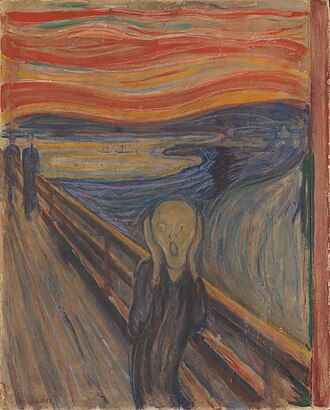 Le Cri - Edvard Munch (1893)
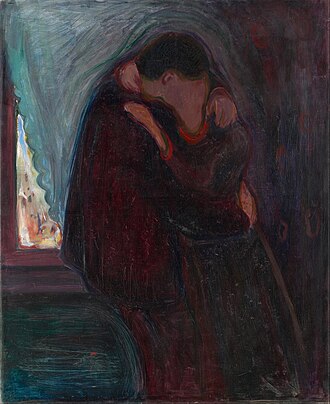 Le Baiser - Edvard Munch (1897)
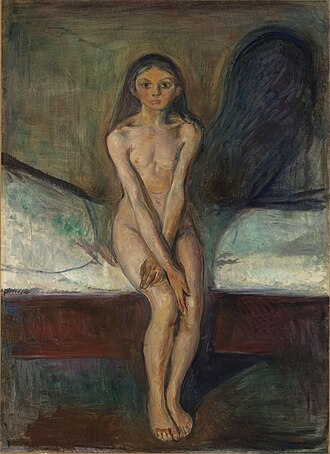 Puberté - Edvard Munch (1895)
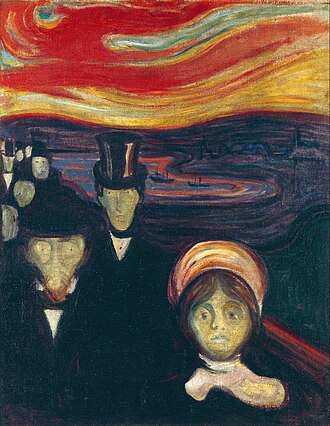 Anxiété - Edvard Munch (1894)
.jpg) Soirée sur l'avenue Karl Johan - Edvard Munch (1892)
Soirée sur l'avenue Karl Johan - Edvard Munch (1892)%2C%20NG.M.01111.jpg) Nuit à Saint-Cloud - Edvard Munch (1890)
Nuit à Saint-Cloud - Edvard Munch (1890)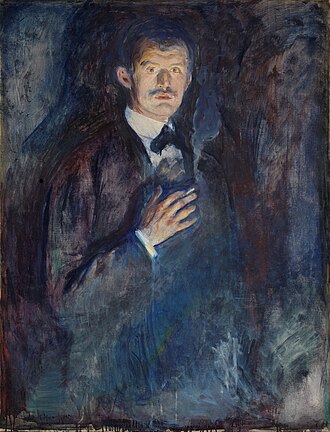 Autoportrait à la cigarette - Edvard Munch (1895)
%2C%20Kunsthalle%20Bremen.jpg) La Mort et l'Enfant - Edvard Munch (1899)
La Mort et l'Enfant - Edvard Munch (1899)