Almées jouant aux échecs
Jean-Léon Gérôme · 1870
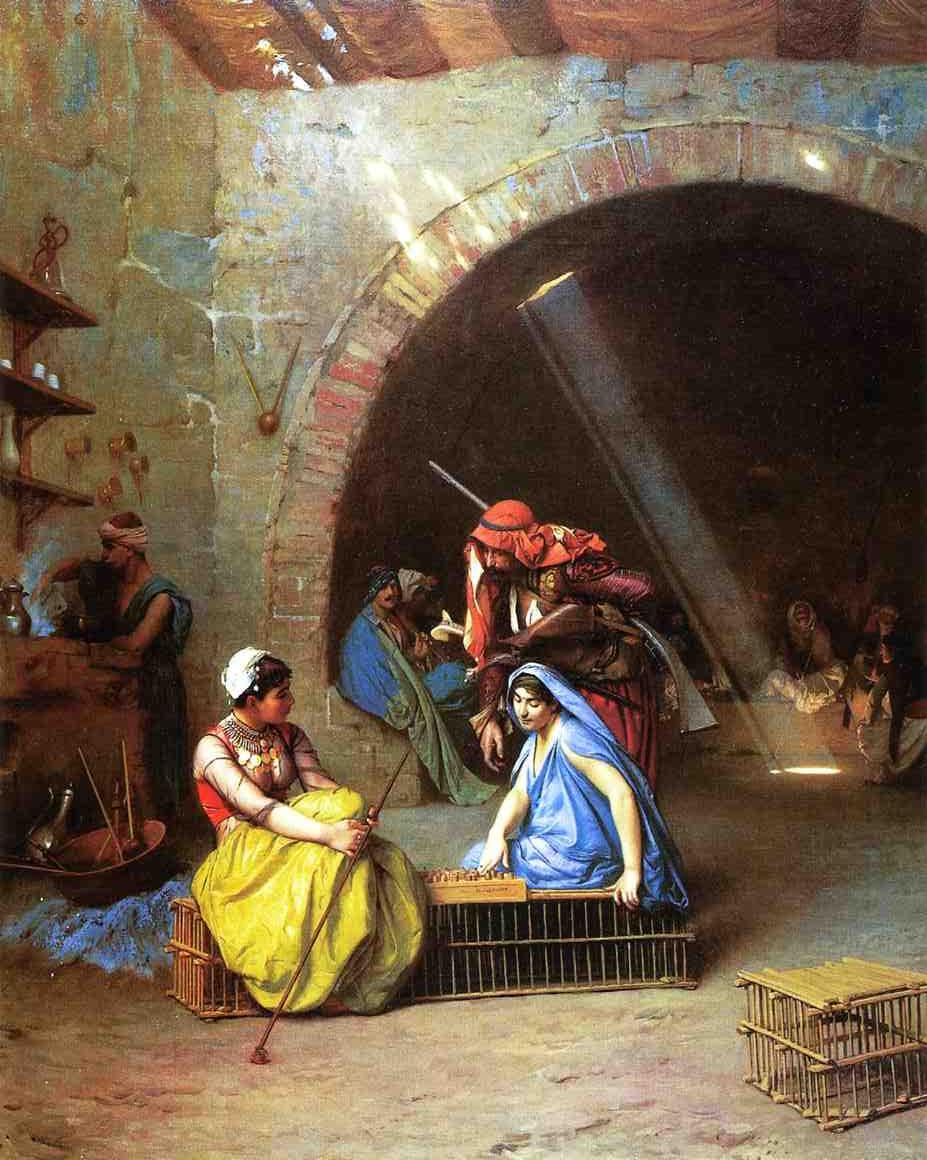
Two women sit on a wooden cage in a dim cafe, bent over a chessboard, while a soldier watches every move. Gérôme painted this quiet game in 1870, after meeting dancers on a journey through Egypt.
The story behind the painting
In 1868 Gérôme travelled to the Fayoum oasis with his companion Paul Lenoir. At Sinuris they met a group of almehs and invited them to join them, and Gérôme's brother-in-law Albert Goupil photographed the women. Back in France the painter obtained costumes for his models. Two years later, in 1870, he painted this scene of life in Ottoman Egypt. The French Wikipedia article gives the canvas as 65.7 by 54.8 cm and calls it privately owned, while Wikidata lists the Metropolitan Museum of Art and the Najd Collection.
What to look for
Two women use a wooden cage as a bench. One wears the almeh's costume: yellow puffed trousers, a red waistcoat, black transparent tulle and a decorated headdress, with a heavy gold necklace hung with medals and a pipe in her left hand, her attention fixed on the game. The other, in a blue cloak of antique style with a blue veil, touches the board with her right hand. Beside them a bashi-bazouk, an irregular Ottoman soldier, watches closely. Behind, a man pours water into a basin and others smoke or talk. A shaft of light falls from an opening in the roof. The signature, J.L. GEROME, sits on the edge of the chessboard.
Meaning and intent
An almeh was a highly skilled Egyptian dancer, singer and musician, often invited into harems to teach and entertain. The word was also used as a euphemism for an erotic dancer, a role that became more visible after the ghawazi, another kind of traditional dancer, were banned in 1834. Almehs rarely performed in public, and the article suggests the model here may more truly be a ghawazi. The light from above makes the scene feel intimate and mysterious, an everyday moment charged with the sensuality and exoticism that recur in Gérôme's work.
Legacy
Gérôme's pictures of almehs, and of Eastern cultures in general, left a lasting mark on nineteenth century Western art. He is sometimes criticised for exoticism and a stereotyped vision of the East, yet his works remain striking examples of academic Orientalism, seen through a European lens. This canvas passed through many hands: Mrs T. A. Scott in Philadelphia from 1885 to 1895, a private American collection, the Newhouse Galleries, the Nelson-Atkins Museum of Art from 1932, the Schoneman Galleries from 1947, a Christie's sale in New York in 1983, and the Mathaf Gallery in London.
Le saviez-vous ?
- Painted by Jean-Léon Gérôme in 1870.
- Inspired by his 1868 journey to the Fayoum oasis.
- The signature is on the edge of the chessboard.
- Once held by the Nelson-Atkins Museum of Art, from 1932.
À propos de l'artiste
Jean-Léon Gérôme (1824-1904)
scène de genre · Metropolitan Museum of Art
Autres œuvres de Jean-Léon Gérôme
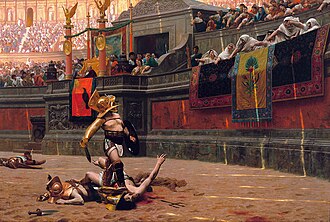 Pollice verso - Jean-Léon Gérôme (1872)
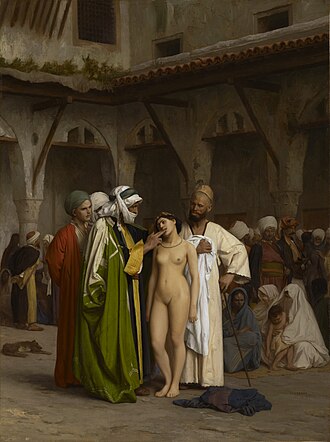 Le Marché aux esclaves - Jean-Léon Gérôme (1866)
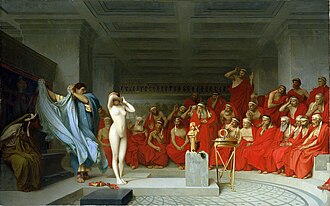 Phryné devant l'Aréopage - Jean-Léon Gérôme (1861)
 La Vérité sortant du puits armée de son martinet pour châtier l’humanité - Jean-Léon Gérôme (1896)
 Bonaparte devant le Sphinx - Jean-Léon Gérôme (1867)
 Cléopâtre et César - Jean-Léon Gérôme (1866)
 Suites d'un bal masqué - Jean-Léon Gérôme (1857)
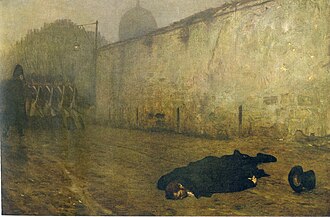 L'exécution du maréchal Ney - Jean-Léon Gérôme (1868)
Œuvres d'artistes liés
 Le Déjeuner sur l'herbe - Édouard Manet (1863)
 Olympia - Édouard Manet (1863)
 L'Origine du monde - Gustave Courbet (1866)
 Un enterrement à Ornans - Gustave Courbet (2020)
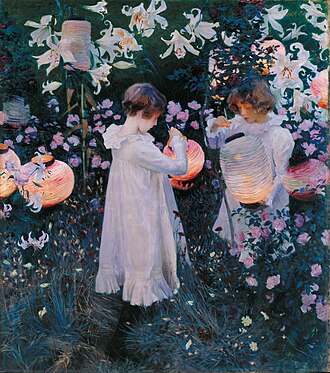 Œillet, lys, lys, rose - John Singer Sargent (1885-1886)
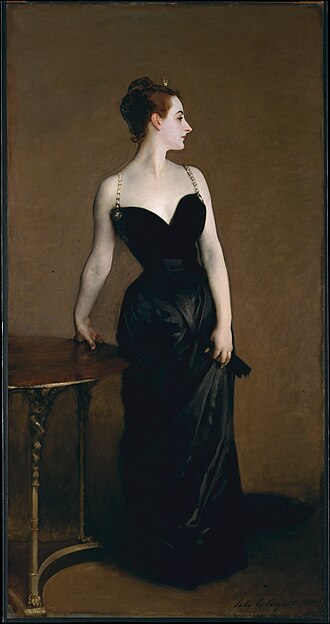 Madame X - John Singer Sargent (1884)
 La Liberté guidant le peuple - Eugène Delacroix (1830)
 La Mort de Sardanapale - Eugène Delacroix (1827)
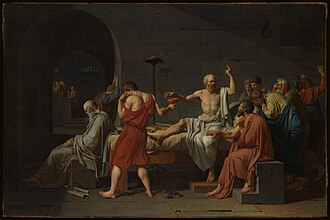 La Mort de Socrate - Jacques-Louis David (1787)
 Le Serment des Horaces - Jacques-Louis David (1784)
 The Ladies Waldegrave - Joshua Reynolds (1780)
 Capitaine George K. H. Coussmaker - Joshua Reynolds (1782)