Eau mystérieuse
Paul Gauguin · 1893
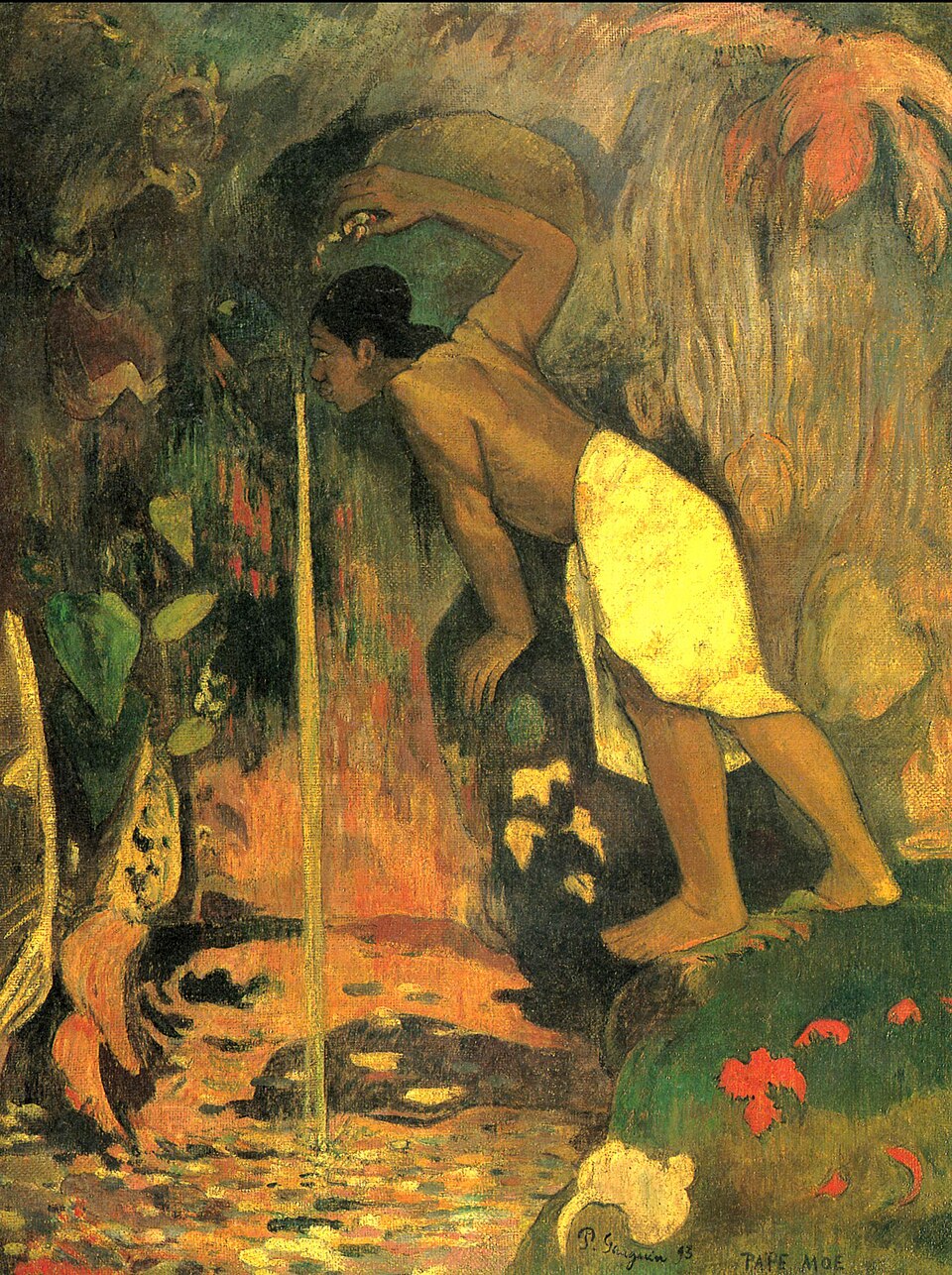
A young Tahitian in a pareo drinks from a spring that bursts from the rock, and hidden in the stone a fish-like shape looks back. Gauguin built this mysterious scene from a photograph taken ten years earlier.
The story behind the painting
Gauguin painted this picture in 1893 during his first stay in Tahiti. Its original title is Pape moe, Pape mo'e in standard Tahitian, and in Spanish it is called Agua misteriosa, Mysterious Water. It is number 498 in the Wildenstein catalogue and is kept in a private collection in Zurich. The image is based directly on a photograph by Charles Georges Spitz, a professional photographer in Papeete who had helped prepare the Tahitian pavilion for the 1889 Paris World's Fair. Isolated from European painters, Gauguin stayed in contact with the island's photographers.
What to look for
The canvas is about 99 by 75 cm. A young Tahitian wearing a pareo bends to drink from a spring that gushes out of the rock, surrounded by exotic vegetation full of mysterious shapes. Look into the rock: the drinking figure meets the gaze of a fish-like form that resembles a human embryo, half hidden in the stone. Gauguin worked the idea of animist transformation into the details of the plants. Spitz's photograph had been taken ten years earlier on an excursion to Mount Aorai.
Meaning and intent
Tahiti is mountainous, rising to 2,241 metres; people live along the coast, and the dense interior was a place for mysteries and legends. In Noa Noa, Gauguin described a mountain excursion with a young Tahitian man and admitted to homosexual impulses. He often painted androgynous beings; in traditional Tahitian culture these were called mahu, people with both male and female qualities, accepted by society as keepers of tradition and performers. Yet when he told a tale about this picture, Gauguin replaced the young mahu with a nymph.
Legacy
The painting sits where a photograph, a personal memory and a legend meet, and Gauguin let all three blur together. The figure might be a young man, a mahu or the nymph of his story, and the water is both an ordinary spring and something enchanted. A watercolour version from 1893 is in the Art Institute of Chicago. The oil, out of public view in Zurich, remains one of the quieter images from his first Tahitian journey, a moment of thirst and wonder in the forest.
Le saviez-vous ?
- Painted in 1893 during Gauguin's first stay in Tahiti.
- Based on a photograph by Charles Georges Spitz.
- Original Tahitian title: Pape moe.
- A watercolour version is in the Art Institute of Chicago.
À propos de l'artiste
Paul Gauguin (1848-1903)
Autres œuvres de Paul Gauguin
 D'où venons-nous ? Que sommes-nous ? Où allons-nous ? - Paul Gauguin (1897-1898)
 Le Christ jaune - Paul Gauguin (1889)
 Quand te maries-tu ? - Paul Gauguin (1892)
 Femmes de Tahiti - Paul Gauguin (1890)
 Vision après le sermon - Paul Gauguin (1888)
Manaò tupapaú - Paul Gauguin (1892)
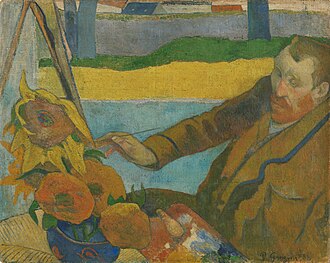 Vincent van Gogh peignant les tournesols - Paul Gauguin (1888)
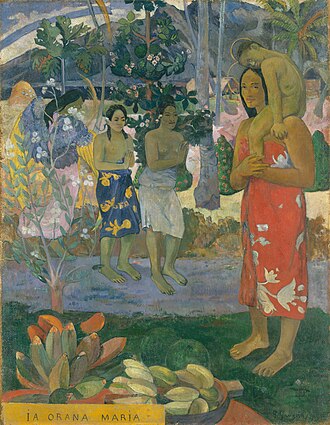 Ia Orana Maria - Paul Gauguin (1891)
Œuvres d'artistes liés
 La Nuit étoilée - Vincent van Gogh (1889)
 Terrasse du café le soir - Vincent van Gogh (1888)
 Promenade au bord de la mer - Joaquín Sorolla (1909)
 Triste héritage - Joaquín Sorolla (1898)
 Les Grandes Baigneuses - Paul Cézanne (1900s)
 Le Garçon au gilet rouge - Paul Cézanne
 Bal du moulin de la Galette - Pierre-Auguste Renoir (1876)
 Le Déjeuner des canotiers - Pierre-Auguste Renoir (1881)
 Au Moulin-Rouge - Henri de Toulouse-Lautrec (1892)
 La Toilette - Henri de Toulouse-Lautrec (1896)