Agostina Segatori au café du Tambourin
Vincent van Gogh · 1887
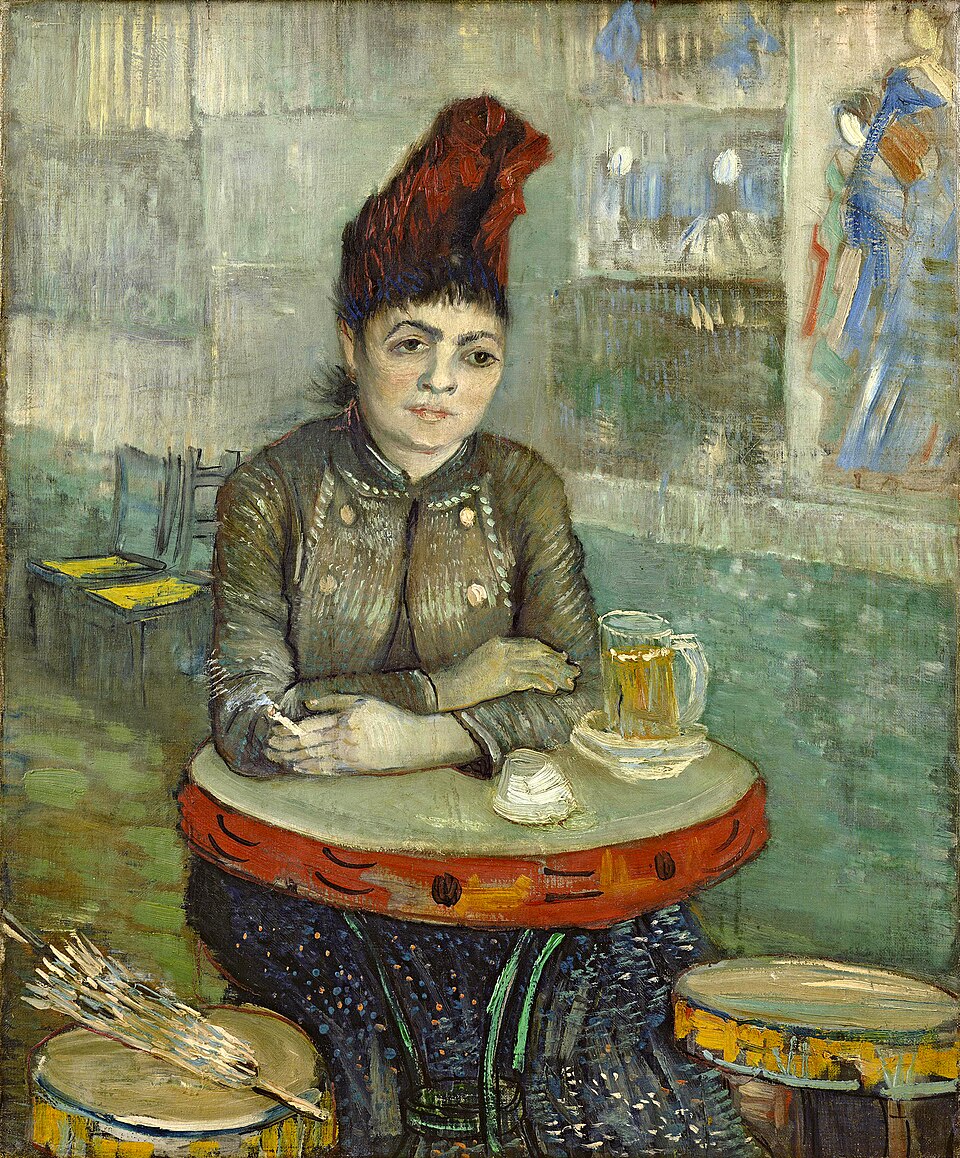
A woman sits alone at a table shaped like a tambourine, a cigarette in her hand and two saucers under her beer. She ran the café, Van Gogh paid for his meals with paintings, and for a while he was in love with her.
The story behind the painting
In 1886 Vincent van Gogh left the Netherlands for Paris, never to return, to live with his brother Theo. Just around the corner from their home, on the Boulevard de Clichy, stood the Café du Tambourin. It was run by Agostina Segatori, a Naples-born former model who had posed for Manet, Corot and others, and who used her savings to open this Italian-themed café in 1885. It catered especially to artists and hung their work on its walls. In 1887 Van Gogh ate there several times a week, paying not in cash but in paintings that decorated the room. He also held an exhibition of his Japanese prints there, and he fell in love with Agostina, who was twelve years older than he was. This portrait, painted in 1887, comes from that brief and hopeful chapter.
What to look for
Agostina sits at a small round table, its shape echoing a tambourine, the café's emblem, as do the stools around her. She holds a cigarette, and two saucers stacked beneath her beer mug quietly tell us this is her second glass. Her fashionable hat, her make-up and hairstyle, and a jacket cut differently from her dress all mark her as a modern woman of the city. A parasol rests on a seat beside her. On the wall behind her hang Japanese prints, the very ones Van Gogh began exhibiting at the café in February 1887. Notice how bright the colour is. Compared with the dark, heavy peasants Van Gogh painted in Holland only a short time before, this picture feels lighter and more open, a sign of an artist absorbing everything Paris had to show him.
Meaning and intent
The theme of a woman alone at a café table was one the Impressionists had made their own, with Edgar Degas and Édouard Manet among those who painted it. Van Gogh takes up that modern subject but fills it with his own discoveries. In Paris he met Pissarro, Toulouse-Lautrec, Gauguin and Émile Bernard, and studied Japanese printmakers such as Hiroshige and Hokusai, whose flat patterns of colour without shadow fascinated him. The prints on the wall are more than decoration; they announce the new language he was learning. The confident sitter and the bright palette show a shift in his outlook, from tragic rural poverty toward urban life and colour. Seen this way, the painting is a portrait of Agostina and also a quiet self-portrait of an artist in transformation.
Legacy
The story of the café ended sadly. Agostina fell ill and the business, in debt, failed. According to Émile Bernard's recollection, Van Gogh's paintings there, mostly still lifes of flowers, were sold off by creditors in bundles as waste canvas, and he lost the frames too. This portrait survived that loss and now hangs in the Van Gogh Museum in Amsterdam. It matters because it captures a turning point: the years 1886 to 1888, when Van Gogh grew from a shy, sombre painter into the sophisticated and daring artist the world now knows. Later that same year his Portrait of Père Tanguy would push his use of colour and his love of Japanese prints even further. Here we see that journey beginning, at a small table in a Paris café.
Le saviez-vous ?
- Van Gogh paid for his meals at the Café du Tambourin with paintings that then decorated its walls.
- Agostina Segatori had been a model for Manet and Corot before opening the café in 1885.
- The two saucers under the beer mug suggest Agostina is on her second glass.
- The café's tables and stools were shaped like tambourines, matching its name.
À propos de l'artiste
Vincent van Gogh (1853-1890)
portrait · musée Van-Gogh · table · chaise
Autres œuvres de Vincent van Gogh
 La Nuit étoilée - Vincent van Gogh (1889)
.jpg) Terrasse du café le soir - Vincent van Gogh (1888)
Terrasse du café le soir - Vincent van Gogh (1888) Les Tournesols - Vincent van Gogh (1888)
 Amandier en fleurs - Vincent van Gogh (1890)
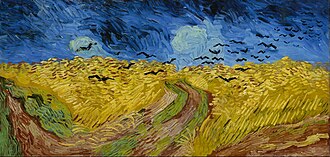 Champ de blé aux corbeaux - Vincent van Gogh (1890)
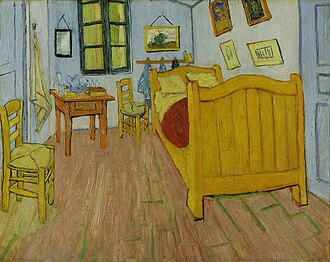 La Chambre à coucher - Vincent van Gogh (1888)
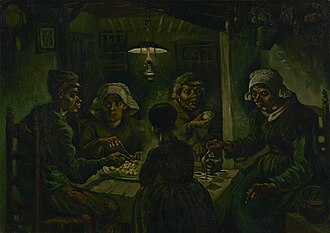 Les Mangeurs de pommes de terre - Vincent van Gogh (1885)
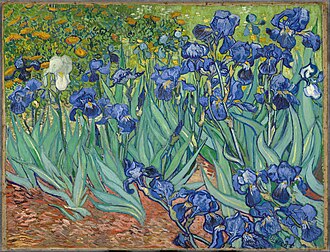 Iris - Vincent van Gogh (1889)
Œuvres d'artistes liés
 D'où venons-nous ? Que sommes-nous ? Où allons-nous ? - Paul Gauguin (1897-1898)
%201889.jpg) Le Christ jaune - Paul Gauguin (1889)
Le Christ jaune - Paul Gauguin (1889) Le Déjeuner sur l'herbe - Édouard Manet (1863)
 Olympia - Édouard Manet (1863)