Le Charmeur de serpents
Jean-Léon Gérôme · 1879
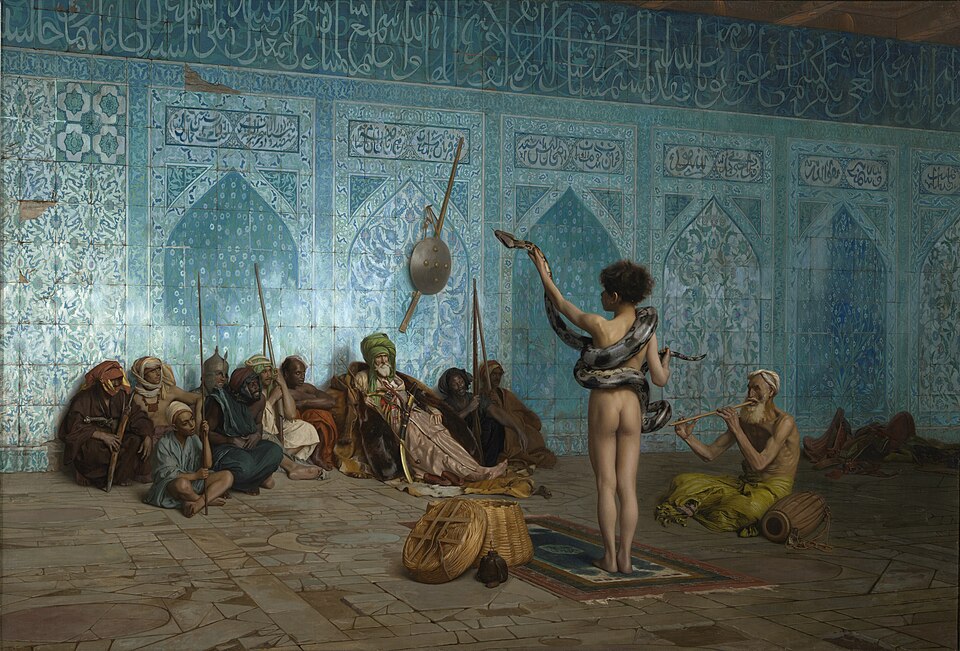
A boy stands naked on a small carpet, a python coiled around him, while armed men watch in silence before glittering blue tiles. Gérôme's scene became the most famous emblem of Orientalism and its critics.
The story behind the painting
Jean-Léon Gérôme painted The Snake Charmer around 1879. Catalogue writer Sarah Lees explains that the scene is one the artist could not possibly have witnessed: it fuses Ottoman Turkey and Egypt in a hybrid, invented space. Snake charming was not part of Ottoman culture, but it was practised in Egypt in the nineteenth century, and Maxime du Camp described a similar performance in Cairo during his 1849 to 1851 journey with Gustave Flaubert, including a boy who undressed to rule out any charge of fraud. Gérôme's dealer Goupil et Cie sold the painting in 1880 to the American collector Albert Spencer.
What to look for
A naked boy stands on a small carpet in the centre of a room, his back to us, holding a python that coils around his waist and over his shoulder. An older man sits to his right playing a fipple flute. A motley group of armed men watches, each with different clothes and weapons. The blue tiles behind them are inspired by İznik panels in Topkapı Palace. The large frieze at the top, running right to left, is a legible Koranic verse, 2:256, in thuluth script. A herpetologist thought the snake looked more like a South American boa constrictor, perhaps studied at the Jardin des Plantes in Paris.
Meaning and intent
In 1978 the painting appeared on the cover of Edward Said's book Orientalism, though Said never mentions it in the text. It became a lightning rod for criticism. Linda Nochlin, in her 1983 essay The Imaginary Orient, argued that its almost photographic finish lets an unreal scene pass as a true picture of the East, and called it a visual document of nineteenth-century colonialist ideology. The critic Jonathan Jones called it a sleazy imperialist vision. In 2010 the author writing as Ibn Warraq published a defence of Gérôme and Orientalist painting against Nochlin. Lees, by contrast, reads the boy's nudity not as erotic display but as proof that there was no trick.
Legacy
The painting changed hands many times. Alfred Corning Clark lent it to the World's Columbian Exposition in Chicago in 1893, and his widow later lent it to the Metropolitan Museum before selling it. August Heckscher acquired it in 1902, and Clark's son Robert Sterling Clark bought it back in 1942, at a moment when Gérôme had fallen far out of favour with collectors. Since 1955 it has belonged to the Clark Art Institute in Williamstown, Massachusetts, which also owns his Slave Market. It was shown at the Getty Museum in 2010 and the Musée d'Orsay in 2010 to 2011.
Le saviez-vous ?
- Painted around 1879 by Jean-Léon Gérôme.
- Cover image of Edward Said's Orientalism (1978).
- The frieze shows Koranic verse 2:256 in thuluth script.
- In the Clark Art Institute since 1955.
À propos de l'artiste
Jean-Léon Gérôme (1824-1904)
scène de genre · garçon · nu · nudité · station debout · académisme · panier · fesse · tapis
Autres œuvres de Jean-Léon Gérôme
 Pollice verso - Jean-Léon Gérôme (1872)
 Le Marché aux esclaves - Jean-Léon Gérôme (1866)
%20-%2001.jpg) Phryné devant l'Aréopage - Jean-Léon Gérôme (1861)
Phryné devant l'Aréopage - Jean-Léon Gérôme (1861) La Vérité sortant du puits armée de son martinet pour châtier l’humanité - Jean-Léon Gérôme (1896)
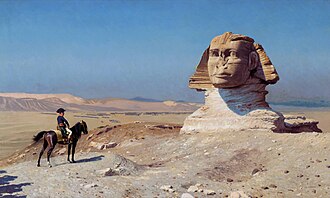 Bonaparte devant le Sphinx - Jean-Léon Gérôme (1867)
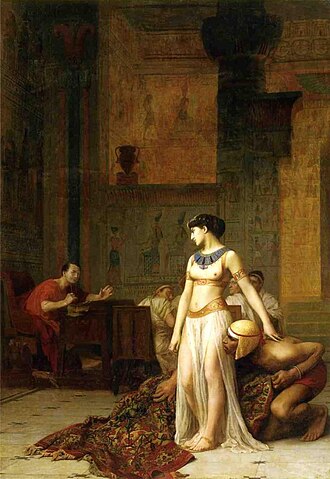 Cléopâtre et César - Jean-Léon Gérôme (1866)
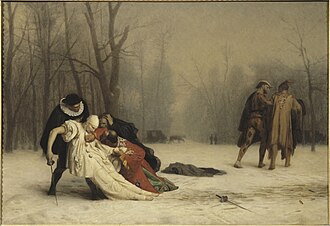 Suites d'un bal masqué - Jean-Léon Gérôme (1857)
.jpg) L'exécution du maréchal Ney - Jean-Léon Gérôme (1868)
L'exécution du maréchal Ney - Jean-Léon Gérôme (1868)
Œuvres d'artistes liés
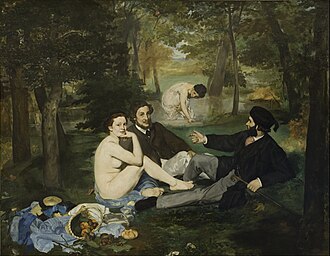 Le Déjeuner sur l'herbe - Édouard Manet (1863)
 Olympia - Édouard Manet (1863)
 L'Origine du monde - Gustave Courbet (1866)
 Un enterrement à Ornans - Gustave Courbet (2020)
 Œillet, lys, lys, rose - John Singer Sargent (1885-1886)
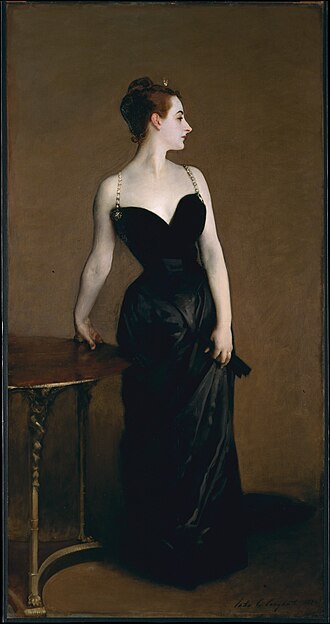 Madame X - John Singer Sargent (1884)
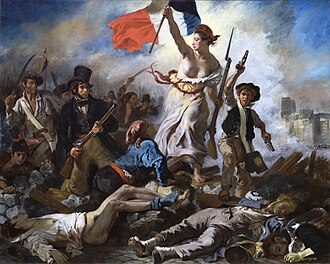 La Liberté guidant le peuple - Eugène Delacroix (1830)
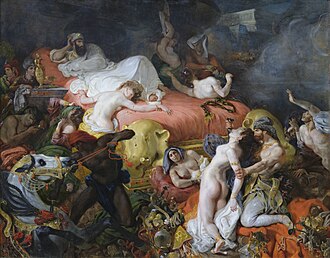 La Mort de Sardanapale - Eugène Delacroix (1827)
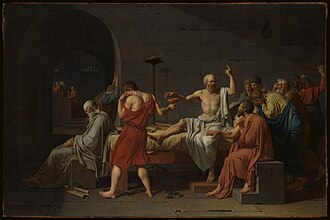 La Mort de Socrate - Jacques-Louis David (1787)
 Le Serment des Horaces - Jacques-Louis David (1784)
 Le Dernier Voyage du Téméraire - J. M. W. Turner (1839)
 Pluie, Vapeur et Vitesse - J. M. W. Turner (1844)