posimpresionismo
Post-Impressionism is the name we give to a group of bold, very different painters who came after the Impressionists in France.
Vincent van Gogh · Paul Gauguin · Pierre-Auguste Renoir · Georges Seurat
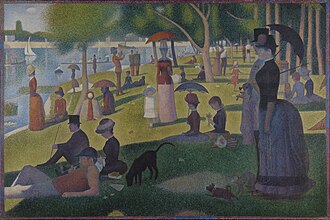 Tarde de domingo en la isla de La Grande Jatte - Georges Seurat (1884-1886)
.jpg) Terraza de café por la noche - Vincent van Gogh (1888)
Terraza de café por la noche - Vincent van Gogh (1888)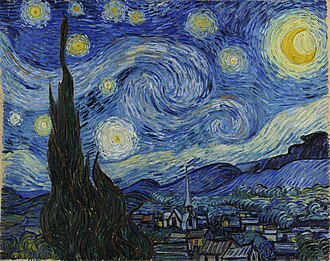 La noche estrellada - Vincent van Gogh (1889)
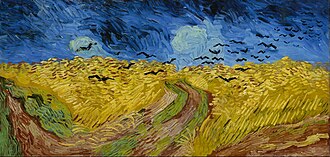 Campo de trigo con cuervos - Vincent van Gogh (1890)
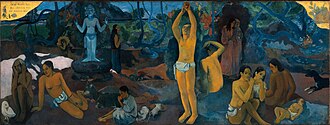 ¿De dónde venimos? ¿Qué somos? ¿Adónde vamos? - Paul Gauguin (1897-1898)
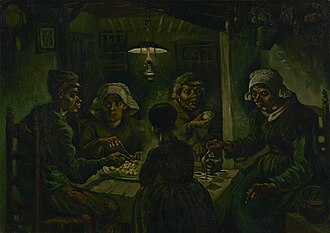 Los comedores de patatas - Vincent van Gogh (1885)
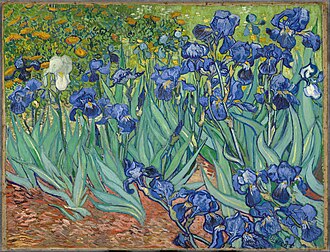 Lirios - Vincent van Gogh (1889)
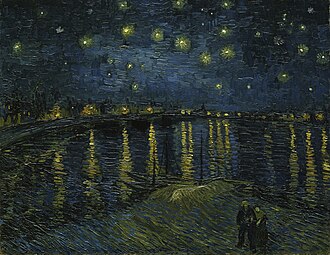 Noche estrellada sobre el rodano - Vincent van Gogh (1888)
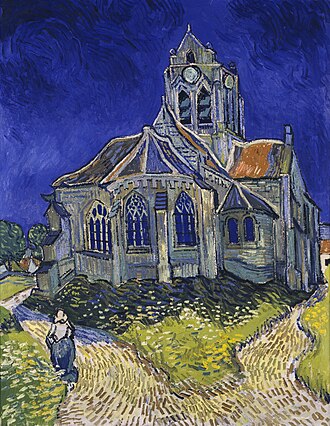 La iglesia de Auvers-sur-Oise - Vincent van Gogh (1890)
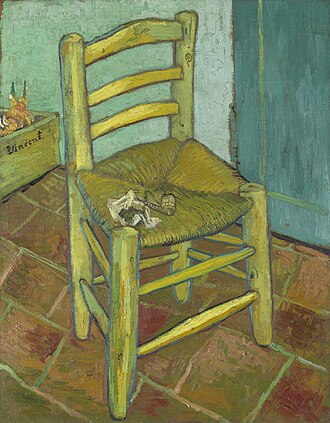 Silla con pipa - Vincent van Gogh (1889)
.jpg) Raíces de árbol - Vincent van Gogh (1890)
Raíces de árbol - Vincent van Gogh (1890).jpg) Vista del mar en Scheveningen - Vincent van Gogh (1882)
Vista del mar en Scheveningen - Vincent van Gogh (1882)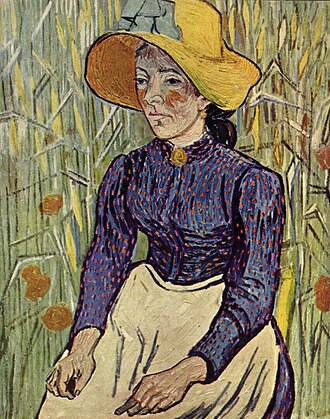 Mujer campesina con un fondo de trigo - Vincent van Gogh (1890)
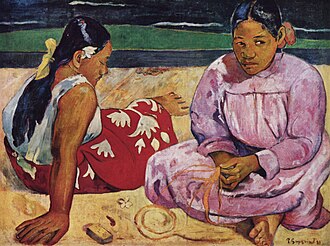 Mujeres de Tahití - Paul Gauguin (1890)
El espíritu de los muertos vela - Paul Gauguin (1892)
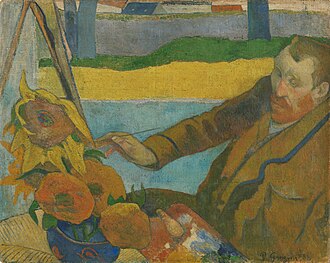 Van Gogh pintando girasoles - Paul Gauguin (1888)
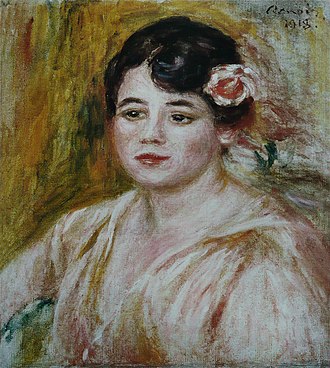 Retrato de Adèle Besson - Pierre-Auguste Renoir (1918)
%20-%201926.198%20-%20Art%20Institute%20of%20Chicago.jpg) Day of the God - Paul Gauguin (1894)
Day of the God - Paul Gauguin (1894)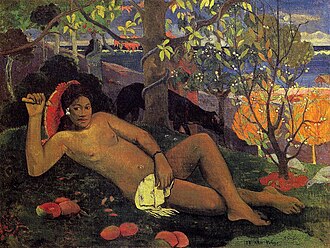 La reina - Paul Gauguin (1896)
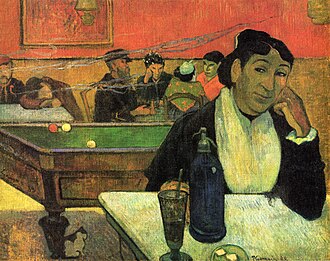 Café de noche en Arlés - Paul Gauguin (1888)
%2C%20oil%20on%20canvas%2C%2073.2%20x%2091.5%20cm%2C%20Kunstmuseum%20Basel.jpg) Ta Matete - Paul Gauguin (1892)
Ta Matete - Paul Gauguin (1892)
¿Te preguntas qué es posimpresionismo?
Post-Impressionism is the name we give to a group of bold, very different painters who came after the Impressionists in France. Cézanne, Gauguin, Van Gogh and Seurat kept the bright colours they had learned, then pushed painting toward structure, emotion and symbols. If modern art has a doorway, this is it.
What is Post-Impressionism, in simple words?
It is a mainly French art movement from roughly 1886-1905, made by painters who grew up with Impressionism and then wanted something more. They still loved vivid colour and often painted from life, but they were happier to stress geometric shapes, to bend forms for expressive effect, and to use colour that was not natural. It was never one tidy group with one programme; it is an umbrella over several very different personal styles.
Why is it called Post-Impressionism?
The name was chosen by the English critic Roger Fry. He used it in 1906 and again in 1910, when he organised the exhibition Manet and the Post-Impressionists at the Grafton Galleries in London. Fry admitted he needed a convenient label and picked the vaguest, most non-committal one he could find. As he put it, the name merely stated their position in time: these artists came after Impressionism.
When and where did it start?
It grew in France, starting around 1886, the year of the last Impressionist exhibition, and running until about 1905, when Fauvism appeared. The historian John Rewald first limited the period to 1886-1892, while later writers stretched it as far as 1914. Its ideas also travelled abroad: by 1913 Post-Impressionism had reached Canada, where painters such as John Lyman, members of the Group of Seven and Emily Carr carried it forward.
Who were the main painters?
The four big names are Paul Cézanne, often called the father of Post-Impressionism, Paul Gauguin, Vincent van Gogh and Georges Seurat. Around them were many others, including Henri Rousseau, Henri de Toulouse-Lautrec and Émile Bernard. The label also covers smaller groups and styles that grew in the same years, such as Neo-Impressionism, Les Nabis, Symbolism, Cloisonnism, the Pont-Aven School and Synthetism.
How can I recognise a Post-Impressionist painting?
Look for strong, often unnatural colour and a feeling that the artist is arranging the picture rather than just recording a moment. Seurat built images from tiny dots of colour, a method called pointillism. Cézanne reduced objects to basic, solid shapes. Van Gogh used vibrant colour and very visible brushstrokes, sometimes thick impasto. In general, harmony, structure and symbolic meaning matter more than copying nature exactly.
How is it different from Impressionism?
Post-Impressionists kept many Impressionist tools, like bright colour and painting from life, but they felt Impressionism had lost structure and often chose trivial subjects. Instead of chasing natural light and passing effects, they cared about order, expression and ideas. Cézanne summed up the goal when he said he wanted to make of Impressionism something solid and durable, like the art of the museums.
Was it controversial at the time?
Yes. The movement met strong resistance from critics and from other artists of the day. When Roger Fry showed these painters in London in 1910-1911, and again in the Second Post-Impressionist Exhibition of 1912, the label itself was new to the public. In Canada, a 1913 spring show at the Art Association of Montreal that included Post-Impressionist works drew sharp criticism from two Montreal daily newspapers.
What were the painters trying to do?
There was no single shared aim, which is part of what makes the movement interesting. Each artist followed a personal path: Seurat wanted a systematic, almost scientific way of using colour, Cézanne wanted lasting structure, Van Gogh wanted to express feeling, and others leaned toward symbols and abstraction. What they had in common was putting harmony and the arrangement of the picture ahead of simple naturalism.
Which famous works should I see first?
A good start is Georges Seurat's A Sunday on La Grande Jatte (1884), the classic example of painting with dots. Then look at Paul Cézanne's The Card Players, Henri Rousseau's The Centenary of Independence (1892), Paul Sérusier's The Talisman (1888) and Émile Bernard's The Pardon (1888). Together they show how wide the movement was, from careful dots to flat, bold areas of colour.
Where can I see these paintings today?
Some of the works named in the Wikipedia article are in well-known public collections. Cézanne's The Card Players is at the Metropolitan Museum of Art in New York. Henri Rousseau's The Centenary of Independence (1892) is at the Getty Center in Los Angeles. Toulouse-Lautrec's Portrait of Émile Bernard (1886) is at the Tate in London. Some others, like Pissarro's Haying at Eragny (1889), are in private hands.
Why does Post-Impressionism still matter?
It is the bridge between nineteenth-century painting and modern art. By moving from careful naturalism toward abstraction and expression, these painters opened the way for many twentieth-century movements, including Fauvism, Cubism, Expressionism and the German group Die Brücke. When you see a modern painting with bold colour or simplified shapes, you are often seeing an idea that Post-Impressionism made possible.