The Seed of the Areoi
Paul Gauguin · 1892
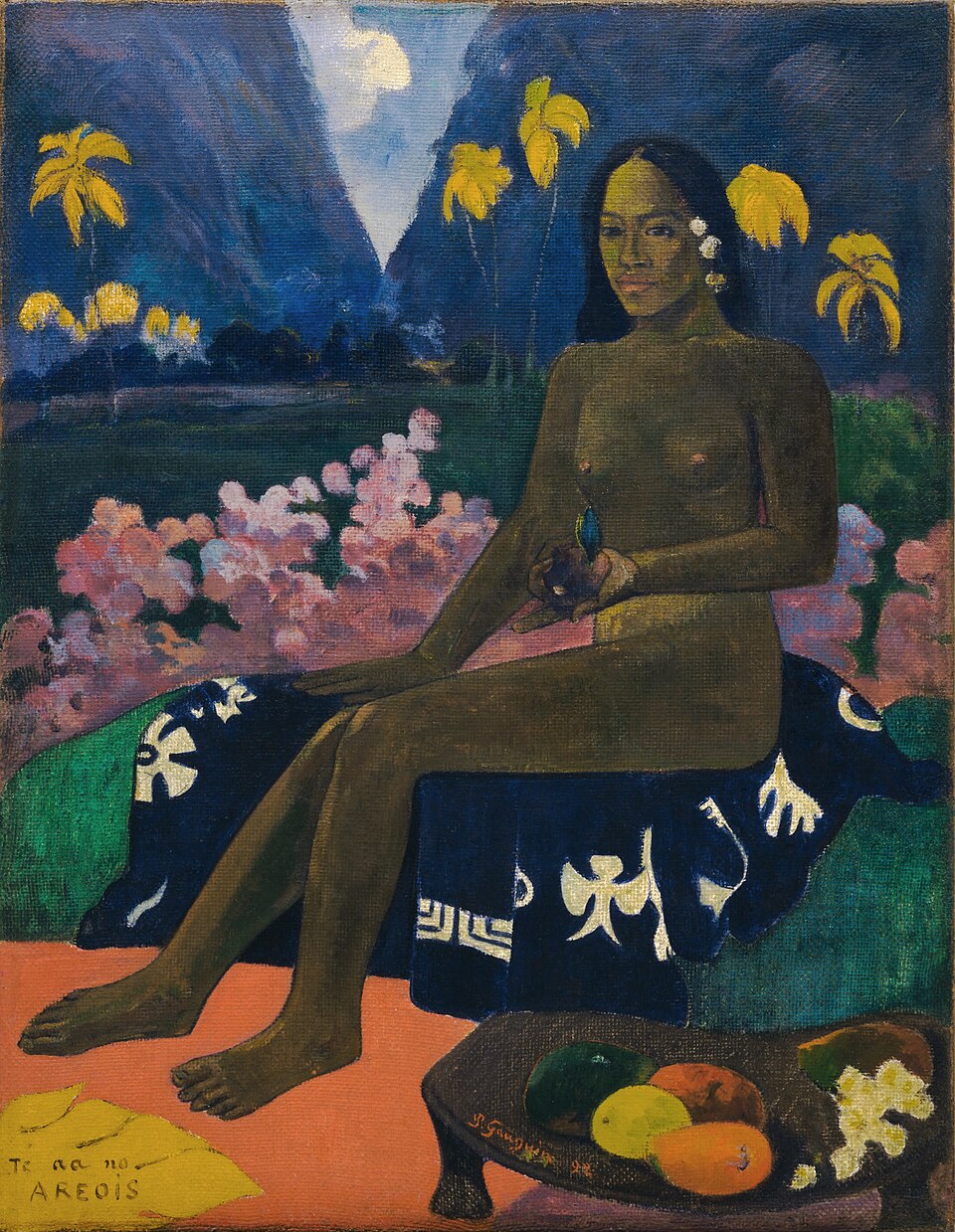
A Tahitian woman sits on a deep blue cloth, a flowering sprout in her hand, before yellow palms and a blue ravine. Gauguin's colours shocked his first viewers, and the painting helped open the way to Primitivism.
The story behind the painting
Gauguin travelled to Tahiti in 1891 and reached Papeete in June. His romantic image of an untouched paradise was shaped partly by Pierre Loti's novel The Marriage of Loti, but he found that French colonisation had destroyed that ideal. So he tried to express aspects of the culture in his work, choosing Tahitian titles and simple forms. He painted this canvas in 1892 and gave it the Tahitian title Te aa no areois, The Seed of the Areoi. In July 1893 he returned to France hoping for success with his new work.
What to look for
The picture, 92.1 by 72.1 cm, is painted in oil on burlap. The woman sits on a dark blue cloth decorated in part with white figurative and geometric symbols, holding a flowering plant in her left hand, her feet on a red ground. At lower left the title is written on a fallen yellow palm leaf; at lower right is a small table with fruit and the red signature P. Gauguin 92. Behind her are pink and violet flowers, a green meadow with yellow-leaved palms, and a deep V-shaped ravine with steep blue rock walls under a white, cloudy sky.
Meaning and intent
Gauguin's colours shocked the public of his time: red, yellow and brown in the foreground, yellow and its complement violet behind. The flat areas of colour have no shadows, suggesting the influence of Japanese painting. The woman's posture is inspired by ancient Egypt, and the position of her arms follows reliefs at the Javanese temple of Borobudur. There are also Western sources, such as the Symbolist painter Pierre Puvis de Chavannes, who had painted similar poses before. Gauguin, and this painting in particular, pioneered Primitivism, which helped artists move beyond Renaissance vanishing-point perspective.
Legacy
The painting was shown in Gauguin's solo exhibition at Durand-Ruel's gallery in November 1893, but neither that show nor his book Noa Noa was well received, and in July 1895 he left France for good. The canvas belonged to A. Fontaine, then Dr Abel Desjardins. The dealer Jacques Seligmann sold it in 1936 to the New York media executive William S. Paley. After Paley's death in 1990 his collection, including this picture, went to the Museum of Modern Art in New York. It was shown again in 2004, when MoMA's masterpieces travelled to the Neue Nationalgalerie in Berlin.
¿Sabías que…?
- Painted in Tahiti in 1892, oil on burlap.
- The title is written on a fallen palm leaf.
- The arms follow reliefs at Borobudur.
- Part of William S. Paley's gift to MoMA after 1990.
Sobre el artista
Paul Gauguin (1848-1903)
retrato · impresionismo · posimpresionismo · Museo de Arte Moderno
Más obras de Paul Gauguin
 ¿De dónde venimos? ¿Qué somos? ¿Adónde vamos? - Paul Gauguin (1897-1898)
%201889.jpg) El Cristo amarillo - Paul Gauguin (1889)
El Cristo amarillo - Paul Gauguin (1889)%201892%2C%20oil%20on%20canvas%2C%20101%20x%2077%20cm.jpg) ¿Cuando te casas? - Paul Gauguin (1892)
¿Cuando te casas? - Paul Gauguin (1892)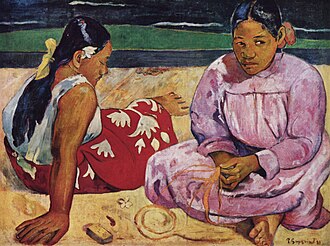 Mujeres de Tahití - Paul Gauguin (1890)
.jpg) La visión tras el sermón - Paul Gauguin (1888)
La visión tras el sermón - Paul Gauguin (1888)El espíritu de los muertos vela - Paul Gauguin (1892)
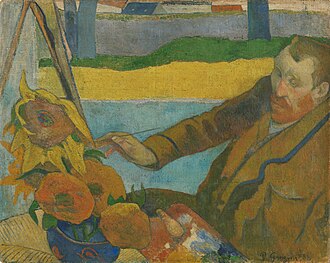 Van Gogh pintando girasoles - Paul Gauguin (1888)
 Café de noche en Arlés - Paul Gauguin (1888)
Obras de artistas relacionados
 La noche estrellada - Vincent van Gogh (1889)
.jpg) Terraza de café por la noche - Vincent van Gogh (1888)
Terraza de café por la noche - Vincent van Gogh (1888) Baile en el Moulin de la Galette - Pierre-Auguste Renoir (1876)
 El almuerzo de los remeros - Pierre-Auguste Renoir (1881)