View of Vétheuil
Claude Monet · 1880
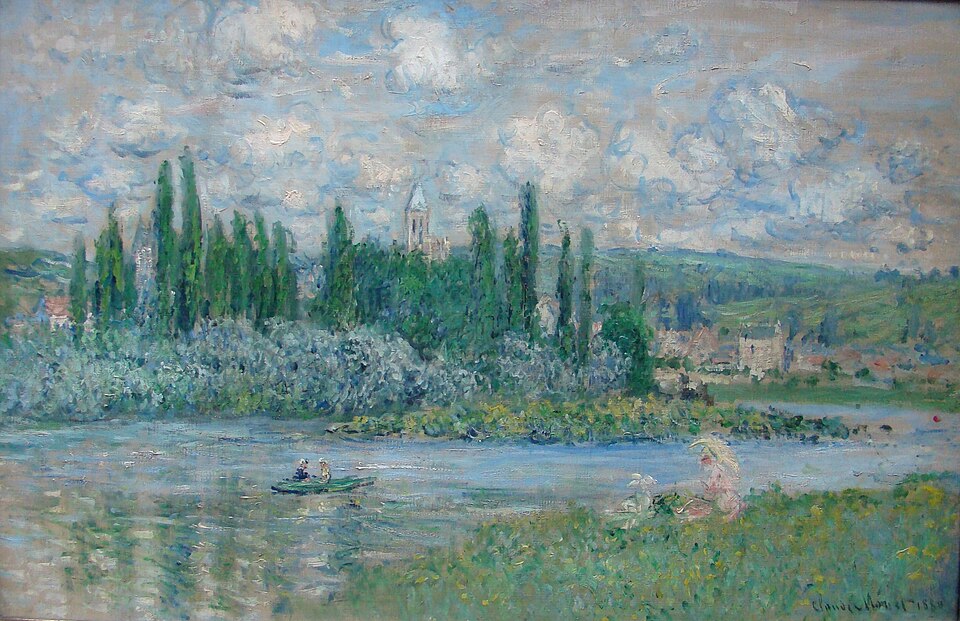
A summer meadow, the Seine glittering, a church tower rising out of the trees. Monet painted this joyful view in 1880, months after the hardest year of his life.
The story behind the painting
Monet lived in Vetheuil, about 60 km west of Paris on the Seine, from 1878 to 1881. He arrived deep in debt, struggling to sell work, with his wife Camille expecting their second child. In September 1878 the family moved into a rented house shared with the family of his friend Ernest Hoschede, who had gone bankrupt and soon returned to Paris, leaving his wife Alice and their six children. Camille never recovered after the birth; she was diagnosed with cancer and died in autumn 1879, aged 32. Alice nursed her and cared for all eight children, and she and Monet later married.
What to look for
The canvas is 60 by 100 cm, signed and dated Claude Monet 1880 at lower right. A meadow of green and yellow dabs fills the right foreground. The Seine runs from the lower left corner to the right edge, in long blue-white strokes on the right and short green, white and blue strokes for reflections on the left. Behind, foaming blue-green bushes and a tall row of dark poplars hide most of the village, so only the tower of Notre-Dame pokes up in the centre. A woman in a pale dress sits under a yellow parasol, perhaps reading; a rowing boat with two people floats on the left.
Meaning and intent
In Vetheuil Monet's style changed: small strokes, a buoyant touch and a new pastel-like colour. Bare primed canvas shows in the sky, stressing how quickly and freely it was painted. He likely stood on the far bank at Lavacourt, and the trees may belong to an island in the river. He also broke from his friends: in 1880 he skipped the Impressionist group show and sent work to the Salon instead, and in June he had his first solo show at the offices of La Vie moderne. Both brought him the attention he wanted, and slowly his finances began to improve.
Legacy
Monet probably sold the picture in 1881 to the dealer Paul Durand-Ruel, who kept it until November 1896, when Hugo von Tschudi bought it for the Nationalgalerie in Berlin in his first year as director, with funds given by the banker Karl von der Heydt. Tschudi called it a particularly instructive example of how Monet simplified his means and heightened their intensity. In 1898 Julius Meier-Graefe compared it to Turner and wrote that champagne foams in its colour. In 1912 Karl Scheffler called it a true marvel, where everything moves: clouds drift, the river flows, trees sway, the air trembles.
¿Sabías que…?
- Painted in summer 1880, signed and dated by Monet.
- Made after the death of his wife Camille in 1879.
- Bought for Berlin's Nationalgalerie in 1896.
- Now in the Alte Nationalgalerie, Berlin.
Sobre el artista
Claude Monet (1840-1926)
Sena · Antigua Galería Nacional de Berlín
Más obras de Claude Monet
 Impresión, sol naciente - Claude Monet (1872)
 Nenúfares - Claude Monet (1906)
 Mujer con sombrilla - Claude Monet (1875)
 La terraza de Sainte-Adresse - Claude Monet (1867)
 Mujeres en el jardín - Claude Monet (1866)
 La urraca - Claude Monet (1868)
 Mujer en el jardín - Claude Monet (1867)
 El almuerzo sobre la hierba - Claude Monet (1866)
Obras de artistas relacionados
 El Temerario remolcado - J. M. W. Turner (1839)
 Lluvia, vapor y velocidad. El gran ferrocarril del Oeste - J. M. W. Turner (1844)
 El origen del mundo - Gustave Courbet (1866)
 Entierro en Ornans - Gustave Courbet (2020)
 Almuerzo sobre la hierba - Édouard Manet (1863)
 Olympia - Édouard Manet (1863)
 Baile en el Moulin de la Galette - Pierre-Auguste Renoir (1876)
 El almuerzo de los remeros - Pierre-Auguste Renoir (1881)
 La cuna - Berthe Morisot (1872)
 Summer's Day - Berthe Morisot (1879)
 El ajenjo - Edgar Degas (1875)
 Die Bellelli Familie - Edgar Degas (1858)