Vaches au Pâturage
Édouard Manet · 1873
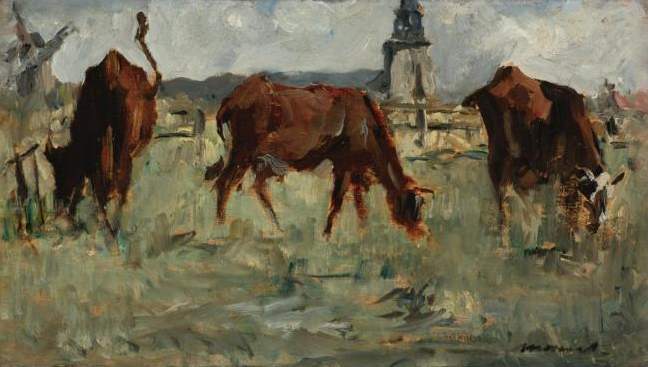
Three brown cows bend to the grass, a church tower rising between them. Manet painted this tiny oil on wood in a summer holiday at Berck in 1873, quick as a sketch but signed as a finished work.
The story behind the painting
1873 was a very good year for Manet. At the spring Salon his Le Bon Bock finally won the critics' approval after years of rejection, though his younger friends disliked its traditional, Dutch-inspired style. That summer he travelled with his wife Suzanne, his mother and his brother Eugène to the Channel coast at Étaples and Berck. He painted sea views and fishing boats on the beach, and some pictures around the old town, Berck-Ville. Vaches au pâturage, or Three Cows in a Pasture, is one of them.
What to look for
The panel is unusually small for Manet, about 12 by 21 cm. Three brown cows stand in a row, heads lowered to the grass: the left one seen from behind with its tail raised, the middle one in profile, the right one almost frontal with white patches on its head. Behind a wooden fence rise the buildings of Berck, the grey tower of the Église Saint-Jean-Baptiste cut by the top edge, a windmill on the left and red roofs on the right. Short lively strokes suggest the grass. It is signed Manet at lower right.
Meaning and intent
The coast here resembles the Dutch North Sea landscape, and that may have drawn Manet, whose wife was Dutch and who knew Dutch painting from museums in Amsterdam and Haarlem. The windmill recalls Jan van Goyen and Salomon van Ruysdael; the cows recall Paulus Potter, who made cattle a subject in their own right more than 200 years earlier. Yet Manet moved away from tradition here, toward open-air painting and a loose brush. Unlike his Young Bull in a Meadow of 1881, the source says, this picture carries no symbolism.
Legacy
The view is very close to that of The Swallows, which Manet sent to the Salon of 1874 and which was rejected; whether the cows came first as a study is not documented. Manet kept the painting three years, then gave it to a charity sale on 11 and 12 May 1876 at the Hôtel Drouot for the widow of the painter Jean-Adolphe Beaucé. The doctor Georges de Bellio, a friend of many painters, acquired it. Later it passed through Galerie Bernheim-Jeune into private hands, where it remains.
¿Sabías que…?
- Painted at Berck in the summer of 1873.
- Oil on wood, about 12 by 21 cm, signed at lower right.
- Recalls Dutch models such as Paulus Potter.
- First owned after Manet by Dr Georges de Bellio, now in a private collection.
Sobre el artista
Édouard Manet (1832-1883)
Más obras de Édouard Manet
 Almuerzo sobre la hierba - Édouard Manet (1863)
 Olympia - Édouard Manet (1863)
 Un bar del Folies Bergère - Édouard Manet (1882)
 El balcón - Édouard Manet (1868)
 La música en las Tullerías - Édouard Manet (1862)
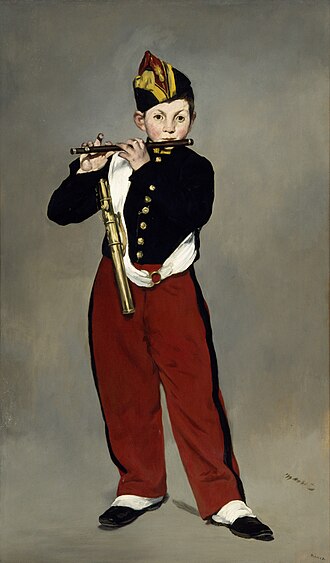 El pífano - Édouard Manet (1866)
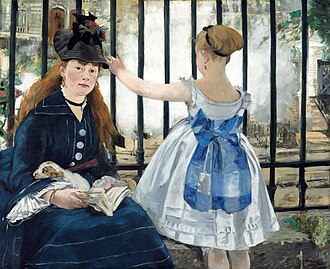 El Ferrocarril o El Camino de Hierro. - Édouard Manet (1873)
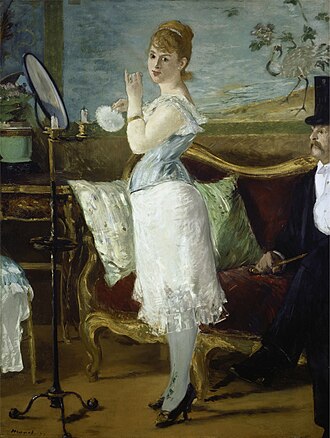 Nana - Édouard Manet (1877)
Obras de artistas relacionados
 Impresión, sol naciente - Claude Monet (1872)
 Nenúfares - Claude Monet (1906)
 Baile en el Moulin de la Galette - Pierre-Auguste Renoir (1876)
 El almuerzo de los remeros - Pierre-Auguste Renoir (1881)
 La cuna - Berthe Morisot (1872)
 Summer's Day - Berthe Morisot (1879)
 El ajenjo - Edgar Degas (1875)
 Die Bellelli Familie - Edgar Degas (1858)
 El canal del Loing - Alfred Sisley (1892)
 The Watering Pond at Marly with Hoarfrost - Alfred Sisley (1876)
 Calle de Paris, dia de lluvia - Gustave Caillebotte (1877)
 Los acuchilladores de parqué - Gustave Caillebotte (1875)