El tren en la nieve
Claude Monet · 1875
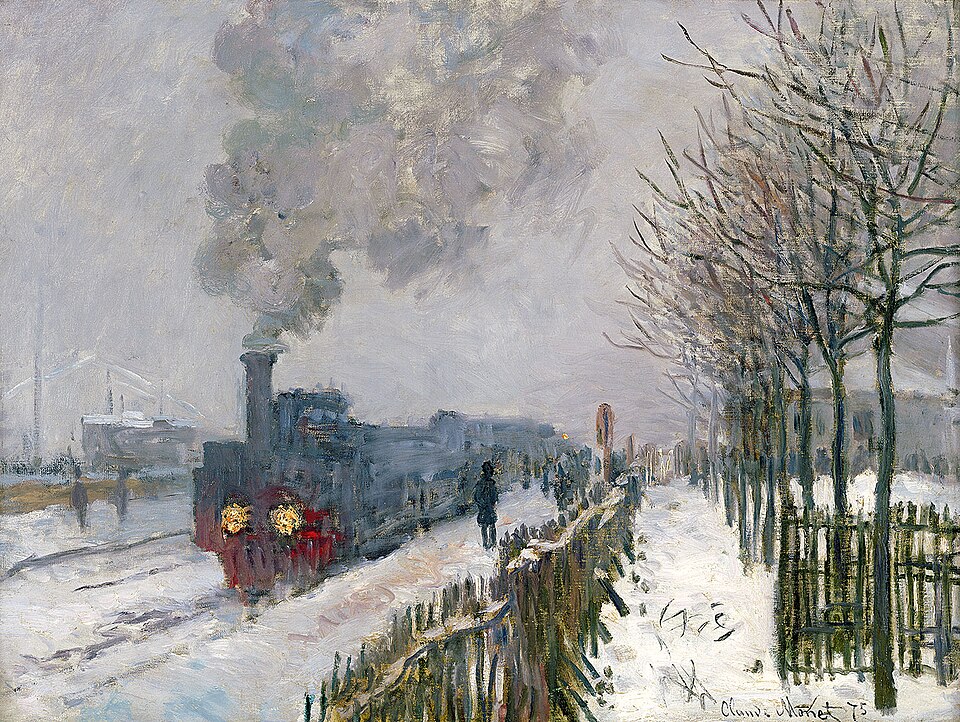
A dark locomotive stands in the snow at Argenteuil, its lamps glowing red and yellow through grey smoke. Monet painted it from the platform of his own commuter station in the winter of 1874 to 1875.
The story behind the painting
After the Franco-Prussian War, during which Monet and his new wife Camille fled to England for fear of his conscription, the couple settled in late 1871 at Argenteuil on the Seine. The town was linked by rail to Paris, Le Havre and Rouen, and Argenteuil station, Monet's commuter stop, always had trains and engines in view. Throughout the winter of 1874 to 1875 he painted snow scenes around his home, working on the station platform itself. Of his many train pictures, he seems to have painted only three snowy scenes, in 1875 and 1876, and this is one.
What to look for
A steam train arrives at Argenteuil station, with travellers waiting on the platform and a signal man near the front of the engine, beside the stop sign. Smoke billows from the dark train into a sky as cold and grey as the snow, in the words of the curator Marianne Delafond, but look closely and you find hints of purple in it. Red and yellow lights shine from the locomotive; the red at the front seems to bloody the snow, and the yellow appears again at the vanishing point. The fence, the trees and the tracks form strong diagonals.
Meaning and intent
Historians read it as Monet's effort to bring nature and industry together, but they disagree on the details. Paul Hayes Tucker notes that although we stand no more than 30 metres from the train, industry seems far away, the engine dissolved in snow-filled air, and that the converging lines make a stopped train feel in motion. Marian Robinson sees in the engines an apocalyptic vision of industrial destruction. John House finds the fences break up the space, while James Rubin thinks the fence, trees and soft snow set the train in a suburban refuge.
Legacy
Robinson also connects the picture with Emile Zola, whose novel La Bête humaine describes a train caught in snow; Zola knew Monet's train paintings and reviewed them warmly at the Third Impressionist Exhibition in April 1877. Doctor Georges de Bellio bought the painting from Monet, afraid it would fall into the hands of a fool, and lent it to a Monet exhibition at the Galerie Durand-Ruel in 1883, where critics praised it. In 1940 his daughter Victorine and her husband Eugène Donop de Monchy gave it to the Musée Marmottan Monet in Paris.
¿Sabías que…?
- Painted at Argenteuil station in the winter of 1874-1875.
- One of only three snowy train scenes by Monet.
- Shown at the Galerie Durand-Ruel in 1883.
- Given to the Musée Marmottan Monet in 1940.
Sobre el artista
Claude Monet (1840-1926)
Más obras de Claude Monet
 Impresión, sol naciente - Claude Monet (1872)
 Nenúfares - Claude Monet (1906)
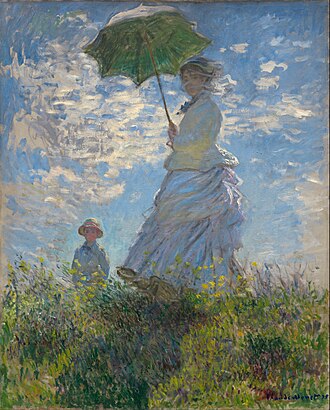 Mujer con sombrilla - Claude Monet (1875)
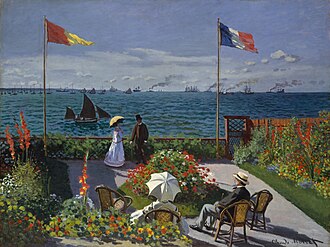 La terraza de Sainte-Adresse - Claude Monet (1867)
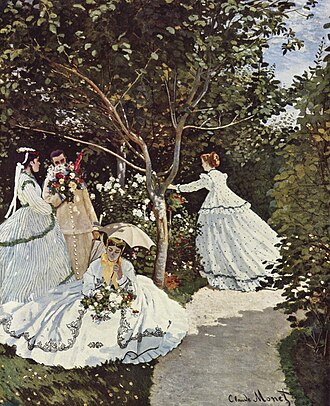 Mujeres en el jardín - Claude Monet (1866)
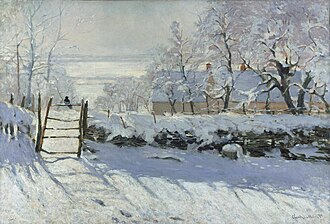 La urraca - Claude Monet (1868)
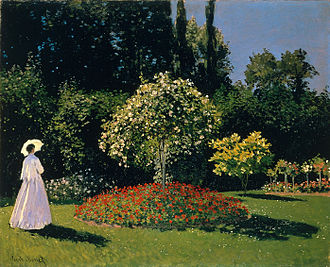 Mujer en el jardín - Claude Monet (1867)
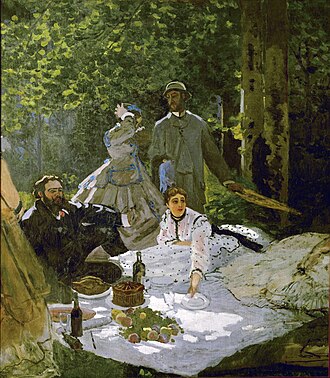 El almuerzo sobre la hierba - Claude Monet (1866)
Obras de artistas relacionados
 El Temerario remolcado - J. M. W. Turner (1839)
 Lluvia, vapor y velocidad. El gran ferrocarril del Oeste - J. M. W. Turner (1844)
 El origen del mundo - Gustave Courbet (1866)
 Entierro en Ornans - Gustave Courbet (2020)
 Almuerzo sobre la hierba - Édouard Manet (1863)
 Olympia - Édouard Manet (1863)
 Baile en el Moulin de la Galette - Pierre-Auguste Renoir (1876)
 El almuerzo de los remeros - Pierre-Auguste Renoir (1881)
 La cuna - Berthe Morisot (1872)
 Summer's Day - Berthe Morisot (1879)
 El ajenjo - Edgar Degas (1875)
 Die Bellelli Familie - Edgar Degas (1858)