¿Cuando te casas?
Paul Gauguin · 1892
%201892%2C%20oil%20on%20canvas%2C%20101%20x%2077%20cm.jpg)
Two women sit in a Tahitian landscape: one in a traditional wrap with a white flower behind her ear, one upright in a high-necked pink dress, and a painted question hangs between them.
The story behind the painting
Paul Gauguin travelled to Tahiti for the first time in 1891, hoping to find an untouched paradise where he could create a pure, primitive art. The island he found was very different. It had been colonised, and diseases brought by Europeans had killed at least two-thirds of its indigenous people. Gauguin nonetheless painted many pictures of Tahitian women, some nude, some in traditional clothing, others in Western-style dresses, like the rear figure here. When Will You Marry? dates from 1892, during this first stay. At this time Gauguin often inscribed his paintings in Tahitian, a language that fascinated him even though he never advanced beyond its rudiments. Here the words NAFEA Faa ipoipo, meaning When will you marry, appear at the lower right of the canvas.
What to look for
The front and middle ground are built from broad areas of green, yellow and blue. On the threshold between them sits a young woman in traditional dress, stretching, her face stylised and simplified. Look for the white tiare flower behind her ear. Behind her, flush with the yellow and blue field, a second woman sits upright in a high-necked Western-style dress. Her pink dress stands apart from every other colour in the picture, and her face, painted with individual features, forms the centre of the image. Notice her raised hand: art historians have connected the gesture to Buddhist art, and Naomi Maurer identified it as a mudra signifying threat or warning. Finally, find the Tahitian inscription at lower right, set into the landscape like part of the design.
Meaning and intent
The title asks a question, but whose? Richard Field suggested the tiare flower behind the front woman's ear signals that she is seeking a husband, which would make the painting a scene of courtship and expectation. The contrast between the two women, one in traditional wrap and one in a missionary-style dress, also hints at a Tahiti caught between old ways and Western influence. Scholars have traced the front figure's pose to Japanese precedents or to Delacroix's Women of Algiers. The art historian Nancy Mowll Mathews offers a more critical reading: Gauguin portrayed Tahitians as living only to sing and make love, an image that drew interest and funds in France, while he knew Tahiti was in fact a westernised island with an international community.
Legacy
When Gauguin returned to France, his Tahitian paintings, this one included, met with relative indifference. His 1893 exhibition at Durand-Ruel won some favourable reviews but was only a limited success, and this canvas found no buyer, although Gauguin had set it among his most highly valued works. In 1917 the Swiss collector Rudolf Staechelin acquired it at the Maison Moos gallery in Geneva. For nearly half a century it was on loan to the Kunstmuseum Basel, before the Staechelin family sold it privately in 2015; it was then shown at the Fondation Beyeler in Riehen. In 2017 a pencil sketch of the central figure was uncovered and authenticated, adding a new chapter to the story of one of Gauguin's best-known Tahitian images.
¿Sabías que…?
- The inscription NAFEA Faa ipoipo is Tahitian for When will you marry?
- The rear woman's raised hand has been identified as a mudra meaning threat or warning.
- It hung on loan at the Kunstmuseum Basel for nearly 50 years.
- A pencil sketch of the central figure was authenticated in 2017.
Sobre el artista
Paul Gauguin (1848-1903)
mujer · escena de género · retrato · sentado
Más obras de Paul Gauguin
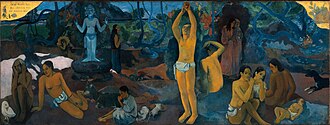 ¿De dónde venimos? ¿Qué somos? ¿Adónde vamos? - Paul Gauguin (1897-1898)
%201889.jpg) El Cristo amarillo - Paul Gauguin (1889)
El Cristo amarillo - Paul Gauguin (1889)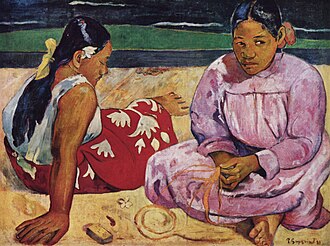 Mujeres de Tahití - Paul Gauguin (1890)
.jpg) La visión tras el sermón - Paul Gauguin (1888)
La visión tras el sermón - Paul Gauguin (1888)El espíritu de los muertos vela - Paul Gauguin (1892)
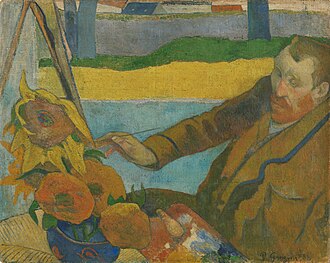 Van Gogh pintando girasoles - Paul Gauguin (1888)
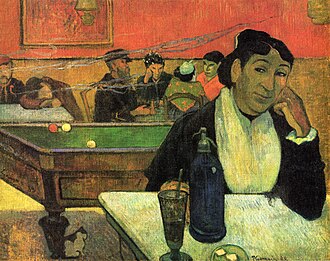 Café de noche en Arlés - Paul Gauguin (1888)
%20-%201926.198%20-%20Art%20Institute%20of%20Chicago.jpg) Day of the God - Paul Gauguin (1894)
Day of the God - Paul Gauguin (1894)
Obras de artistas relacionados
 La noche estrellada - Vincent van Gogh (1889)
.jpg) Terraza de café por la noche - Vincent van Gogh (1888)
Terraza de café por la noche - Vincent van Gogh (1888) Baile en el Moulin de la Galette - Pierre-Auguste Renoir (1876)
 El almuerzo de los remeros - Pierre-Auguste Renoir (1881)