The Railway Bridge in Argenteuil
Claude Monet · 1873
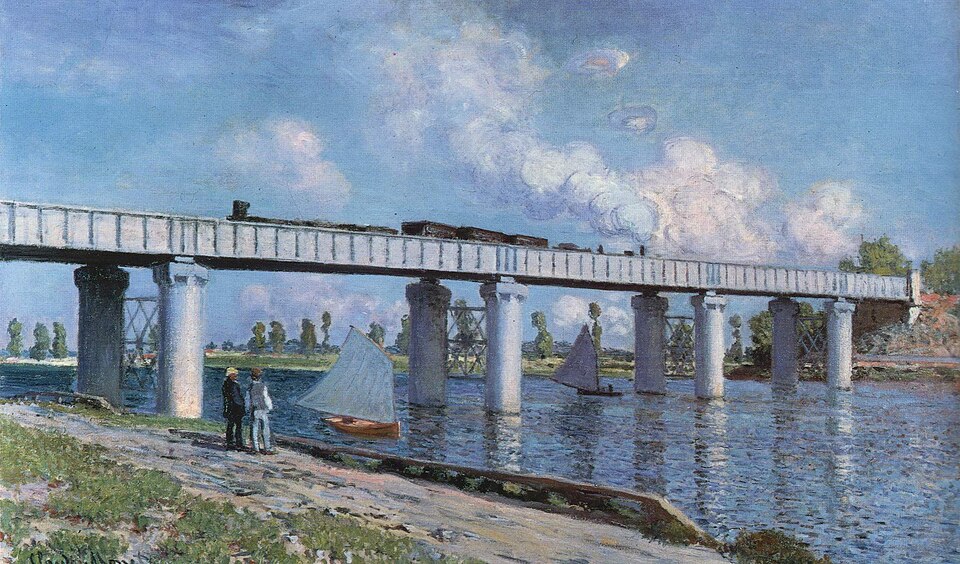
Two trains cross on a plain new bridge, one puffing a great white cloud that melts into the summer sky, while two men on the bank watch sailboats glide beneath. Monet painted this in 1873 as a picture of progress and an optimistic future.
The story behind the painting
Monet had fled to London during the Franco-Prussian War of 1870 to 1871. He returned to France in September 1871 and settled in Argenteuil at the end of that year, renting a house through his friend Édouard Manet, whose family came from nearby Gennevilliers, close to the railway bridge and the station. The bridge, first built in 1863, had cut the trip to Paris Saint-Lazare, 10 kilometres away, to 15 minutes. French troops destroyed it in the war to slow the enemy's advance on Paris. When Monet arrived it was still in ruins. This 1873 canvas shows it rebuilt.
What to look for
The canvas, 60 by 99 cm, is dominated by the long concrete and steel bridge on four pairs of piers. Its sunlit girder hides two passenger trains crossing, showing only chimneys and carriage tops. The left engine gives off no steam, as it is slowing for the station just out of the picture, while the right one, just leaving, sends out a big white cloud that mixes with the sky in blue, pink and white. Two sailboats pass under the bridge, one in sun, one in shade. On the bank two men stand with their backs to us, one in a yellow straw hat, their long shadows suggesting a summer afternoon.
Meaning and intent
The German Wikipedia article reads the picture as a symbol of progress and an optimistic future. A plain bridge made of prefabricated parts as the central subject of a landscape was unusually modern for painting at the time. Monet worked under the influence of the English painter William Turner and of Japanese ukiyo-e woodblock prints, then new in Europe. The painting records two changes of its age: industrialisation and the new leisure society. The railway brought weekend visitors to the Seine at Argenteuil for sailing, so by placing the sailboats right beside the bridge Monet showed that the sailors came because of the trains.
Legacy
In the six years from December 1871 to January 1878 that Monet lived in Argenteuil, he painted more than 170 pictures, many of them of the river. Among them are several views of both the old road bridge, with its traditional stone arches, and the railway bridge, whose bare iron and concrete stood for modern times. This canvas is counted among Monet's main works of the 1870s. Wikidata names no museum for it, and the German Wikipedia article states that it is in a private collection, so it is rarely seen by the public.
¿Sabías que…?
- Painted by Claude Monet in 1873, oil on canvas, 60 x 99 cm.
- Shows the Argenteuil railway bridge rebuilt after the war of 1870 to 1871.
- Influenced by William Turner and Japanese ukiyo-e prints.
- Counted among Monet's main works of the 1870s, now in a private collection.
Sobre el artista
Claude Monet (1840-1926)
Sena · Argenteuil · puente
Más obras de Claude Monet
 Impresión, sol naciente - Claude Monet (1872)
 Nenúfares - Claude Monet (1906)
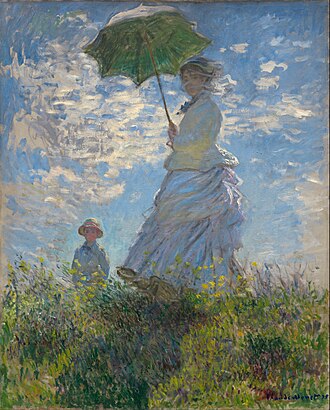 Mujer con sombrilla - Claude Monet (1875)
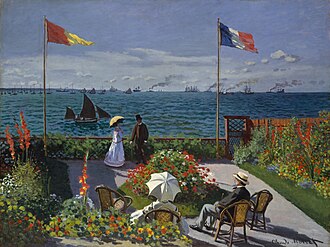 La terraza de Sainte-Adresse - Claude Monet (1867)
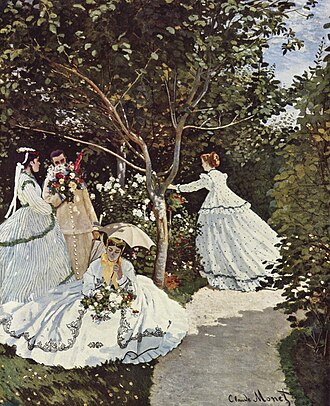 Mujeres en el jardín - Claude Monet (1866)
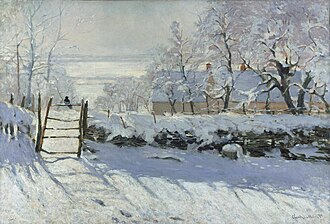 La urraca - Claude Monet (1868)
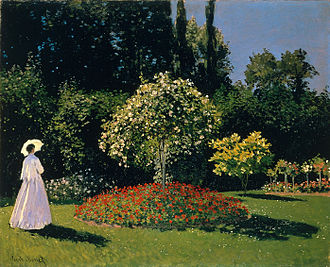 Mujer en el jardín - Claude Monet (1867)
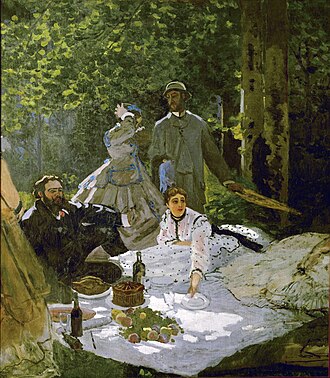 El almuerzo sobre la hierba - Claude Monet (1866)
Obras de artistas relacionados
 El Temerario remolcado - J. M. W. Turner (1839)
 Lluvia, vapor y velocidad. El gran ferrocarril del Oeste - J. M. W. Turner (1844)
 El origen del mundo - Gustave Courbet (1866)
 Entierro en Ornans - Gustave Courbet (2020)
 Almuerzo sobre la hierba - Édouard Manet (1863)
 Olympia - Édouard Manet (1863)
 Baile en el Moulin de la Galette - Pierre-Auguste Renoir (1876)
 El almuerzo de los remeros - Pierre-Auguste Renoir (1881)
 La cuna - Berthe Morisot (1872)
 Summer's Day - Berthe Morisot (1879)
 El ajenjo - Edgar Degas (1875)
 Die Bellelli Familie - Edgar Degas (1858)