La Rama Dorada
J. M. W. Turner · 1834
%20The%20Golden%20Bough%20-%20Joseph%20Mallord%20William%20Turner%20-%20Tate%20Britain.jpg)
By a golden lake that leads to the Underworld, the Sibyl raises a cut branch of gold, while dancers nearby barely notice. Turner's dreamlike Virgil scene later became the opening image of one of the most famous books of the modern age.
The story behind the painting
Turner painted several scenes from Virgil's Aeneid, including Lake Avernus: Aeneas and the Cumaean Sibyl of 1814 to 1815 and The Bay of Baiae of 1823, to which John Ruskin called The Golden Bough a sequel. Earlier Aeneid pictures were probably commissioned by Sir Richard Hoare, but this subject seems to have been Turner's own choice. Eric Shanes suggests he was moved by the death of his father in 1829. The imagery follows Christopher Pitt's English translation of Virgil. The collector Robert Vernon bought the canvas before it was ever exhibited, and it was shown at the Royal Academy in 1834.
What to look for
In Book Six of the Aeneid, the hero Aeneas wants to enter the Underworld to consult his dead father, and the Sibyl of Cumae tells him he must offer Proserpine a golden bough from a sacred tree. Turner shows the landscape around Lake Avernus, the entrance to the Underworld. The Sibyl stands at the left holding a sickle and the cut bough. In the background the Fates dance, and in the foreground a snake hints at the mysteries below. Nearby are several half-clothed dancers and two women apparently watching them. Look for who is missing: Aeneas himself is nowhere in the scene.
Meaning and intent
Turner departs from Virgil on purpose. In the poem the bough never leaves Aeneas's hands from the moment he takes it until he lays it down in the Underworld, yet here the Sibyl holds it up and the hero is absent. The dancers and watching women seem to ignore the golden branch entirely. Shanes reads this as a comment on human indifference, perhaps toward religion, perhaps toward art. He also sees the picture as a reflection on the gap between the mortality of an artist and the immortality of art, a theme that may echo Turner's grief after losing his father.
Legacy
Vernon gave the painting to the National Gallery in 1847 as part of the Vernon Gift, and in 1929 it was transferred to the Tate, where it remains, though it was not on display as of 2020. James George Frazer used it as the frontispiece of the first edition of his book The Golden Bough in 1890 and opened the text by asking who does not know Turner's picture. Frazer, however, took the lake for Lake Nemi, sacred to Diana, rather than Avernus. The frontispiece was dropped from editions from 1959. As a young man, W. B. Yeats spent long periods looking at the painting, and the golden bough later appears in his Byzantium poems.
¿Sabías que…?
- Exhibited at the Royal Academy in 1834.
- Based on Book Six of Virgil's Aeneid.
- Frontispiece of Frazer's The Golden Bough, 1890.
- Part of the Vernon Gift of 1847, transferred to the Tate in 1929.
Sobre el artista
J. M. W. Turner (1775-1851)
National Gallery de Londres · Tate
Más obras de J. M. W. Turner
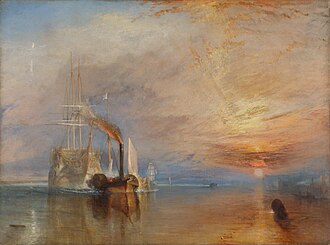 El Temerario remolcado - J. M. W. Turner (1839)
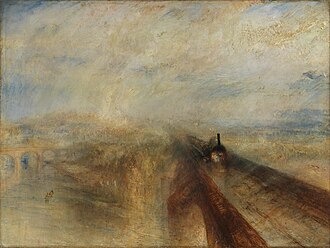 Lluvia, vapor y velocidad. El gran ferrocarril del Oeste - J. M. W. Turner (1844)
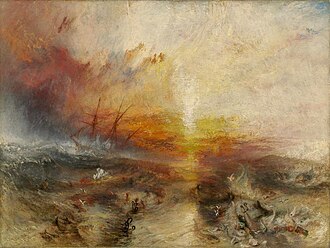 The Slave Ship - J. M. W. Turner (1840)
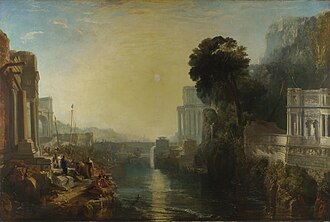 Dido building Carthage - J. M. W. Turner (1815)
.jpg) La Batalla de Trafalgar - J. M. W. Turner (1820s)
La Batalla de Trafalgar - J. M. W. Turner (1820s) Fishermen at Sea - J. M. W. Turner (1796)
 Aníbal cruzando los Alpes - J. M. W. Turner (1812)
 Snow Storm: Steam-Boat off a Harbour's Mouth - J. M. W. Turner (1842)
Obras de artistas relacionados
 Impresión, sol naciente - Claude Monet (1872)
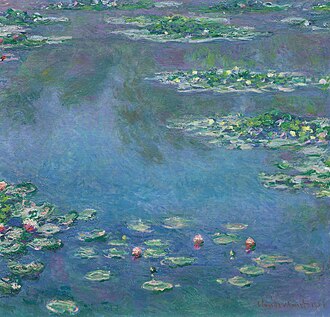 Nenúfares - Claude Monet (1906)
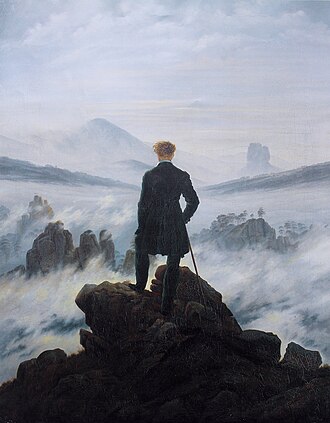 El caminante sobre el mar de nubes - Caspar David Friedrich (c. 1818)
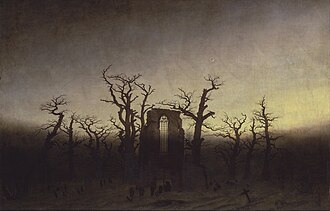 Abadía en el robledal - Caspar David Friedrich (1800s)
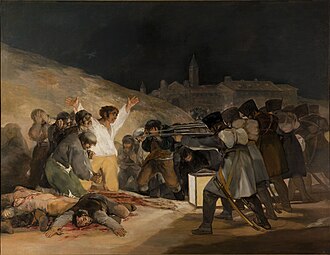 El tres de mayo de 1808 - Francisco Goya (1814)
.jpg) La Maja desnuda - Francisco Goya (1800)
La Maja desnuda - Francisco Goya (1800)