El coleccionista de grabados
Edgar Degas · 1866
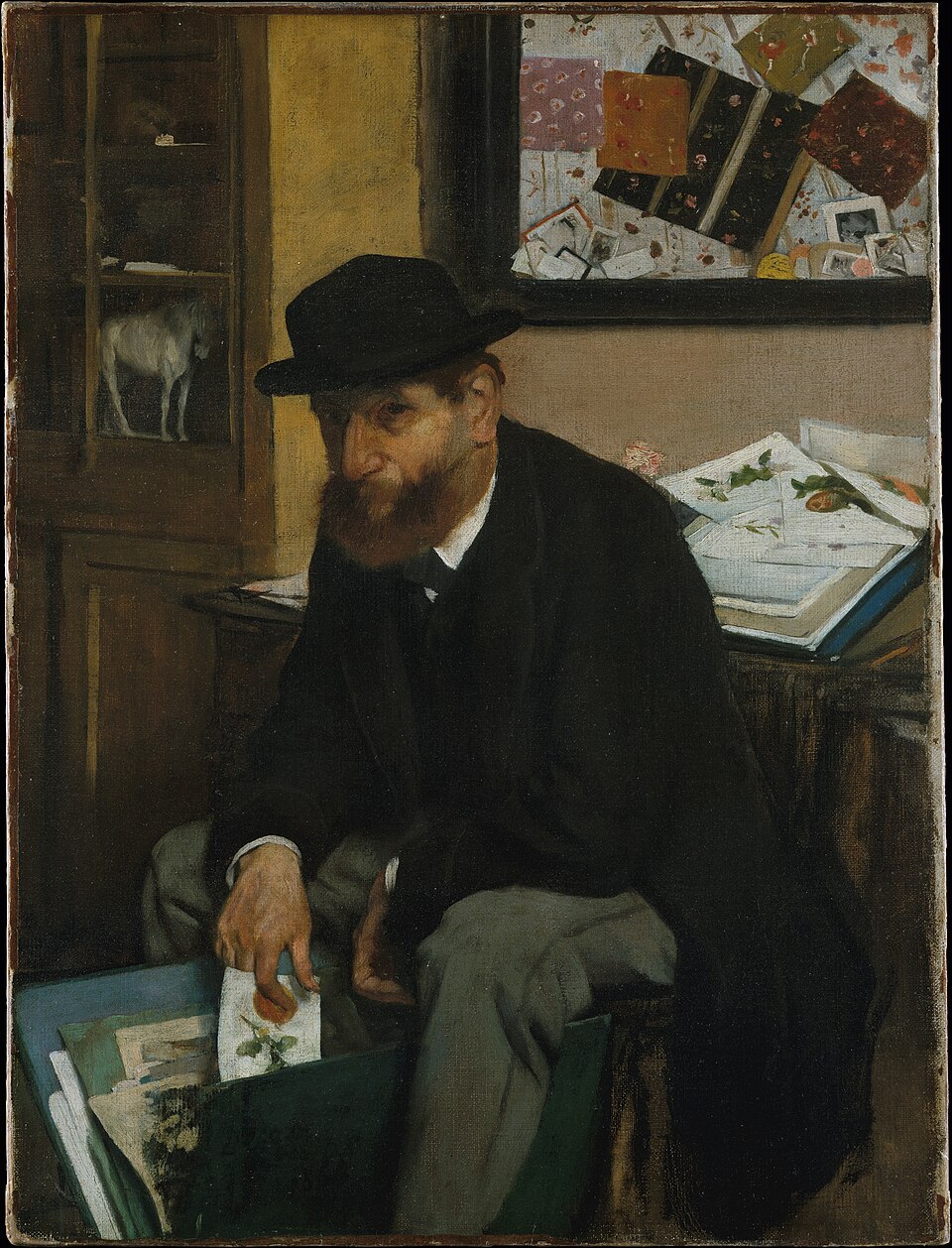
A man pauses over a portfolio of flower prints and looks straight back at us. Around him Degas crowded silk scraps, cards and a little ceramic horse, a whole collector's world in one room.
The story behind the painting
The painting dates from 1866. Between 1866 and 1871 Degas experimented with shifting attention to the backgrounds of his pictures, sometimes painting pictures within pictures, as in the Portrait of James Tissot and Sulking. He followed the advice of Manet and the critic Duranty not to separate a sitter from his setting, and tried instead to bind the two together. He also responded to Daumier's The Print Collector, painted six years earlier, another picture of a man surrounded by his collection.
What to look for
To the right of the sitter, a board is pinned with European stationery and, most visibly, fragments of Japanese embroidered silk, probably meant for pocketbooks and jacket linings. Such fabrics were popular with French collectors for their unusual colour combinations. The papers on the table behind him have been identified as small colour lithographs of flowers, in the manner of Pierre Redoute, and the same prints fill the portfolio in his hands. In the cupboard, a white ceramic horse with bent head and flaring nostrils resembles figures made in China under the Tang dynasty.
Meaning and intent
Unlike Daumier's collector, Degas's man looks directly at the viewer, and he is surrounded by objects from many artistic styles. Art historians describe him differently. Some see a passionate fanatic devoted to his next find, not someone spending lavishly to follow fashion. Others see a modest collector with whom Degas identified, echoing his confession that he had only known how to accumulate beautiful pictures, not money. Degas met collectors in his youth and became one himself, and the sitter can be read as a portrait of deep devotion to art.
Legacy
The man remains unknown, but the painting has a clear later history. In 1895 Louisine Havemeyer bought it through the dealer Durand-Ruel. Today it belongs to The Metropolitan Museum of Art in New York, where the Wikipedia article places it in Gallery 815. The canvas measures 53 by 40 cm, a small format packed with detail. It stands as one of the works in which Degas, himself a collector of Japanese art, folded the art he loved into his own painting.
¿Sabías que…?
- Painted in 1866.
- The sitter is unknown.
- Background includes Japanese silk and a Tang-style ceramic horse.
- Bought by Louisine Havemeyer in 1895, now at the Met.
Sobre el artista
Edgar Degas (1834-1917)
retrato · varón · Museo Metropolitano de Arte · retrato
Más obras de Edgar Degas
 El ajenjo - Edgar Degas (1875)
 Die Bellelli Familie - Edgar Degas (1858)
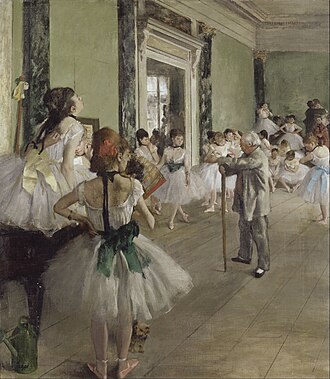 Clase de ballet - Edgar Degas (1871)
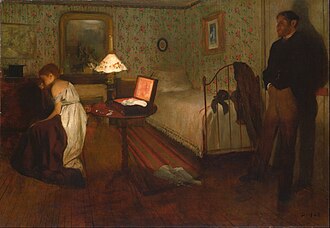 Interior - Edgar Degas (1868)
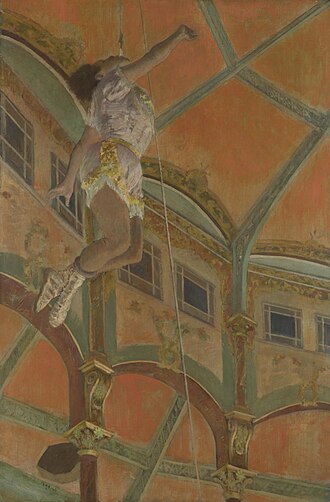 Miss La La en el Circo Fernando - Edgar Degas (1879)
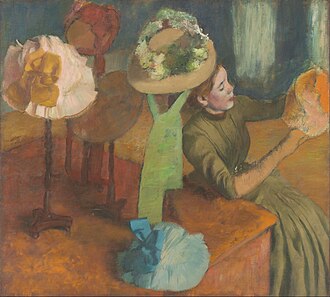 The Millinery Shop by Edgar Degas - Edgar Degas
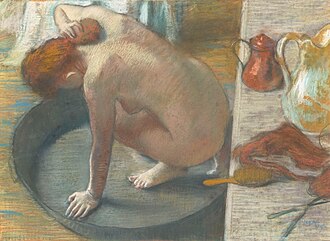 The Tub - Edgar Degas (1886)
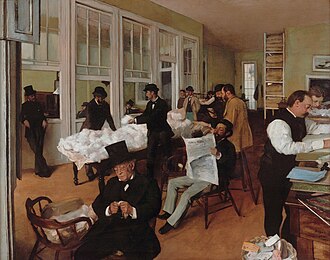 A Cotton Office in New Orleans - Edgar Degas (1873)
Obras de artistas relacionados
 Impresión, sol naciente - Claude Monet (1872)
 Nenúfares - Claude Monet (1906)
 Almuerzo sobre la hierba - Édouard Manet (1863)
 Olympia - Édouard Manet (1863)
 Baile en el Moulin de la Galette - Pierre-Auguste Renoir (1876)
 El almuerzo de los remeros - Pierre-Auguste Renoir (1881)
 La cuna - Berthe Morisot (1872)
 Summer's Day - Berthe Morisot (1879)
 El canal del Loing - Alfred Sisley (1892)
 The Watering Pond at Marly with Hoarfrost - Alfred Sisley (1876)
 Calle de Paris, dia de lluvia - Gustave Caillebotte (1877)
 Los acuchilladores de parqué - Gustave Caillebotte (1875)