La última oración de los mártires cristianos
Jean-Léon Gérôme · 1883
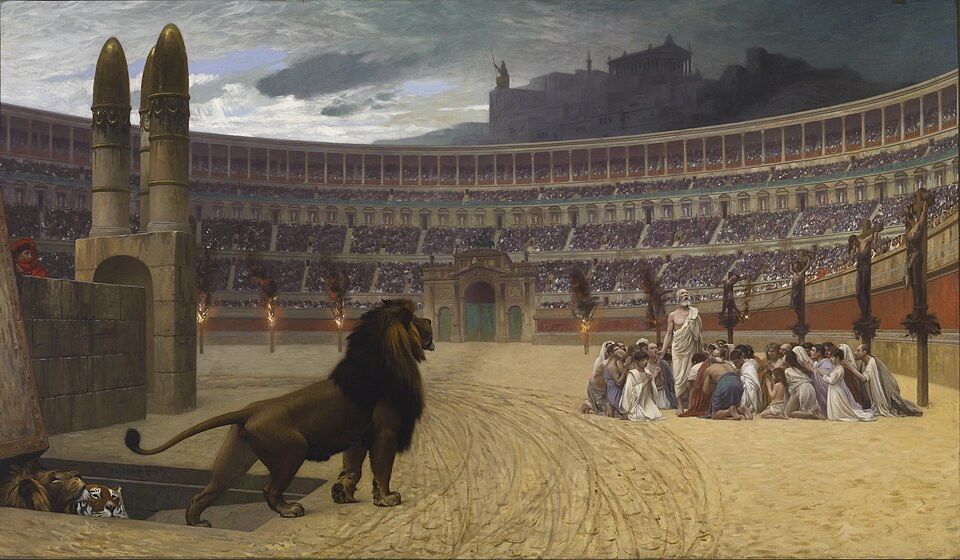
A small group kneels in prayer on the sand while a lion steps out of the dark into the blinding light of a packed arena. Gérôme kept this canvas on his easel for over twenty years and repainted it three times before he let it go.
The story behind the painting
W. T. Walters of Baltimore commissioned the painting in 1863, but Gérôme only delivered it in 1883. In a letter sent with the canvas he apologised for the wait: the picture had been on his easel for more than twenty years, he had repainted it from the beginning three times and reworked both effect and composition, always keeping his first idea. This, he wrote, is really the third canvas you receive. He called it one of his most studied works, the one that gave him the most trouble, and ended with a question: is it a success?
What to look for
Gérôme explained that the scene is the Circus Maximus, not an amphitheatre, though only its curved end is visible. On the left stands the meta at the end of the spina, the turning post for chariots, and you can see wheel tracks in the sand. In the middle distance hang those condemned to be burned, tied to crosses and smeared with pitch. In one corner the Christians, emaciated and in rags after long imprisonment, pray together, while from an opened underground passage the starved beasts emerge. He chose the moment the animals first stop, astonished by daylight and the crowd, like a Spanish bull halting mid-stride as it enters the ring.
Meaning and intent
Gérôme wrote that for these believers dying was a joy; their only thought was to stay firm to the end, and apostasy was rare. Their hearts and their faith alone remained strong. The Wikipedia article sets the scene beside Tacitus's account of Christians under Nero, torn by dogs or burned as lamps by night, which notes that pity arose because they seemed sacrificed to the ferocity of one man. It also notes that who exactly Tacitus was referring to is disputed.
Legacy
Finished in 1883, it became one of Gérôme's most famous works. It is also known as The Christian Martyrs and The Last Prayer, and remains in the Walters Art Museum in Baltimore, the collection of the family who commissioned it. Wikidata gives its size as 87.9 by 150.1 cm. His letter travelled with the canvas, so the painting arrived with its own explanation: the Circus Maximus, he wrote, held more than one hundred and fifty thousand spectators and touched the Palace of the Caesars. Few paintings carry their maker's doubts so openly, ending with the simple question of whether it is a success.
¿Sabías que…?
- Commissioned in 1863, delivered in 1883.
- Repainted from the beginning three times, by Gérôme's own account.
- Set in the Circus Maximus in Rome.
- Held by the Walters Art Museum in Baltimore.
Sobre el artista
Jean-Léon Gérôme (1824-1904)
Más obras de Jean-Léon Gérôme
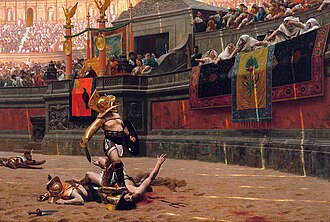 Pollice verso - Jean-Léon Gérôme (1872)
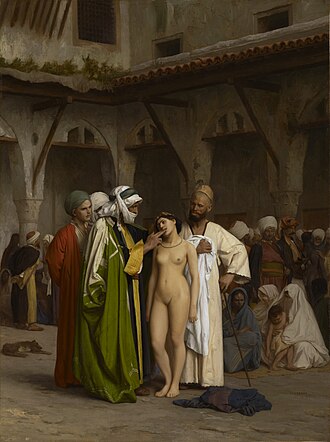 El mercado de esclavos - Jean-Léon Gérôme (1866)
%20-%2001.jpg) Friné frente al Areópago - Jean-Léon Gérôme (1861)
Friné frente al Areópago - Jean-Léon Gérôme (1861)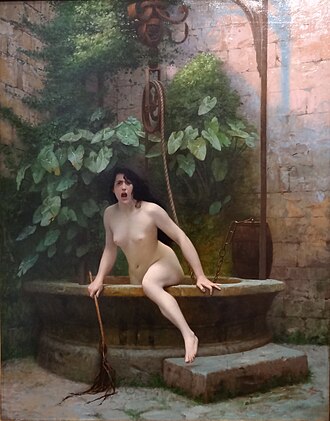 La verdad saliendo del pozo - Jean-Léon Gérôme (1896)
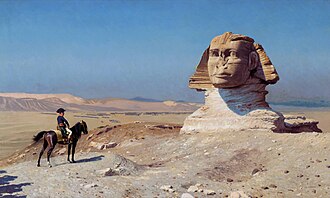 Bonaparte ante la Esfinge - Jean-Léon Gérôme (1867)
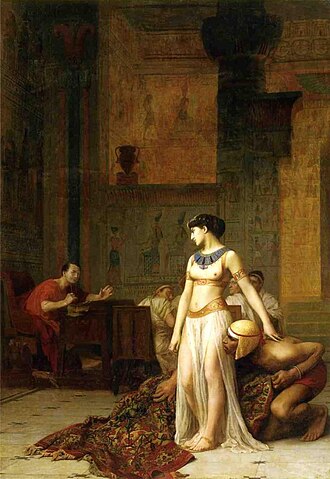 Cleopatra y César - Jean-Léon Gérôme (1866)
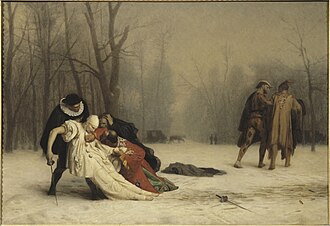 La salida del baile de máscaras - Jean-Léon Gérôme (1857)
.jpg) La Ejecución del mariscal Ney - Jean-Léon Gérôme (1868)
La Ejecución del mariscal Ney - Jean-Léon Gérôme (1868)
Obras de artistas relacionados
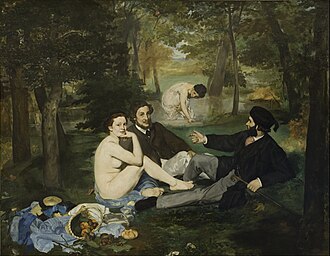 Almuerzo sobre la hierba - Édouard Manet (1863)
 Olympia - Édouard Manet (1863)
 El origen del mundo - Gustave Courbet (1866)
 Entierro en Ornans - Gustave Courbet (2020)
 Clavel, lirio, lirio, rosa - John Singer Sargent (1885-1886)
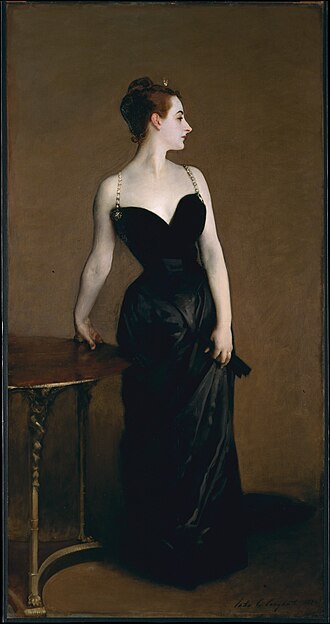 Retrato de Madame X - John Singer Sargent (1884)
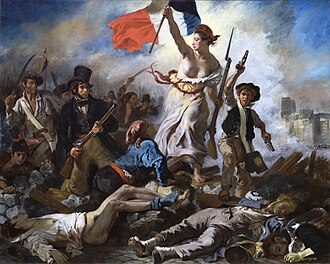 La Libertad guiando al pueblo - Eugène Delacroix (1830)
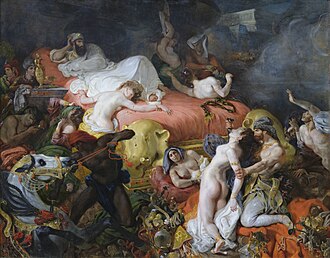 La muerte de Sardanápalo - Eugène Delacroix (1827)
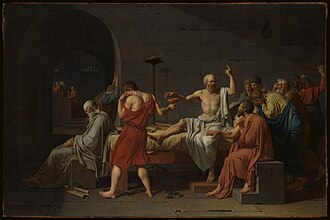 La muerte de Sócrates - Jacques-Louis David (1787)
 Juramento de los Horacios - Jacques-Louis David (1784)
 El Temerario remolcado - J. M. W. Turner (1839)
 Lluvia, vapor y velocidad. El gran ferrocarril del Oeste - J. M. W. Turner (1844)