The Bodmer Oak, Fontainebleau Forest
Claude Monet · 1865
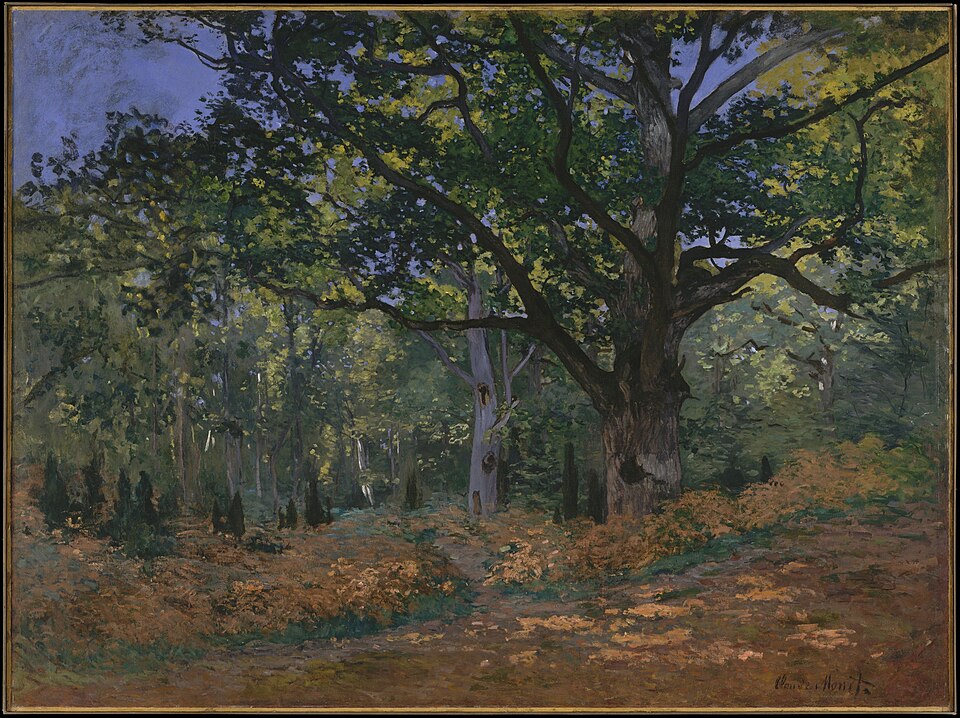
A single great oak in the Fontainebleau forest, dark and detailed against a deep blue sky. The young Monet painted it in 1865, then had it seized by his creditors before he could sell it.
The story behind the painting
In spring 1863 Monet and his fellow students Renoir, Sisley and Bazille left the academic classes of Gleyre so he could put his own ideas about nature into practice. With Bazille he went to Chailly en Bière, on the edge of the Fontainebleau forest, and they returned several times until 1865. The place was known to art lovers thanks to the Barbizon school, and Monet thought similar subjects would find buyers more easily. He painted this oak in 1865. Corot had already painted an oak at the Bas Bréau, and so had Karl Bodmer, whose name the tree took.
What to look for
The picture, about 96.2 by 129.2 cm, is built in three planes. The foreground and the background are light and lightly detailed, while the oak in the middle ground is painted in dark colours and in great detail. This mix of chiaroscuro contrast and a focus on the subject makes the tree stand out. Monet treats the shadow with colour, and he discreetly uses the trunks of the trees behind to give the space depth. The deep blue of the sky harmonises with the red brown ground, and the backlight adds to the majesty of the oak.
Meaning and intent
The tree is the hero. By sacrificing detail around it, Monet leads the eye straight to the oak, an approach close to that of the photographer Gustave Le Gray, who knew the forest well and advised sacrificing details to draw attention to the main subject. The Bas Bréau was one of the parts of the forest protected from 1853, confirmed by an imperial decree of 1861 that recognised its artistic value, and the Barbizon painters had pressed for that protection. To paint this oak was also to paint a place artists had fought to save. Monet painted another picture of the same tree.
Legacy
Monet took the canvas to Paris, then to Ville d'Avray, where he hoped to escape his creditors, but it was seized at the end of 1866 or early 1867. He later recovered it and sold it to the dealer Durand Ruel in 1872. Durand Ruel sent it to New York, where it passed through private collections before entering the Metropolitan Museum of Art in 1964. Over the years the painting has taken part in more than twenty exhibitions around the world, a long journey for a picture once taken away to pay its young painter's debts.
¿Sabías que…?
- Painted in the Fontainebleau forest in 1865.
- The oak was named after the Barbizon painter Karl Bodmer.
- Seized by creditors in 1866 or 1867, later sold to Durand Ruel.
- In the Metropolitan Museum of Art since 1964.
Sobre el artista
Claude Monet (1840-1926)
Más obras de Claude Monet
 Impresión, sol naciente - Claude Monet (1872)
 Nenúfares - Claude Monet (1906)
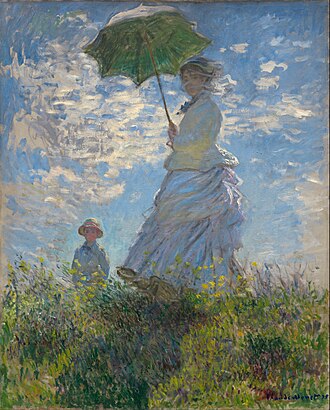 Mujer con sombrilla - Claude Monet (1875)
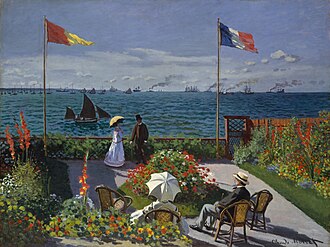 La terraza de Sainte-Adresse - Claude Monet (1867)
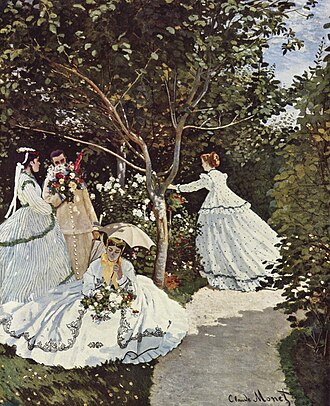 Mujeres en el jardín - Claude Monet (1866)
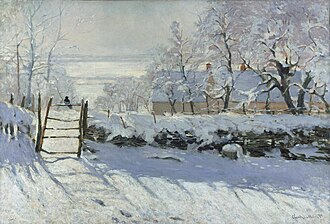 La urraca - Claude Monet (1868)
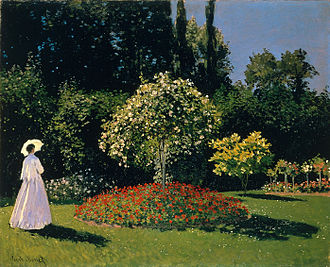 Mujer en el jardín - Claude Monet (1867)
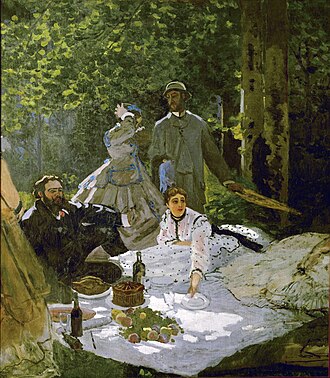 El almuerzo sobre la hierba - Claude Monet (1866)
Obras de artistas relacionados
 El Temerario remolcado - J. M. W. Turner (1839)
 Lluvia, vapor y velocidad. El gran ferrocarril del Oeste - J. M. W. Turner (1844)
 El origen del mundo - Gustave Courbet (1866)
 Entierro en Ornans - Gustave Courbet (2020)
 Almuerzo sobre la hierba - Édouard Manet (1863)
 Olympia - Édouard Manet (1863)
 Baile en el Moulin de la Galette - Pierre-Auguste Renoir (1876)
 El almuerzo de los remeros - Pierre-Auguste Renoir (1881)
 La cuna - Berthe Morisot (1872)
 Summer's Day - Berthe Morisot (1879)
 El ajenjo - Edgar Degas (1875)
 Die Bellelli Familie - Edgar Degas (1858)