The Battle of Trafalgar, as Seen from the Mizen Starboard Shrouds of the Victory
J. M. W. Turner · 1800s
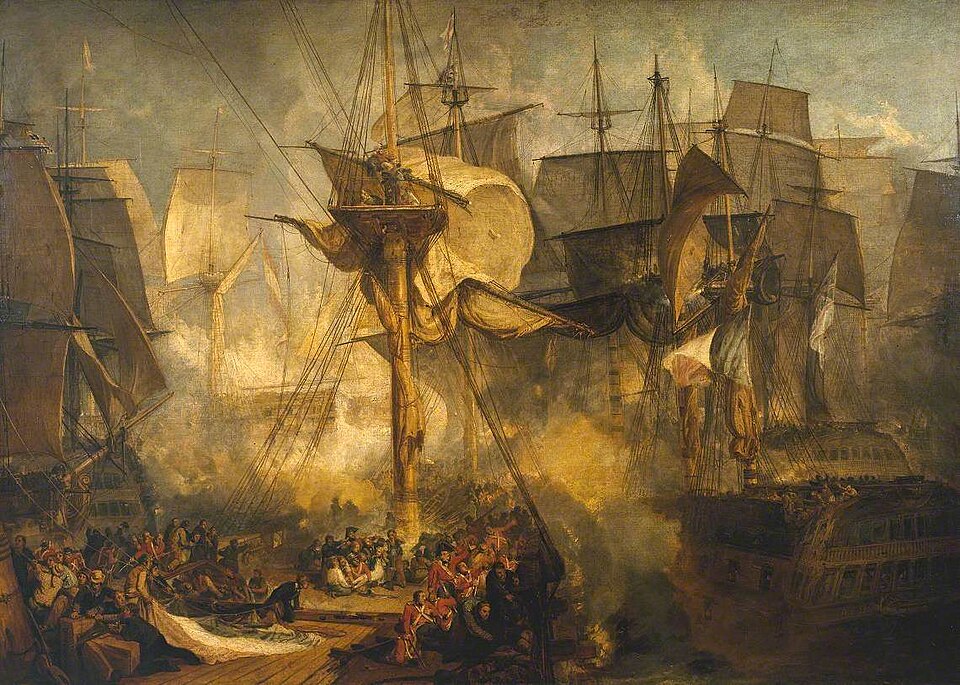
Smoke, sails and wreckage, and on the crowded deck of HMS Victory a small group bending over a fallen man. Turner painted the instant Nelson was shot at Trafalgar, after climbing over the real ship and questioning its crew.
The story behind the painting
When Turner learned that Nelson's body would be brought to London aboard his flagship, the Victory, he went to sketch the ship from every angle. He also interviewed crew members to learn exactly what had happened, including where the officers had stood during the battle of 1805. Nelson's heroic death was a popular subject, and Benjamin West's The Death of Nelson had great success in 1806. Turner first showed his picture in his own studio gallery in Marylebone in 1806, then, after reworking it significantly, at the British Institution in 1808.
What to look for
As the long title says, we look down from the mizen starboard shrouds, high at the right rear of the ship, over a wide view of the Victory's deck. Amid the raging battle, figures gather around the fallen Nelson, while red coated Marines exchange fire with the French ship Redoutable, from which the fatal shot came. Behind rises a cluster of sails from the ships of the line, with the general wreckage of battle. The smoke and the closeness of the enemy ships create a sense of confusion, a vivid picture of the fog of war at sea.
Meaning and intent
Turner wanted more than a death scene. Next to the painting he placed a handwritten description with a numbered key identifying the officers, many of whom he had interviewed, so the canvas was offered almost as reportage. The Repository of Arts wrote that he had detailed the death of his hero and also suggested the whole of a great naval victory in a single picture, something it believed had never before been achieved. Critics in general found it masterful, and John Landseer praised it, but Benjamin West, President of the Royal Academy, called the figures miserably bad.
Legacy
The painting entered the Turner Bequest to the nation after the artist's death in 1851 and is now at Tate Britain. Turner returned to the battle in 1822 with a different Battle of Trafalgar, a royal commission from George IV obtained through his friend Thomas Lawrence and the largest painting he ever made. It was rejected, and none of his paintings entered the Royal Collection. In 1838 he painted The Fighting Temeraire, showing one of the last great sailing ships from Trafalgar returning to London.
¿Sabías que…?
- Shows the moment Nelson was shot aboard HMS Victory in 1805.
- Turner sketched the Victory and interviewed its crew.
- Shown in 1806 and, reworked, at the British Institution in 1808.
- Part of the Turner Bequest, now at Tate Britain.
Sobre el artista
J. M. W. Turner (1775-1851)
National Gallery de Londres · Tate
Más obras de J. M. W. Turner
 El Temerario remolcado - J. M. W. Turner (1839)
 Lluvia, vapor y velocidad. El gran ferrocarril del Oeste - J. M. W. Turner (1844)
 The Slave Ship - J. M. W. Turner (1840)
 Dido building Carthage - J. M. W. Turner (1815)
 La Batalla de Trafalgar - J. M. W. Turner (1820s)
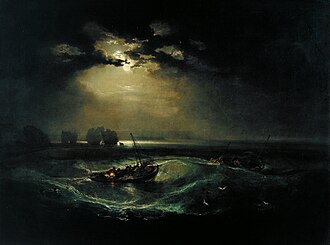 Fishermen at Sea - J. M. W. Turner (1796)
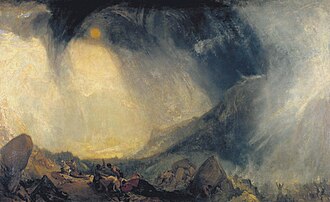 Aníbal cruzando los Alpes - J. M. W. Turner (1812)
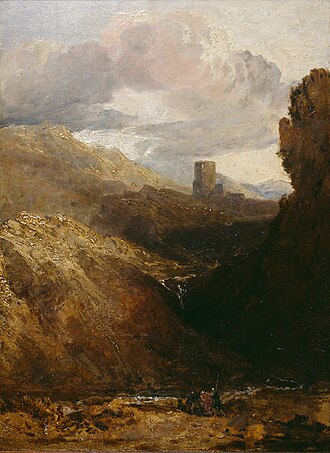 Castillo Dolbadarn - J. M. W. Turner (1800)
Obras de artistas relacionados
 Las hermanas Waldgrave - Joshua Reynolds (1780)
 Capitán George K. H. Coussmaker - Joshua Reynolds (1782)
 Impresión, sol naciente - Claude Monet (1872)
 Nenúfares - Claude Monet (1906)
 El tres de mayo de 1808 - Francisco Goya (1814)
 La Maja desnuda - Francisco Goya (1800)
 El caminante sobre el mar de nubes - Caspar David Friedrich (c. 1818)
 Abadía en el robledal - Caspar David Friedrich (1800s)
 La Libertad guiando al pueblo - Eugène Delacroix (1830)
 La muerte de Sardanápalo - Eugène Delacroix (1827)
 El joven azul - Thomas Gainsborough (1770)
 El Señor y la Señora Andrews - Thomas Gainsborough (1748)