The Ancestors of Christ: Uzziah, Jotham and Ahaz
Miguel Ángel · 1510
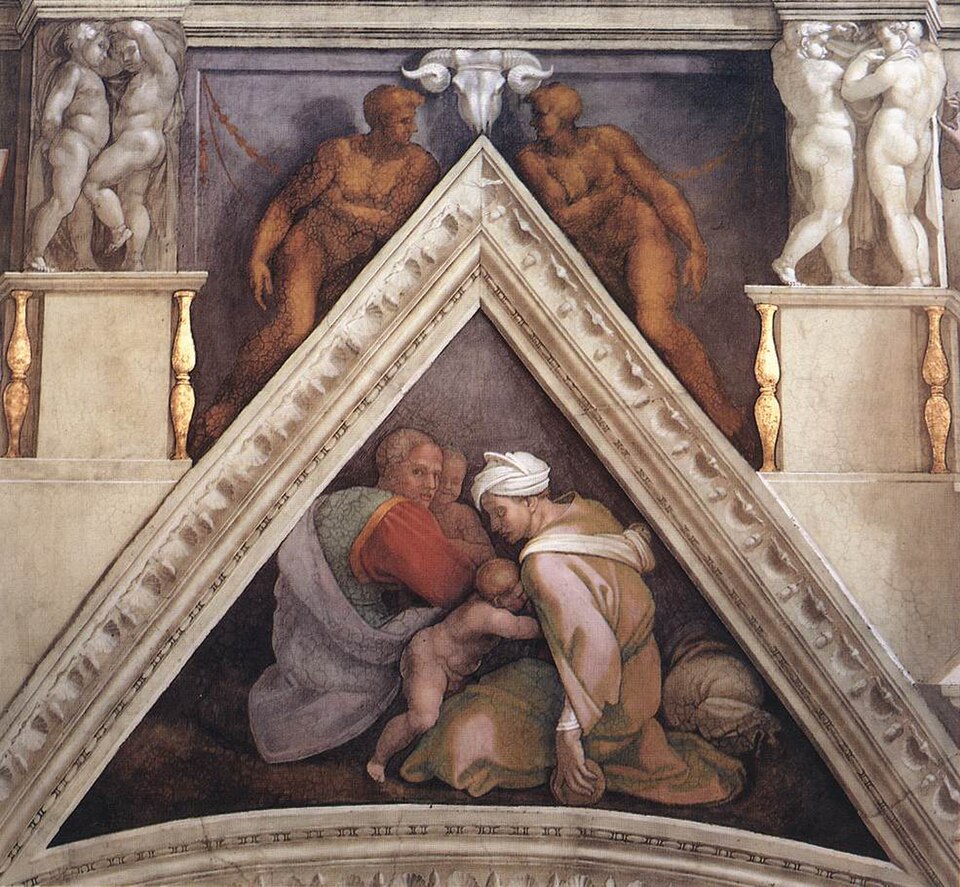
A woman turns her back to us, as if to hide the gesture of nursing her child. Painted in just two days of fresco on the Sistine Chapel ceiling, this small family scene is one of Michelangelo's most tender.
The story behind the painting
Above the lunettes of the Sistine Chapel, Michelangelo painted a row of curved triangular vaults, part of the ceiling commissioned by Pope Julius II. Together with the lunettes below, they hold the series of the Ancestors of Christ, drawn from the genealogy of Jesus in the Gospel of Matthew. The ceiling was frescoed in two phases, starting from the wall opposite the altar, so the latest episodes of the story were painted first. By summer 1511 the first half was done, the scaffolding was taken down and rebuilt, and the second phase, begun in October 1511, ended a year later, in time for the unveiling on the eve of All Saints' Day 1512. This vault, above Uzziah, Jotham and Ahaz, lies close to the scene of the Original Sin and Expulsion from Paradise and dates from the end of the first phase, around 1510, which matches the year given by Wikidata.
What to look for
Jotham and Ahaz are usually identified in the lunette below, so the family of Uzziah should be shown in the vault. The scene took two days of fresco, or giornate. In front, a seated woman turns her upper body toward us as if to hide the gesture of nursing the child who leans toward her breast. Behind them a man holds another child in his arms. The colours of the clothes are rather muted but rich in nuance, modelled with iridescent highlights instead of ordinary shadows: the woman wears a pink dress with green shadows. As elsewhere, the brightest parts are at the front, from her very light headdress back to the face of the child behind, which sits fully in shadow.
Meaning and intent
The vaults differ from the lunettes in style and form: dark backgrounds instead of light ones, and families seated on the ground rather than on steps, to fit the triangular space. The figures are identified only through the names written on the plaques in the lunettes below, and a lunette crowned by a vault usually carries three names instead of two. Scholars do not agree on who is who. Michelangelo gave the figures no iconographic attributes, and he may not have wanted a direct, certain identification at all, concentrating instead on showing different human types and attitudes. That uncertainty is part of what makes these quiet family groups so open to the viewer. The fading from bright foreground to shadowy background is a way of creating depth, similar to the unfinished surfaces Michelangelo used in sculpture, such as the Pitti Tondo and the Taddei Tondo.
Legacy
In the triangular spaces above each vault sit the so-called bronze nudes, monochrome figures imitating bronze, placed symmetrically against dark violet backgrounds and separated by a ram's skull hung with golden ribbons. Here a single day of fresco was enough for both. They lie along the slanted frame, one leg bent forward and one arm back, gazing at each other in profile. They were designed from the same cartoon reversed, with small differences, such as the slightly different position of the shoulders, that prevent a rigid symmetry. The fresco measures about 245 by 340 cm and remains in place in the Sistine Chapel, in the Vatican Museums.
¿Sabías que…?
- Dates from the end of the first phase of the ceiling, around 1510.
- Painted in two days of fresco.
- The family of Uzziah is usually identified in the vault.
- Measures about 245 x 340 cm.
Sobre el artista
Miguel Ángel (1475-1564)
arte religioso · Alto Renacimiento · Capilla Sixtina
Más obras de Miguel Ángel
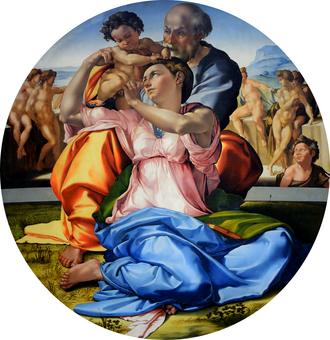 Tondo Doni - Michelangelo (1500s)
 Los tormentos de San Antonio - Michelangelo (1487)
 Santo Entierro - Michelangelo (1500s)
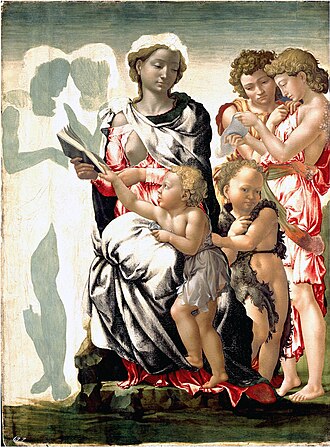 Madonna de Manchester - Michelangelo (1494)
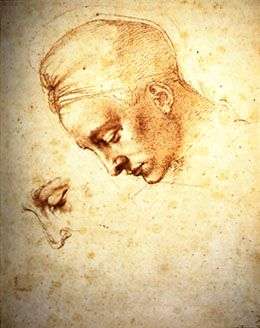 Leda y el cisne - Michelangelo (1530)
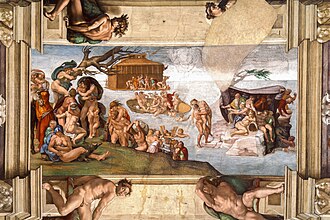 Diluvio Universale - Michelangelo (1508)
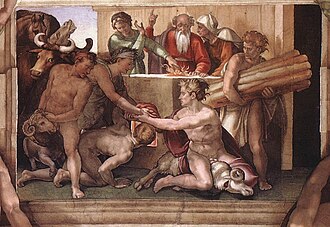 El Sacrificio de Noé - Michelangelo (1508)
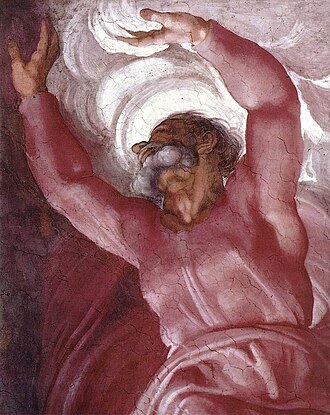 Separación de la luz de la oscuridad - Michelangelo (1512)
Obras de artistas relacionados
 Madonna Sixtina - Raphael (1510s)
 La Fornarina - Raphael
 Venus de Urbino - Titian (1538)
 La Asunción de la Virgen - Titian (1510s)
 La Gioconda - Leonardo da Vinci (1503-1519)
 La dama del armiño - Leonardo da Vinci (1490)
 Autorretrato de Durero - Albrecht Dürer (1500)
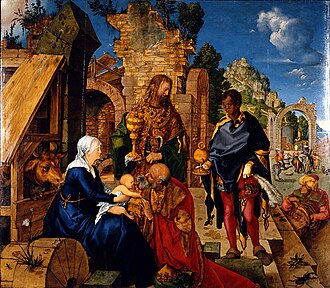 Adoración de los Magos - Albrecht Dürer (1504)
 El nacimiento de Venus - Sandro Botticelli (c. 1485)
 La primavera - Sandro Botticelli (1480s)
 El jardín de las delicias - Hieronymus Bosch
 La nave de los locos - Hieronymus Bosch (1500s)