Portrait de Monsieur Pagans
Édouard Manet · 1879
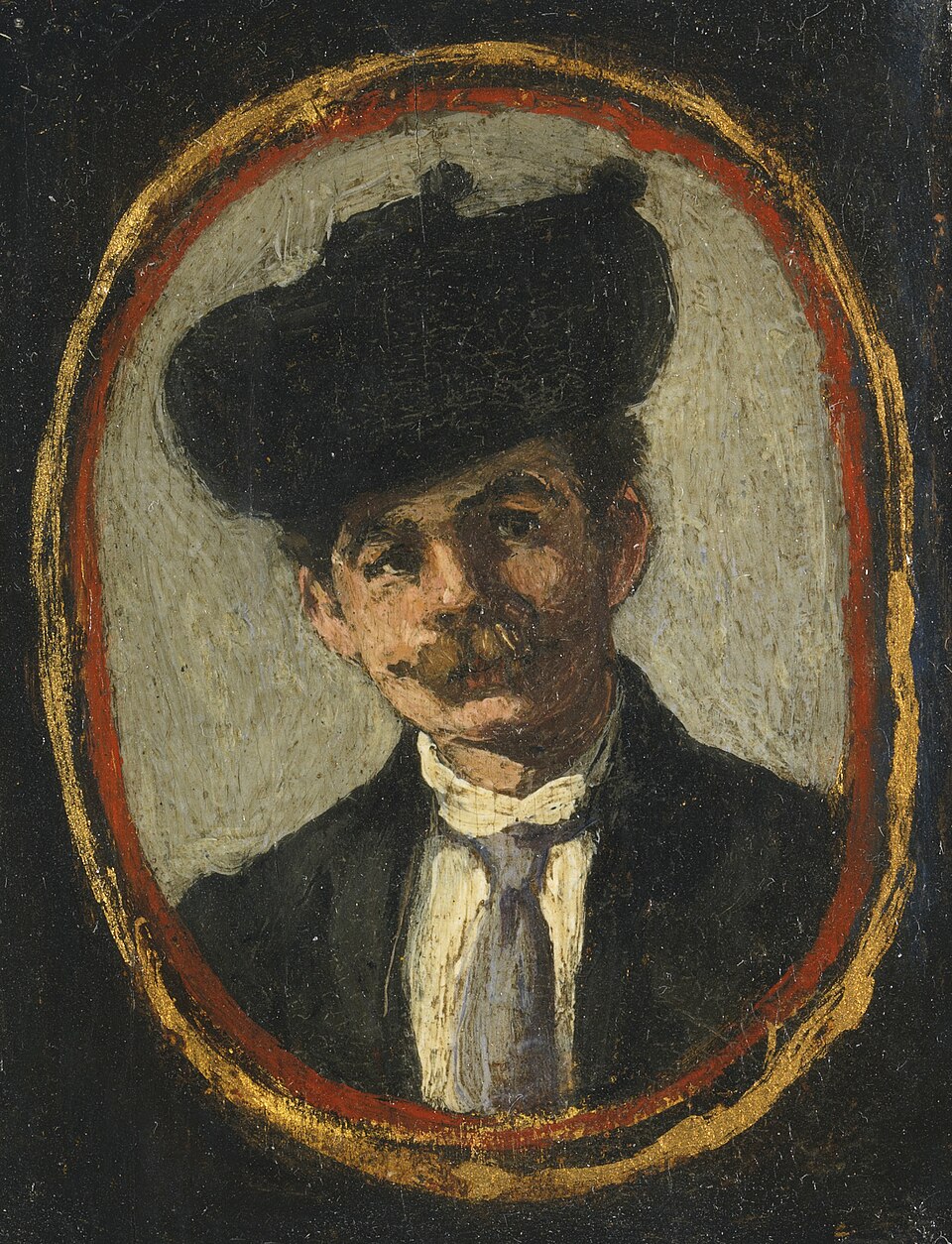
Barely ten centimetres tall, this is one of the smallest oil paintings Manet ever made. It began life as a decoration on a tambourine, painted to help flood victims in Spain.
The story behind the painting
On 15 October 1879 the Río Segura burst its banks in the Spanish province of Murcia, killing about a thousand people. Paris followed the news closely, and writers such as Victor Hugo, Alphonse Daudet and Émile Zola called for donations. The young magazine La Vie moderne invited artists to a benefit exhibition of painted tambourines, among them Renoir, Boldini, de Nittis, Carolus-Duran and Manet. Six painted tambourines by Manet are known. This portrait was a small vignette on the wooden rim of one of them, showing a Spanish dancing couple.
What to look for
The parchment portrait was later mounted on a black-painted wooden panel 10.4 by 6.9 cm, as a medallion inside a painted red border and a gold line. The gold strokes overlap the red, a sign the gold was added later by another hand. Lorenzo Pagans is seen from the shoulders up against grey, head tilted, his dark eyes looking straight at us. Half his face is in shadow, the other half pink in the light. He has a thick moustache, a black jacket, a white collar, a blue tie and a black hat with two pompoms.
Meaning and intent
Pagans, a tenor, pianist and guitarist from Catalonia, had been known to Manet since the 1860s. Around 1871 to 1872 Degas painted him singing with a guitar at a house concert. Pagans frequented Paris salons, including the one held by Suzanne Manet, herself a pianist, and the two may have made music together. The folk-style hat recalls Manet's own Spanish Singer of the 1860s, yet here the musician is not performing. Manet shows him in the manner of the photographic carte de visite portraits so popular at the time.
Legacy
Manet probably sold the tambourine directly to Pagans; his account book records a buyer noted only as P., which could also mean his friend Eugène Pertuiset. Pagans lent the two dancing-couple tambourines to Manet's memorial exhibition in 1884. It is unclear when the portrait was separated from its tambourine; perhaps Pagans's heirs sold the main image and kept his likeness as a keepsake. It later passed through Georges Wildenstein and several New York collectors, and was shown in Philadelphia in 1933 to 1934 and Detroit in 1936. It is now in a private collection.
¿Sabías que…?
- Painted in 1879 for a benefit for Spanish flood victims.
- Originally a vignette on a tambourine rim.
- Measures 10.4 by 6.9 cm on a wooden panel.
- Shows the Catalan singer and guitarist Lorenzo Pagans.
Sobre el artista
Édouard Manet (1832-1883)
retrato · Llorenç Pagans i Julià
Más obras de Édouard Manet
 Almuerzo sobre la hierba - Édouard Manet (1863)
 Olympia - Édouard Manet (1863)
 Un bar del Folies Bergère - Édouard Manet (1882)
 El balcón - Édouard Manet (1868)
 La música en las Tullerías - Édouard Manet (1862)
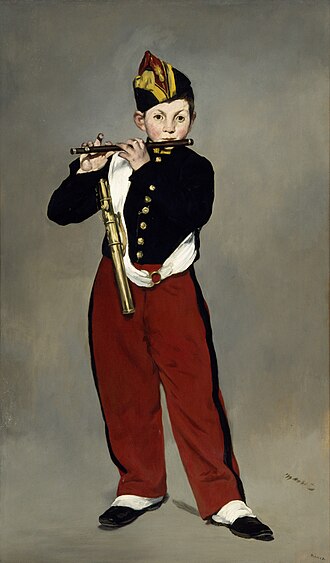 El pífano - Édouard Manet (1866)
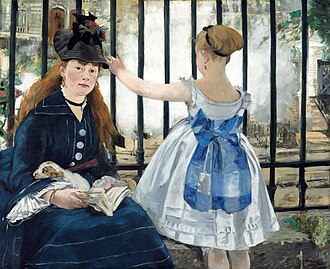 El Ferrocarril o El Camino de Hierro. - Édouard Manet (1873)
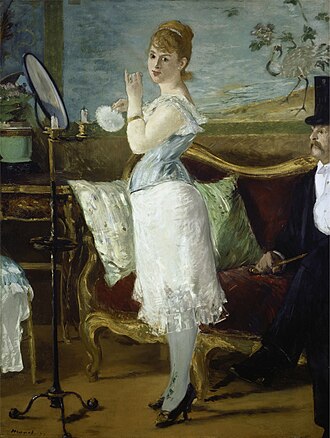 Nana - Édouard Manet (1877)
Obras de artistas relacionados
 Impresión, sol naciente - Claude Monet (1872)
 Nenúfares - Claude Monet (1906)
 Baile en el Moulin de la Galette - Pierre-Auguste Renoir (1876)
 El almuerzo de los remeros - Pierre-Auguste Renoir (1881)
 La cuna - Berthe Morisot (1872)
 Summer's Day - Berthe Morisot (1879)
 El ajenjo - Edgar Degas (1875)
 Die Bellelli Familie - Edgar Degas (1858)
 El canal del Loing - Alfred Sisley (1892)
 The Watering Pond at Marly with Hoarfrost - Alfred Sisley (1876)
 Calle de Paris, dia de lluvia - Gustave Caillebotte (1877)
 Los acuchilladores de parqué - Gustave Caillebotte (1875)