Portrait de Charlotte de Rothschild by Jean-Léon Gérôme
Jean-Léon Gérôme · 1866
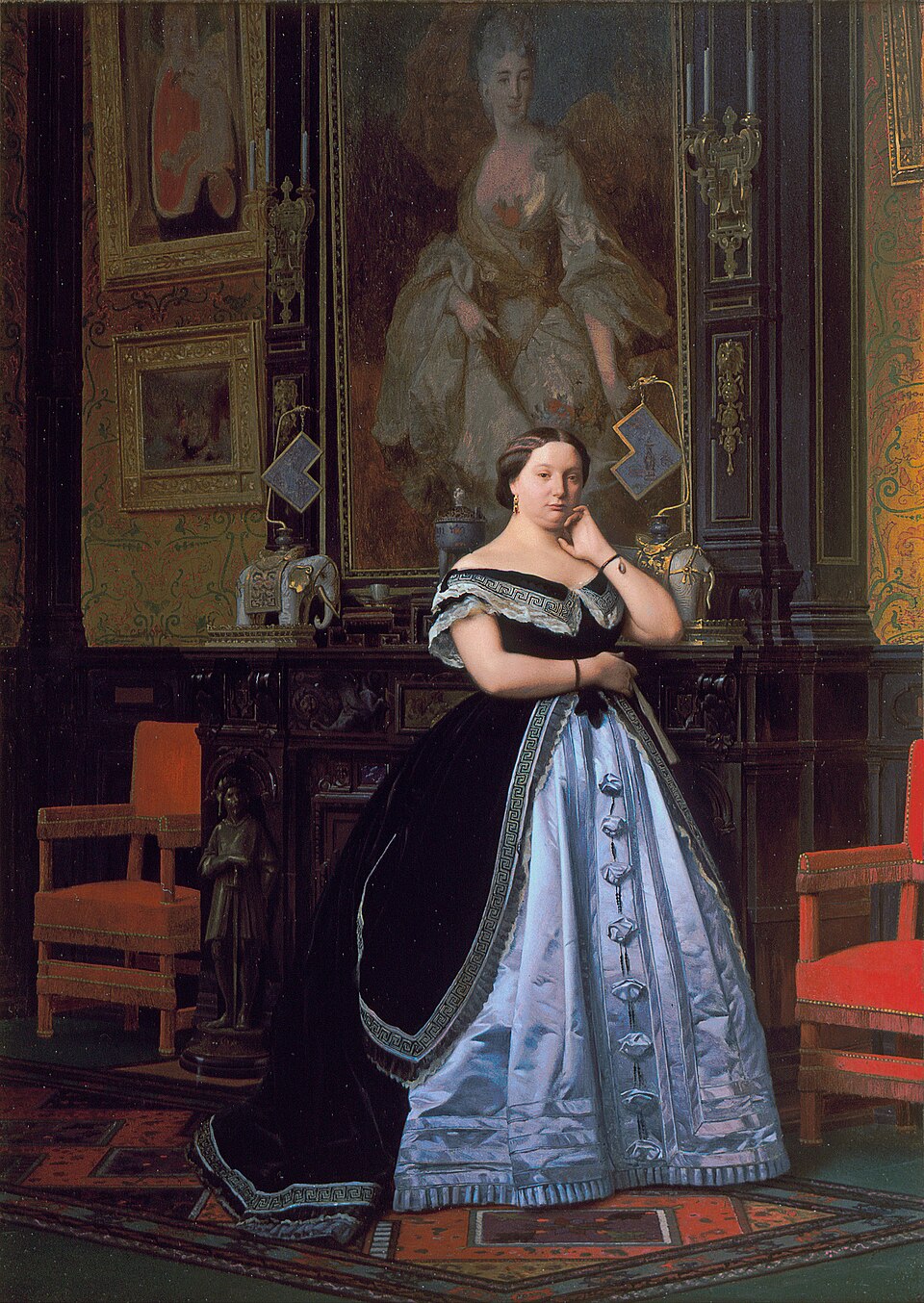
A baroness stands in a room full of treasures she chose herself, on a wooden panel barely half a metre tall. Gérôme painted Charlotte de Rothschild in 1866 as a quiet answer to the portrait Ingres had made of her mother.
The story behind the painting
Charlotte de Rothschild, born in 1825 and known as Baroness Nathaniel de Rothschild, grew up surrounded by music and painting. In 1835 her piano teacher, Frédéric Chopin, dedicated to her one of the two waltzes of his opus 69, the waltz called the Farewell. She also painted in watercolour, showed her work regularly at the Salon and later with the Société des aquarellistes, and collected art objects from many periods and places. In 1866 Jean-Léon Gérôme painted her full-length portrait in oil on wood.
What to look for
The panel is small, 49.6 by 35.8 cm, yet it holds a whole sumptuous Paris interior, probably her apartments in the faubourg Saint-Honoré. She stands before a richly carved fireplace crowded with luxurious objects, among them two bronze elephants of oriental inspiration. Three paintings hang behind her, one of them, at the upper left, a Virgin and Child with a goldfinch. Look closely at the dress: Gérôme lingered over the shimmering, moiré reflections of the fabric. The signature JL. GEROME sits at middle left, above the wooden moulding.
Meaning and intent
The portrait pays homage to the one Jean-Auguste-Dominique Ingres painted in 1848 of her mother, Betty de Rothschild. Gérôme took up a smooth, precise technique close to that of Ingres, with minute attention to detail and to the feel of materials, and he borrowed elements of the pose, such as the hand supporting the chin and the fan held casually. The eclectic, luxurious setting is not mere decoration: it works as a frame that shows her strong taste for the arts and her life as a knowing collector.
Legacy
The objects around her were more than props. Charlotte later bequeathed several pieces from her collection to institutions such as the Musée de Cluny, the Musée des Arts décoratifs and the Louvre, so the room in the painting points toward collections the public can still visit. The portrait itself entered the collections of the Musée d'Orsay in Paris in 2004. Wikidata classes it as academic art, and it stands as a meeting point of two generations of a family painted by two masters of smooth, exact finish.
¿Sabías que…?
- Painted by Jean-Léon Gérôme in 1866, oil on wood, 49.6 x 35.8 cm.
- Chopin dedicated a waltz of his opus 69 to the sitter in 1835.
- Homage to Ingres's 1848 portrait of her mother, Betty de Rothschild.
- In the Musée d'Orsay since 2004.
Sobre el artista
Jean-Léon Gérôme (1824-1904)
mujer · retrato · Museo de Orsay · vestido · de pie · academicismo · alfombra · sillón · miriñaque
Más obras de Jean-Léon Gérôme
 Pollice verso - Jean-Léon Gérôme (1872)
 El mercado de esclavos - Jean-Léon Gérôme (1866)
 Friné frente al Areópago - Jean-Léon Gérôme (1861)
 La verdad saliendo del pozo - Jean-Léon Gérôme (1896)
 Bonaparte ante la Esfinge - Jean-Léon Gérôme (1867)
 Cleopatra y César - Jean-Léon Gérôme (1866)
 La salida del baile de máscaras - Jean-Léon Gérôme (1857)
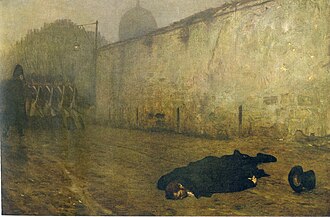 La Ejecución del mariscal Ney - Jean-Léon Gérôme (1868)
Obras de artistas relacionados
 Almuerzo sobre la hierba - Édouard Manet (1863)
 Olympia - Édouard Manet (1863)
 El origen del mundo - Gustave Courbet (1866)
 Entierro en Ornans - Gustave Courbet (2020)
 Clavel, lirio, lirio, rosa - John Singer Sargent (1885-1886)
 Retrato de Madame X - John Singer Sargent (1884)
 La Libertad guiando al pueblo - Eugène Delacroix (1830)
 La muerte de Sardanápalo - Eugène Delacroix (1827)
 La muerte de Sócrates - Jacques-Louis David (1787)
 Juramento de los Horacios - Jacques-Louis David (1784)
 Las hermanas Waldgrave - Joshua Reynolds (1780)
 Capitán George K. H. Coussmaker - Joshua Reynolds (1782)