Paseo de la corte en los jardines de Versalles
Jean-Léon Gérôme · 1895
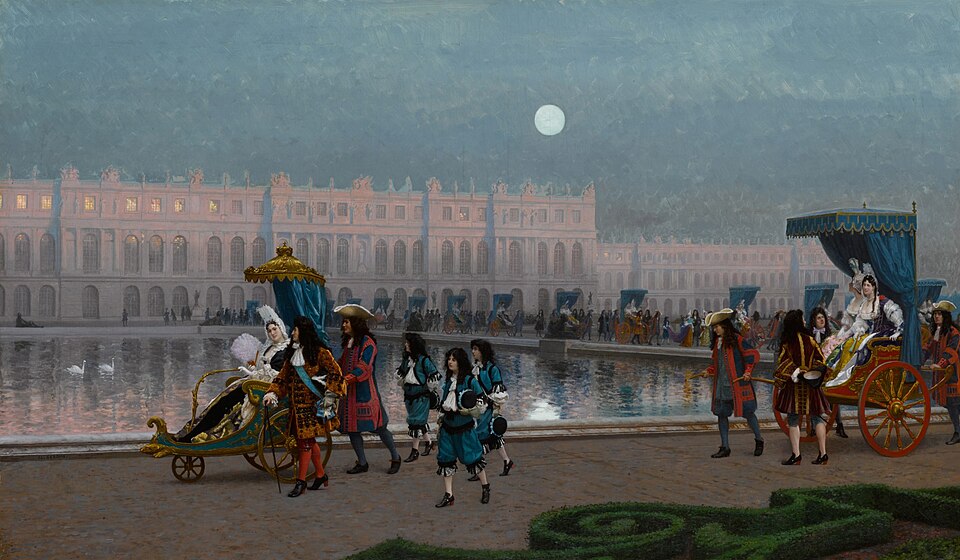
Louis XIV walks beside Madame de Maintenon as the sun sinks behind Versailles and a strange green moon rises. That moon later vanished from the canvas, and Gérôme fought to bring it back.
The story behind the painting
Gérôme found this subject on a visit to Versailles. Invited to a meal there, he arrived late and went into the park to look for his friends. Near the palace he was struck by the view: the low sun barely gilding the top of the building, and above it a greenish moon that added, in his words, a melancholy note, sad, placid and poetic. He knew at once it was the subject of a painting. At the meal his friend Victorien Sardou, an expert on period carriages, offered his collection of drawings, prints and paintings on the subject, and by the end of the meal Gérôme knew exactly what he would paint.
What to look for
The scene unfolds beside the Bassin du Nord, with a procession of the court moving away from the palace. At its head walks Louis XIV beside Madame de Maintenon, seated in a three-wheeled chair pushed by a servant, followed closely by three small pages. Behind them come courtiers in or beside their own wheeled chairs. The setting sun lights only the top floor of the palace, the light glances off the water where a pair of swans glide, and a full greenish moon hangs in a cloudless sky. The oil on canvas measures 81 by 139 cm and is signed J. L. GEROME on the edge of the basin, lower left.
Meaning and intent
For the costumes Gérôme reused the many outfits he had bought for his Reception of Condé at Versailles. The king, the court and the palace are the subject, but the mood comes from the hour: a slow walk at dusk under a moon the painter himself called sad and poetic. The press did not share his feeling. The greenish moon displeased critics, who read a suggestive, salacious hint into it. Gérôme painted Louis XIV in three subjects in all: this promenade, the Reception of the Grand Condé at Versailles, and Louis XIV and Molière.
Legacy
Wikidata dates the canvas 1895, and it was shown at the Salon of 1896, the same year as Truth Coming Out of Her Well. When it was lent for an exhibition in Paris, Gérôme learned that the moon had been removed after Edward Brandus bought it in New York in 1901. He asserted the moral right of an artist to protect the character of his work, repainted the whole sky and put the moon back, softening its unusual colour. On 6 April 1903 he wrote to Brandus that he had restored the mutilated picture. From 1956 it belonged to Joan Cohen in New York, and it changed hands at Sotheby's New York in 2021.
¿Sabías que…?
- Painted in 1895 and shown at the Salon of 1896.
- Inspired by a dusk visit Gérôme made to the Versailles park.
- The green moon was erased after 1901, and Gérôme repainted it.
- Oil on canvas, 81 by 139 cm.
Sobre el artista
Jean-Léon Gérôme (1824-1904)
Más obras de Jean-Léon Gérôme
 Pollice verso - Jean-Léon Gérôme (1872)
 El mercado de esclavos - Jean-Léon Gérôme (1866)
 Friné frente al Areópago - Jean-Léon Gérôme (1861)
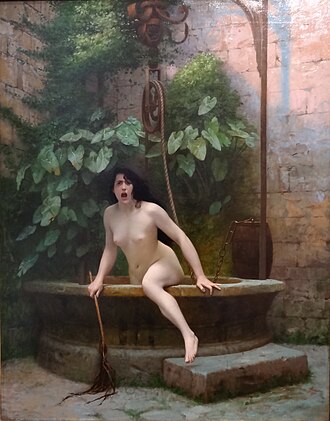 La verdad saliendo del pozo - Jean-Léon Gérôme (1896)
 Bonaparte ante la Esfinge - Jean-Léon Gérôme (1867)
 Cleopatra y César - Jean-Léon Gérôme (1866)
 La salida del baile de máscaras - Jean-Léon Gérôme (1857)
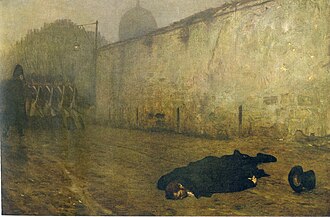 La Ejecución del mariscal Ney - Jean-Léon Gérôme (1868)
Obras de artistas relacionados
 Almuerzo sobre la hierba - Édouard Manet (1863)
 Olympia - Édouard Manet (1863)
 El origen del mundo - Gustave Courbet (1866)
 Entierro en Ornans - Gustave Courbet (2020)
 Clavel, lirio, lirio, rosa - John Singer Sargent (1885-1886)
 Retrato de Madame X - John Singer Sargent (1884)
 La Libertad guiando al pueblo - Eugène Delacroix (1830)
 La muerte de Sardanápalo - Eugène Delacroix (1827)
 La muerte de Sócrates - Jacques-Louis David (1787)
 Juramento de los Horacios - Jacques-Louis David (1784)
 Las hermanas Waldgrave - Joshua Reynolds (1780)
 Capitán George K. H. Coussmaker - Joshua Reynolds (1782)