Le Corsage Noir
Berthe Morisot · 1878
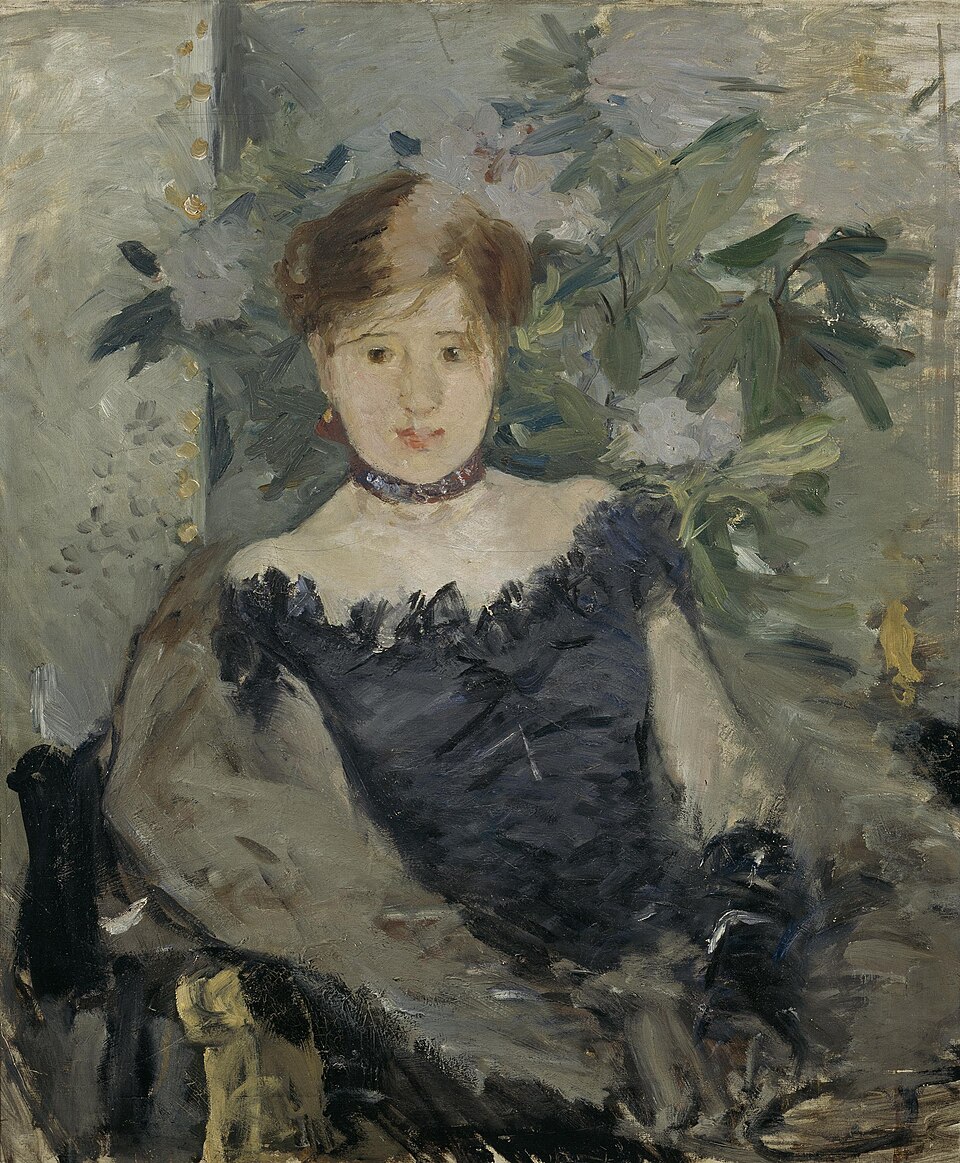
A young woman in an evening gown sits before pale flowers, and her black bodice turns out to be made of blue. The dress belonged to Berthe Morisot herself, and the model's name has been lost.
The story behind the painting
Morisot painted Le Corsage Noir, The Black Bodice, in 1878. The sitter is an unidentified professional model, not a member of the artist's family. The gown was Morisot's own; she wore it in formal studio photographs in 1875. Her daughter Julie Manet was born in November 1878, and the National Gallery of Ireland suggests that the limits of pregnancy and birth may have led Morisot to pursue indoors effects of light and colour she had studied outside. The dating differs: the museum says 1878, while the 1896 retrospective catalogue gave 1876.
What to look for
The figure fills most of the vertical canvas and faces us. Her dark hair is drawn back, a narrow black choker circles her neck, and the low bodice leaves her shoulders bare. Translucent grey fabric lies around her arms and lap; dark gloves and the arms of the chair close the bottom of the picture. Look closely at the dress: it is not flat black but built from feathery strokes of dark blue. Behind her, pale blossoms and green leaves never settle into a clear wall, window or garden.
Meaning and intent
The title names the garment, not the woman. Morisot often dressed models in her own clothes, which art historian Claire Moran reads as a quiet trace of the artist inside anonymous pictures. Moran calls this mode a plein-air interior: the sitter blends with the plants through quick strokes and light tones. Sinéad Helena Furlong sees instead an uneasy debutante, aware of being watched, and finds tension in the loose finish, unlike polished society portraits. The museum itself treats it as an Impressionist exercise in light and colour.
Legacy
The painting stayed with Julie Manet and her husband Ernest Rouart, then passed through Knoedler in London, from whom the National Gallery of Ireland bought it in 1936. In 1894 Morisot painted it again, as a small framed picture on the pink wall of La Coiffure, now in Buenos Aires, where it was read as an emblem of feminine beauty and success. It has travelled widely, to Washington in 1987, to Japan, London and Amsterdam, and in 2024 to Ordrupgaard and to Women Impressionists in Dublin.
¿Sabías que…?
- Painted in 1878; the 1896 catalogue dated it 1876.
- The gown belonged to Morisot herself.
- Appears as a framed picture in her 1894 painting La Coiffure.
- Bought by the National Gallery of Ireland in 1936.
Sobre el artista
Berthe Morisot (1841-1895)
Más obras de Berthe Morisot
 La cuna - Berthe Morisot (1872)
 Summer's Day - Berthe Morisot (1879)
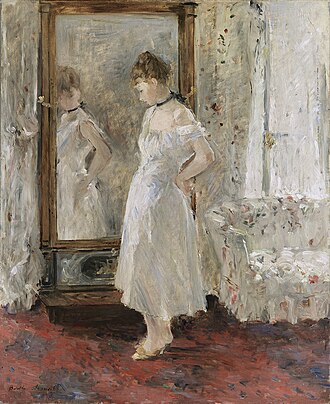 El espejo de vestir - Berthe Morisot (1876)
 The Port at Lorient - Berthe Morisot (1869)
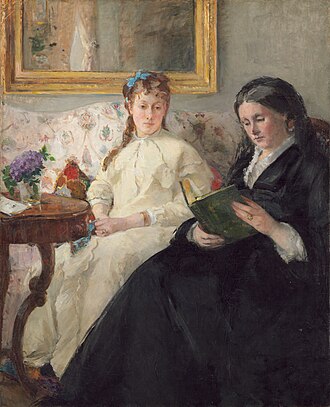 La hermana y la madre de la artista - Berthe Morisot
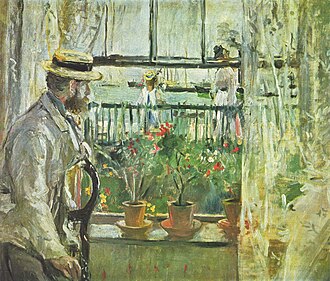 Eugène Manet on Isle of Wight - Berthe Morisot (1875)
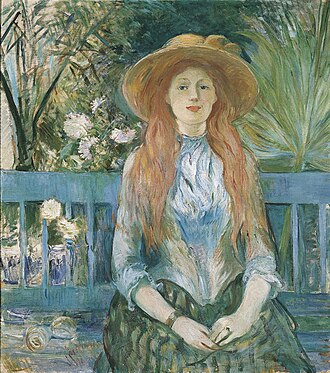 Young girl in a park - Berthe Morisot (1893)
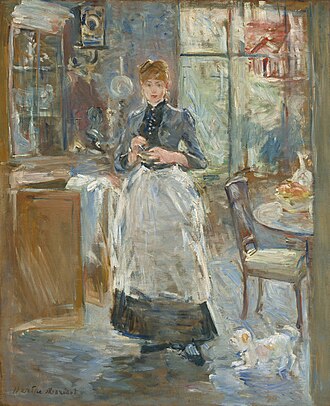 In the Dining Room - Berthe Morisot (1886)
Obras de artistas relacionados
 Impresión, sol naciente - Claude Monet (1872)
 Nenúfares - Claude Monet (1906)
 Almuerzo sobre la hierba - Édouard Manet (1863)
 Olympia - Édouard Manet (1863)
 Baile en el Moulin de la Galette - Pierre-Auguste Renoir (1876)
 El almuerzo de los remeros - Pierre-Auguste Renoir (1881)
 El ajenjo - Edgar Degas (1875)
 Die Bellelli Familie - Edgar Degas (1858)
 El canal del Loing - Alfred Sisley (1892)
 The Watering Pond at Marly with Hoarfrost - Alfred Sisley (1876)
 Calle de Paris, dia de lluvia - Gustave Caillebotte (1877)
 Los acuchilladores de parqué - Gustave Caillebotte (1875)