La parisina
Pierre-Auguste Renoir · 1874
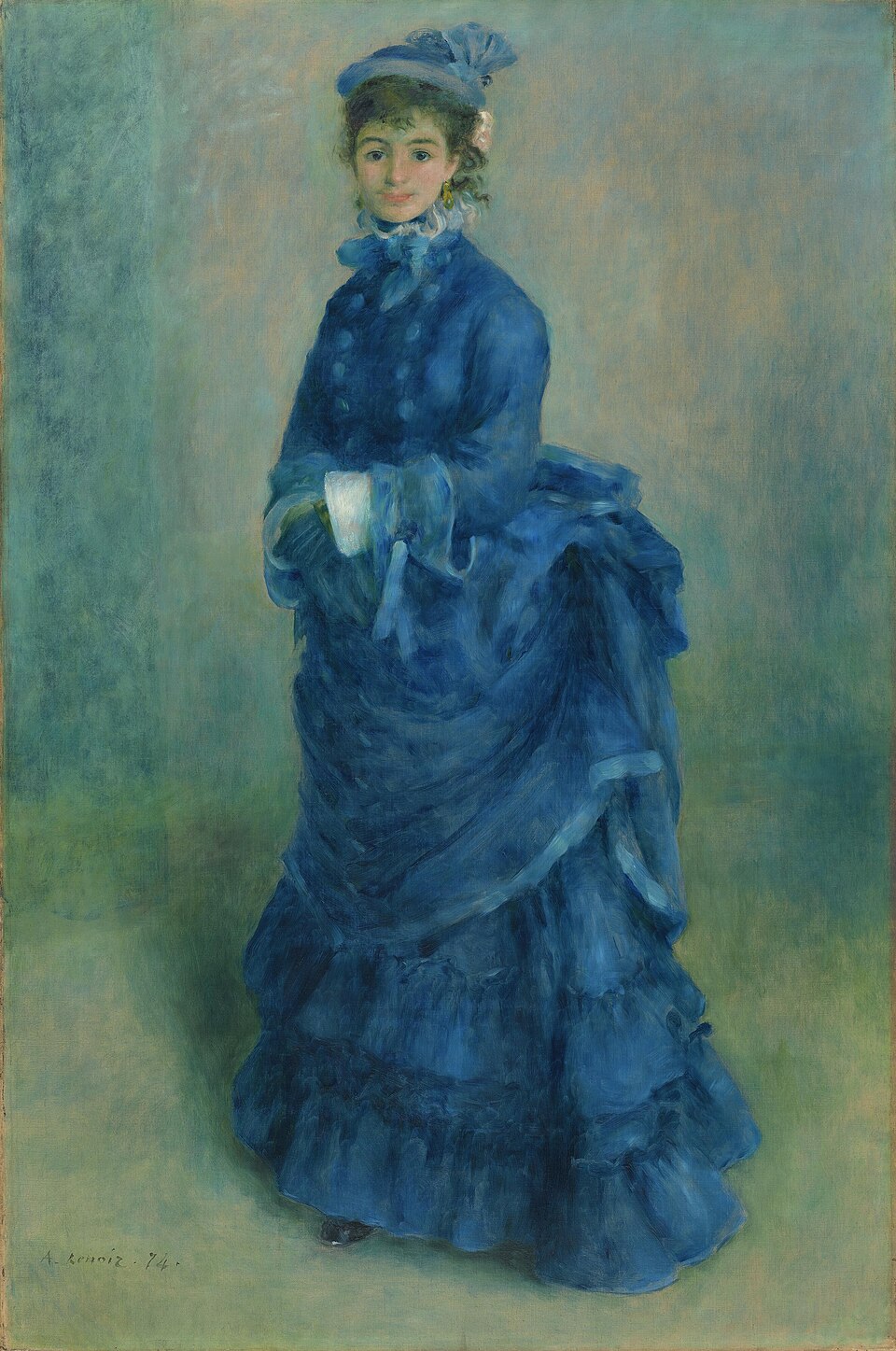
A sixteen-year-old in a deep blue dress pulls on her gloves and turns to look at us. Renoir showed her at the first Impressionist exhibition in 1874, and in Wales she is simply called The Blue Lady.
The story behind the painting
The model was Henriette Henriot, born in 1857, sixteen years old at the sitting and still unknown. She would later become an actress at the Théâtre de l'Odéon and in André Antoine's Théâtre Libre, and she posed for at least eleven other Renoir paintings, including La Source and The Page. Renoir completed the canvas in 1874, signed and dated it, and in April showed it with five other oils and a pastel at Nadar's studio, at the First Impressionist Exhibition, beside works by Monet, Cézanne, Pissarro and Sisley. It is large, 160 by 105.5 cm.
What to look for
Everything turns on the blue: a long layered dress of deep, striking blue, her face turned to us as she puts on her gloves. Renoir first painted a doorway at upper left and a curtain at upper right, then painted them out before the exhibition, so she floats in a neutral space of blue, mauve and yellow-grey. That background is thin and loosely brushed, while the figure is more detailed and layered. Look closely at the hair against the hat, the earrings and the upper eyelashes: these seem to have been added after the painting was varnished. And watch for the toe of her boot peeping out below the hem.
Meaning and intent
Reviews in 1874 were mixed, and many critics mentioned it only in passing; Ernest Chesneau called it a failure. Jean Prouvaire of Le Rappel saw the boot peeping out like a little black mouse, found her hat daringly coquettish, feared it was a portrait, called the smile false, yet admitted something naive about her and praised the dress as a heavenly blue. In 1898 the painter Paul Signac looked again and saw something else: pure intense blue that makes the skin look yellowish, with green reflections, colours interacting admirably. Simple, fresh and beautiful, he wrote, as if it had come straight from the studio.
Legacy
The painter and collector Henri Rouart bought it in 1874 and hung it in his home on the rue de Lisbonne, lending it in 1892 to an exhibition under the title La Dame en Bleu. After his death in 1912 it was bought jointly by Paul Durand-Ruel and the American dealers Knoedler, shown in London in 1913, and bought by the Welsh collector Gwendoline Davies. She bequeathed it to the National Museum Wales in 1952. Ann Sumner called it the most famous painting in the museum, and it hangs in gallery 16 in Cardiff, one of the most popular works there.
¿Sabías que…?
- Shown at the First Impressionist Exhibition in 1874.
- The model was Henriette Henriot, then sixteen.
- Renoir painted out a doorway and curtain behind her.
- Bequeathed by Gwendoline Davies to National Museum Wales in 1952.
Sobre el artista
Pierre-Auguste Renoir (1841-1919)
retrato · Amgueddfa Cymru - Museum Wales
Más obras de Pierre-Auguste Renoir
 Baile en el Moulin de la Galette - Pierre-Auguste Renoir (1876)
 El almuerzo de los remeros - Pierre-Auguste Renoir (1881)
 El columpio - Pierre-Auguste Renoir (1876)
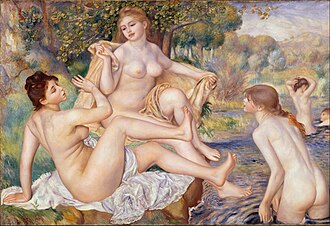 Las grandes bañistas - Pierre-Auguste Renoir (1884)
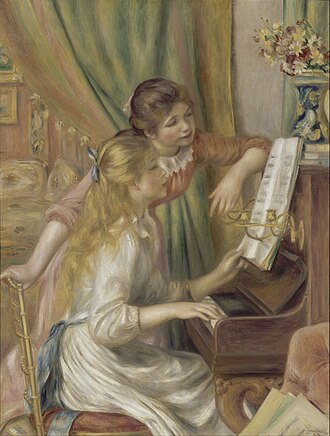 Muchachas al piano - Pierre-Auguste Renoir (1892)
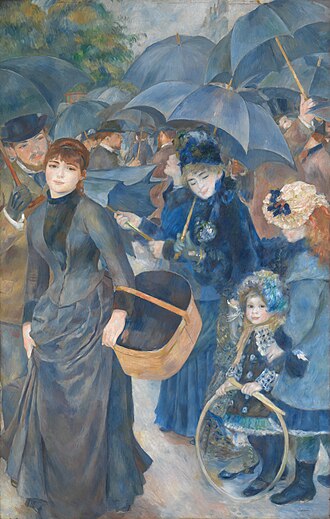 Los paraguas - Pierre-Auguste Renoir (1880s)
%20(46499625955).jpg) El palco - Pierre-Auguste Renoir (1874)
El palco - Pierre-Auguste Renoir (1874)%20-%201933.455%20-%20Art%20Institute%20of%20Chicago.jpg) En la terraza - Pierre-Auguste Renoir (1881)
En la terraza - Pierre-Auguste Renoir (1881)
Obras de artistas relacionados
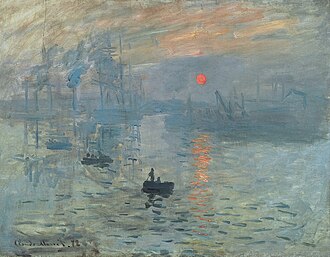 Impresión, sol naciente - Claude Monet (1872)
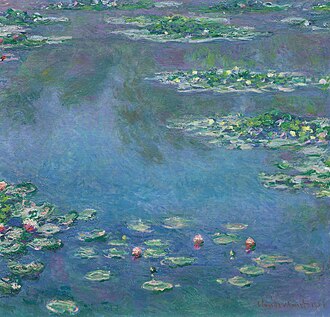 Nenúfares - Claude Monet (1906)
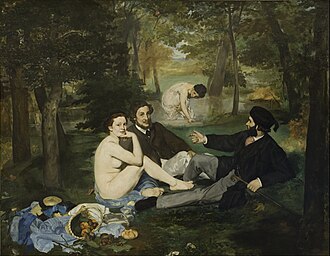 Almuerzo sobre la hierba - Édouard Manet (1863)
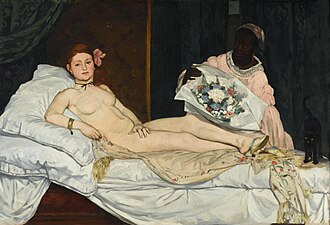 Olympia - Édouard Manet (1863)
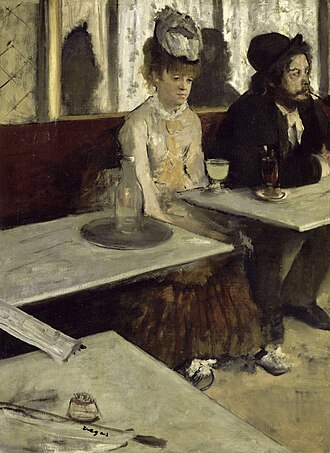 El ajenjo - Edgar Degas (1875)
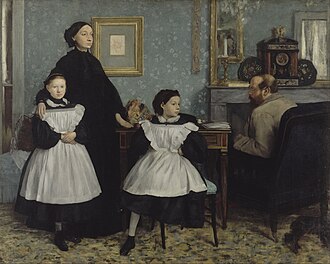 Die Bellelli Familie - Edgar Degas (1858)
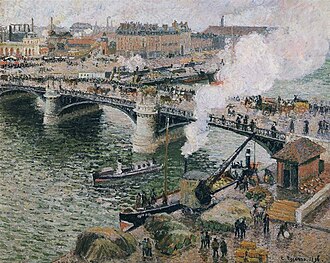 Pont Boieldieu in Rouen, Rainy Weather - Camille Pissarro (1896)
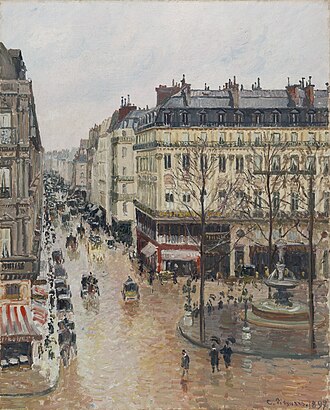 Rue Saint-Honoré por la tarde. Efecto de lluvia. - Camille Pissarro (1897)
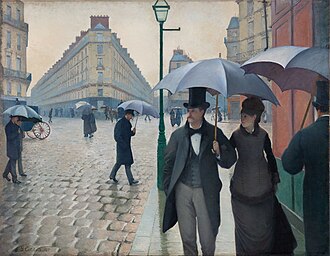 Calle de Paris, dia de lluvia - Gustave Caillebotte (1877)
 Los acuchilladores de parqué - Gustave Caillebotte (1875)
 Paseo a orillas del mar - Joaquín Sorolla (1909)
 Triste herencia - Joaquín Sorolla (1898)