La Chasse aux lions chez les Indiens
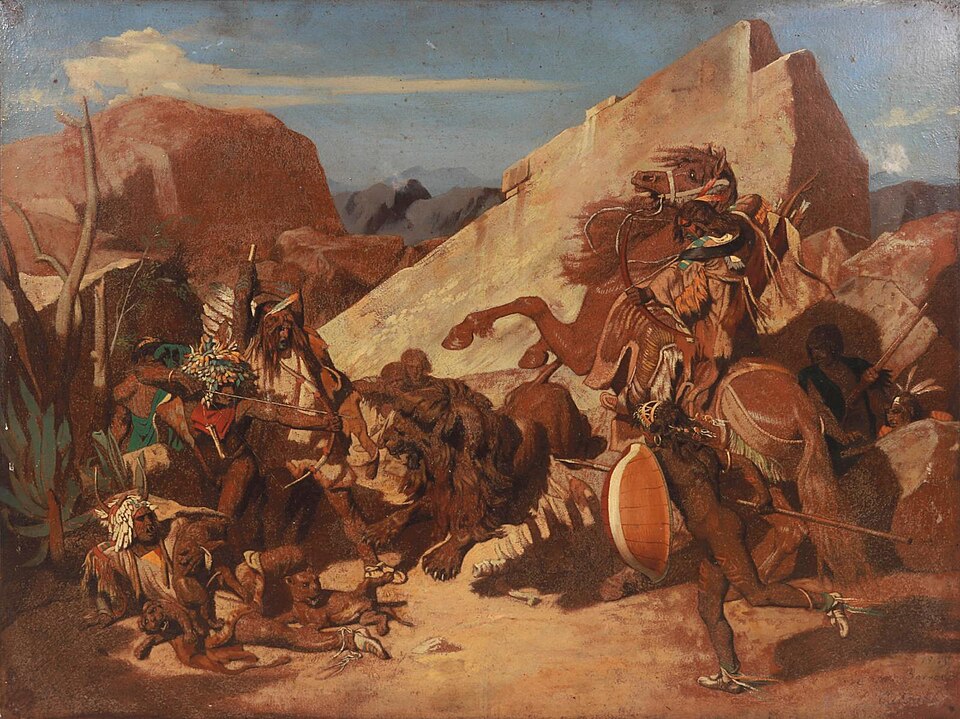
Native Americans hunting lions: a scene that never happened, painted by a young Gérôme in 1845. It was a gift to a friend from the studio, and it stayed in that friend's family for more than a century and a half.
The story behind the painting
In 1845 the American artist George Catlin arrived in Paris to show his Indian Gallery, today kept by the Smithsonian Institution. The French press welcomed it with enthusiasm, and many Romantic artists took an interest, the young Jean-Léon Gérôme among them. Among Catlin's dancers was an Iowa healer known as Si-non-ti-yah, who wore a ceremonial costume decorated with bison horns during the war dance. From this encounter came an imagined scene: a lion hunt by Native Americans, a hunt that is entirely fictional.
What to look for
Look at the lower left: the figure holding the lion cubs wears the horned ceremonial costume, the costume of Si-non-ti-yah. The whole composition is built as a pyramid, crossed by diagonals that convey the brutality of the scene. The work is oil on paper mounted on canvas, about 47.5 by 62.5 cm, a youthful piece. At the lower right Gérôme wrote a dedication to his friend, signed and dated 1845, and on the back another inscription calls the painting a souvenir of his comrade and friend.
Meaning and intent
Gérôme drew on three earlier works for this picture: Antoine-Louis Barye's lion and lioness fighting Bedouin horsemen over a wounded buffalo, Horace Vernet's lion hunt in the desert, and Charles Gleyre's Turkish and Arab horsemen. He borrowed their pyramid composition. So the painting mixes what Paris had just seen of Native American dance with the lion scenes French artists already loved. The lion was one of Gérôme's favourite subjects. He painted many big cats and even went so far as to own a real lion.
Legacy
The canvas was a gift from Gérôme to Jean-Baptiste Barrelon. The two men had met in Charles Gleyre's studio in Paris. Curiously, the dedication on the front reads Barreton, not Barrelon. The picture remained in the Barrelon family until 2021, when it was sold to a French collector, and it is in a private collection today. It offers a rare look at a famous painter before his fame, still sketching out his love of lions on a scene that he invented.
¿Sabías que…?
- Painted in 1845, oil on paper mounted on canvas.
- Inspired by George Catlin's Indian Gallery shown in Paris in 1845.
- A gift to Jean-Baptiste Barrelon, a friend from Gleyre's studio.
- In a private collection since 2021.
Sobre el artista
Jean-Léon Gérôme (1824-1904)
Más obras de Jean-Léon Gérôme
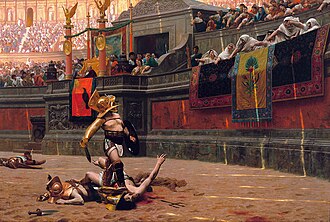 Pollice verso - Jean-Léon Gérôme (1872)
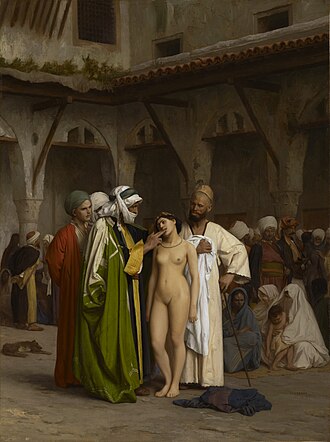 El mercado de esclavos - Jean-Léon Gérôme (1866)
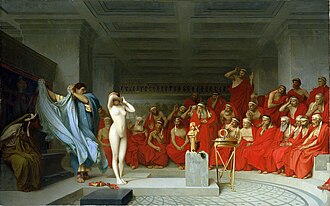 Friné frente al Areópago - Jean-Léon Gérôme (1861)
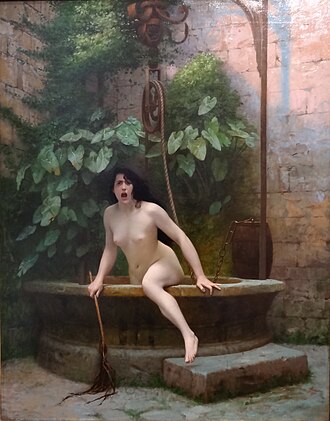 La verdad saliendo del pozo - Jean-Léon Gérôme (1896)
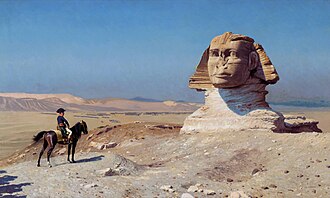 Bonaparte ante la Esfinge - Jean-Léon Gérôme (1867)
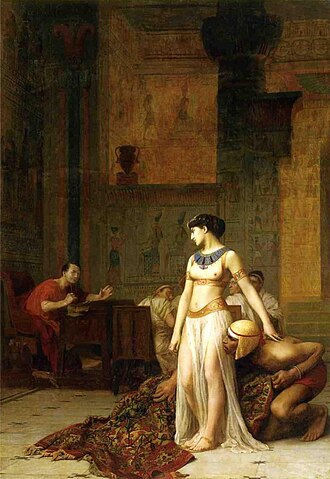 Cleopatra y César - Jean-Léon Gérôme (1866)
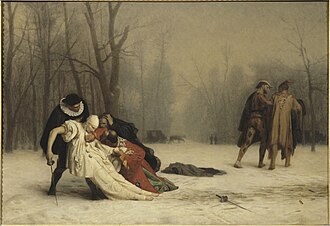 La salida del baile de máscaras - Jean-Léon Gérôme (1857)
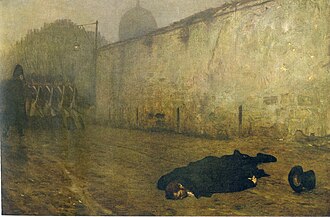 La Ejecución del mariscal Ney - Jean-Léon Gérôme (1868)
Obras de artistas relacionados
 Almuerzo sobre la hierba - Édouard Manet (1863)
 Olympia - Édouard Manet (1863)
 El origen del mundo - Gustave Courbet (1866)
 Entierro en Ornans - Gustave Courbet (2020)
 Clavel, lirio, lirio, rosa - John Singer Sargent (1885-1886)
 Retrato de Madame X - John Singer Sargent (1884)
 La Libertad guiando al pueblo - Eugène Delacroix (1830)
 La muerte de Sardanápalo - Eugène Delacroix (1827)
 La muerte de Sócrates - Jacques-Louis David (1787)
 Juramento de los Horacios - Jacques-Louis David (1784)
 Las hermanas Waldgrave - Joshua Reynolds (1780)
 Capitán George K. H. Coussmaker - Joshua Reynolds (1782)