Julieta y su aya
J. M. W. Turner · 1836
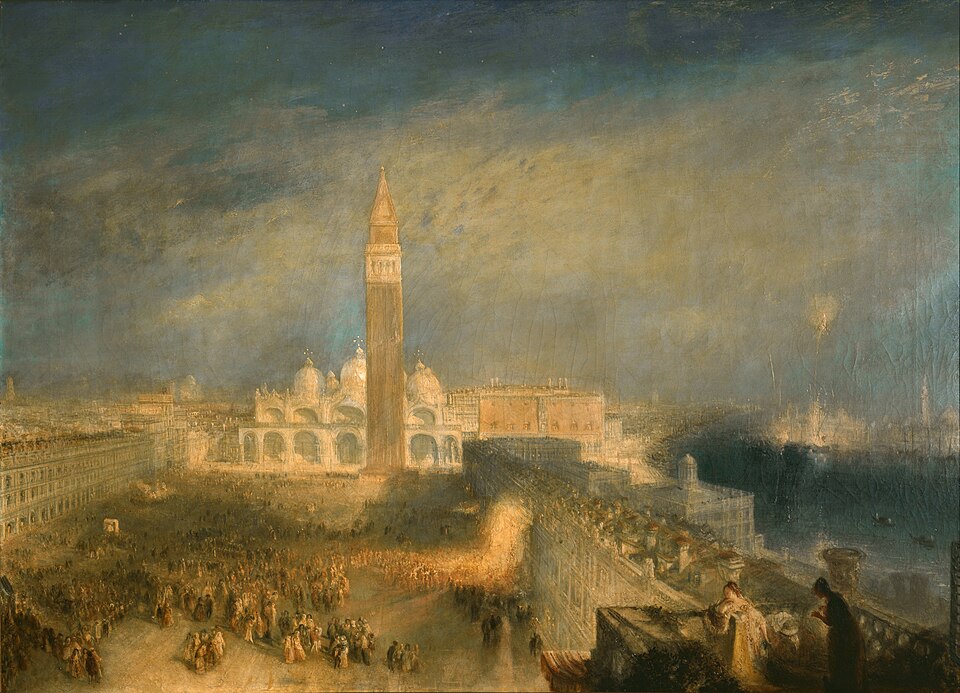
Fireworks burst over a crowded St Mark's Square at dusk, and on a balcony in the corner stand Juliet and her nurse, moved by Turner from Verona to Venice. Critics mocked it, and a young John Ruskin rose in black anger to defend it.
The story behind the painting
Turner painted Juliet and her Nurse in 1836. He had first visited Venice in 1819 and returned in 1833, when he seems to have taken a room with rooftop views. The picture looks east over St Mark's Square from a high viewpoint, with St Mark's Campanile dominating the scene. Shakespeare set Romeo and Juliet in Verona, but Turner placed two of its characters, Juliet and her nurse, on a balcony in Venice instead, an incongruous choice that his critics did not forgive.
What to look for
Venice is seen at dusk. A crowd of Venetians fills the square below to watch fireworks exploding against a blue and yellow sky. The Campanile rises through the glow. Look to the lower right corner for the two small figures on the balcony: Juliet and her nurse, watching the city. The forms dissolve into light and colour, which is exactly what upset critics at the time. The Washington Post critic Paul Richard later called it one of Turner's poetic, visionary, cataclysmic pictures.
Meaning and intent
Shown at the Royal Academy in 1836, the painting was attacked for its abstract elements. The Times said it defied the laws of perspective, both lineal and aerial. The Literary Gazette mocked the two figures, perched like sparrows on a house-top. John Eagles in Blackwood's Magazine called it a strange jumble. That review stirred in John Ruskin, in his words, black anger, and he wrote a defence: Turner was an exception to all rules, a painter who thinks and feels in colour and cannot help doing so.
Legacy
In 1842 George Hollis engraved the picture under the title St Mark's Place, Venice. The Whitney family owned it from 1901 until 1980, when Flora Whitney Miller, honorary chairman of the Whitney Museum of American Art, sold it at auction. At that time it became the most expensive work of art ever sold at auction. The buyer was the Argentine heiress Amalia Lacroze de Fortabat, and since 2008 it has hung in the AMALITA Collection in Buenos Aires, the museum created for her collection.
¿Sabías que…?
- Painted by Turner in 1836, after visits to Venice in 1819 and 1833.
- Shows Shakespeare's Juliet in Venice, not Verona.
- Its harsh reviews prompted John Ruskin to defend Turner.
- In the AMALITA Collection, Buenos Aires, since 2008.
Sobre el artista
J. M. W. Turner (1775-1851)
Más obras de J. M. W. Turner
 El Temerario remolcado - J. M. W. Turner (1839)
 Lluvia, vapor y velocidad. El gran ferrocarril del Oeste - J. M. W. Turner (1844)
 The Slave Ship - J. M. W. Turner (1840)
 Dido building Carthage - J. M. W. Turner (1815)
 La Batalla de Trafalgar - J. M. W. Turner (1820s)
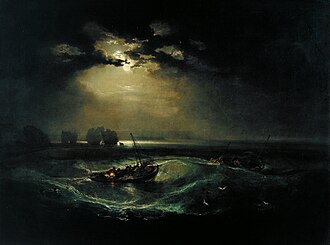 Fishermen at Sea - J. M. W. Turner (1796)
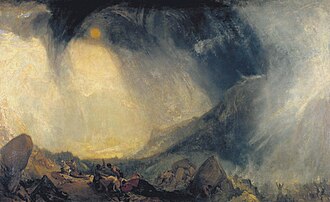 Aníbal cruzando los Alpes - J. M. W. Turner (1812)
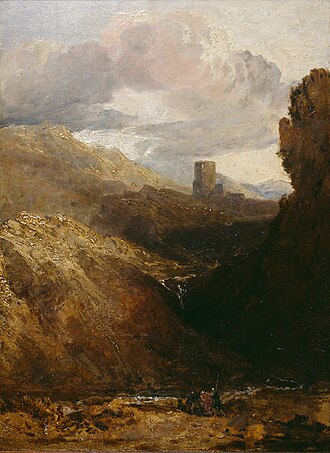 Castillo Dolbadarn - J. M. W. Turner (1800)
Obras de artistas relacionados
 Las hermanas Waldgrave - Joshua Reynolds (1780)
 Capitán George K. H. Coussmaker - Joshua Reynolds (1782)
 Impresión, sol naciente - Claude Monet (1872)
 Nenúfares - Claude Monet (1906)
 El tres de mayo de 1808 - Francisco Goya (1814)
 La Maja desnuda - Francisco Goya (1800)
 El caminante sobre el mar de nubes - Caspar David Friedrich (c. 1818)
 Abadía en el robledal - Caspar David Friedrich (1800s)
 La Libertad guiando al pueblo - Eugène Delacroix (1830)
 La muerte de Sardanápalo - Eugène Delacroix (1827)
 El joven azul - Thomas Gainsborough (1770)
 El Señor y la Señora Andrews - Thomas Gainsborough (1748)