Tumba de Hutten
Caspar David Friedrich · 1823
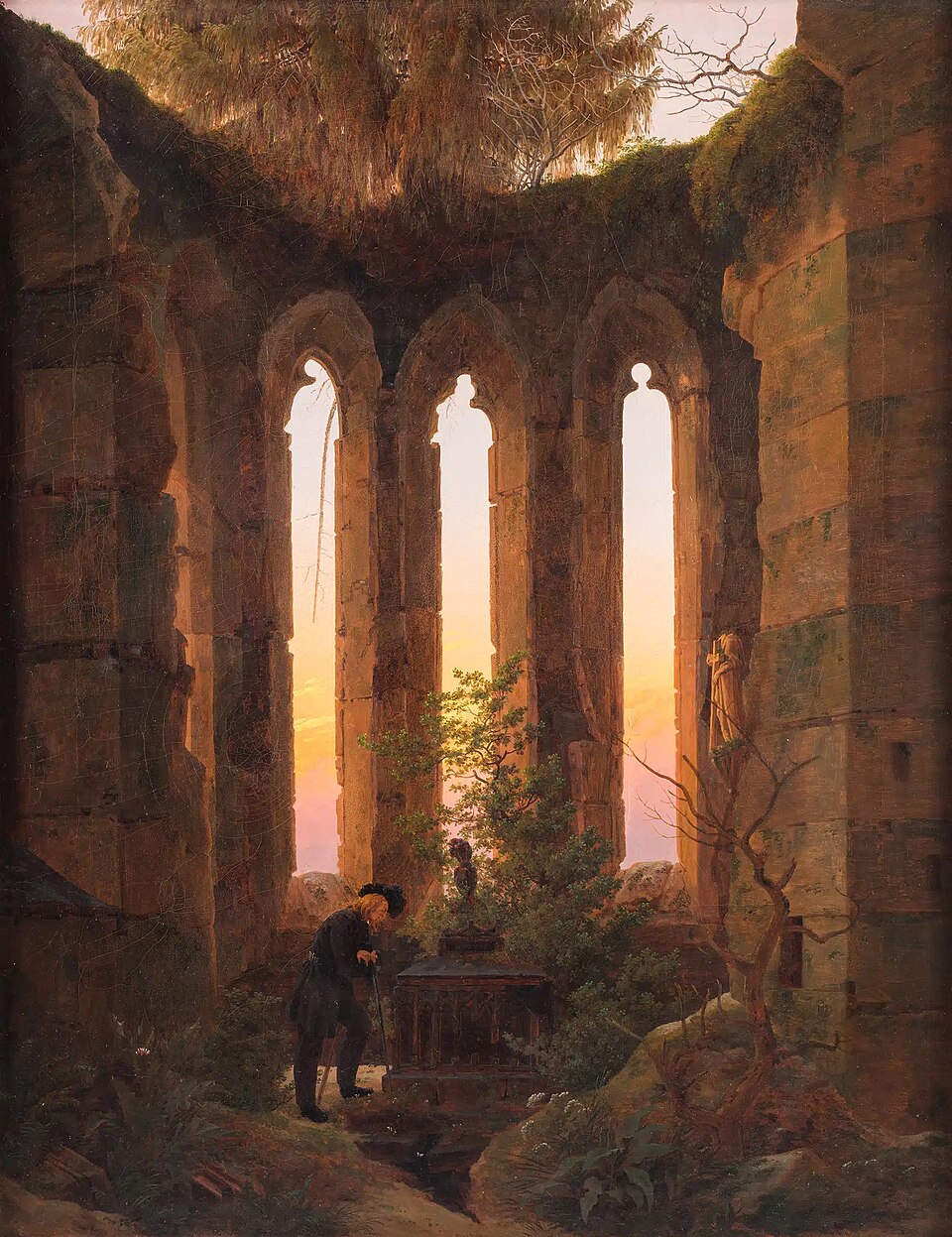
A man in old German dress stands in a ruined church before a tomb carved with the names of persecuted patriots. Friedrich's most political painting is a silent protest against a time that silenced free ideas.
The story behind the painting
After Napoleon's defeat at Leipzig in 1813, ideas of German unity and nationalism grew, especially in the universities. These ideas troubled the rulers and the order set up by the Congress of Vienna, and in 1819 the Carlsbad Decrees severely limited free speech and banned the teaching of liberal ideas. Friedrich saw this as a betrayal of those who had fought Napoleon, and wanted a painting that would honour liberal ideas and stand as a monument to those who died for them. In 1823 he painted Hutten's Grave, marking 300 years since the death of the humanist Ulrich von Hutten.
What to look for
The setting is a Gothic ruin based on a monastery at Oybin, a place Friedrich had painted before in Ruins at Oybin. A man in altdeutsch, old German, dress stands by the tomb; viewers then recognised that style as anti-French and linked to the Lützow Free Corps. He is only half turned, so we see his face. Read the names on the tomb: Jahn 1813, Arndt 1813, Stein 1813, Görres 1821, and Scharnhorst. Behind him stands a headless statue of Faith, and in the foreground a dead tree. The lancet windows have been read as outlines of saints watching over the man and the grave.
Meaning and intent
Friedrich ties past and present together. Hutten, a contemporary of Martin Luther, was a German nationalist, values close to Friedrich, a devout Lutheran who wanted German unity. The names on the tomb belong to nationalist thinkers of his own day: Scharnhorst died in the wars, the others faced persecution or exile. The headless Faith may mourn, or suggest the waning of religion. Some scholars see the broken interior as the old Catholic order and the open world outside as Lutheran freedom and hope. Joseph Koerner calls the man's stance a missed encounter with history, a future only imagined.
Legacy
When the painting was first sold in 1826, all the proceeds went to support the Greek War of Independence, and it was bought by Karl August, Duke of Saxe-Weimar. It belongs today to the Klassik Stiftung Weimar and hangs in the Schlossmuseum in the Weimar city palace. Its story has a dark later chapter: the Nazis co-opted this and other works by Friedrich on German heritage to promote their ideology, stressing nationalism, unification and sacrifice. That association tainted his reputation, and decades of scholarship were needed to restore it. Seen today, the painting speaks again of freedom of thought.
¿Sabías que…?
- Painted in 1823 for the 300th anniversary of Ulrich von Hutten's death.
- The tomb bears the names Jahn, Arndt, Stein, Görres and Scharnhorst.
- Proceeds of its 1826 sale went to the Greek War of Independence.
- Now in the Schlossmuseum, Weimar (Klassik Stiftung Weimar).
Sobre el artista
Caspar David Friedrich (1774-1840)
Más obras de Caspar David Friedrich
 El caminante sobre el mar de nubes - Caspar David Friedrich (c. 1818)
 Abadía en el robledal - Caspar David Friedrich (1800s)
 El mar de hielo - Caspar David Friedrich (1820s)
 Acantilados blancos en Rügen - Caspar David Friedrich (1818)
 Monje a la orilla del mar - Caspar David Friedrich (1808)
 Las etapas de la vida - Caspar David Friedrich (1834)
 Dos hombres contemplando la luna - Caspar David Friedrich (1810s)
 Arco iris en un paisaje de montañas - Caspar David Friedrich (1809)
Obras de artistas relacionados
 El tres de mayo de 1808 - Francisco Goya (1814)
 La Maja desnuda - Francisco Goya (1800)
 La Libertad guiando al pueblo - Eugène Delacroix (1830)
 La muerte de Sardanápalo - Eugène Delacroix (1827)
 El Temerario remolcado - J. M. W. Turner (1839)
 Lluvia, vapor y velocidad. El gran ferrocarril del Oeste - J. M. W. Turner (1844)
 El joven azul - Thomas Gainsborough (1770)
 El Señor y la Señora Andrews - Thomas Gainsborough (1748)