Grace Hoops
Winslow Homer · 1872
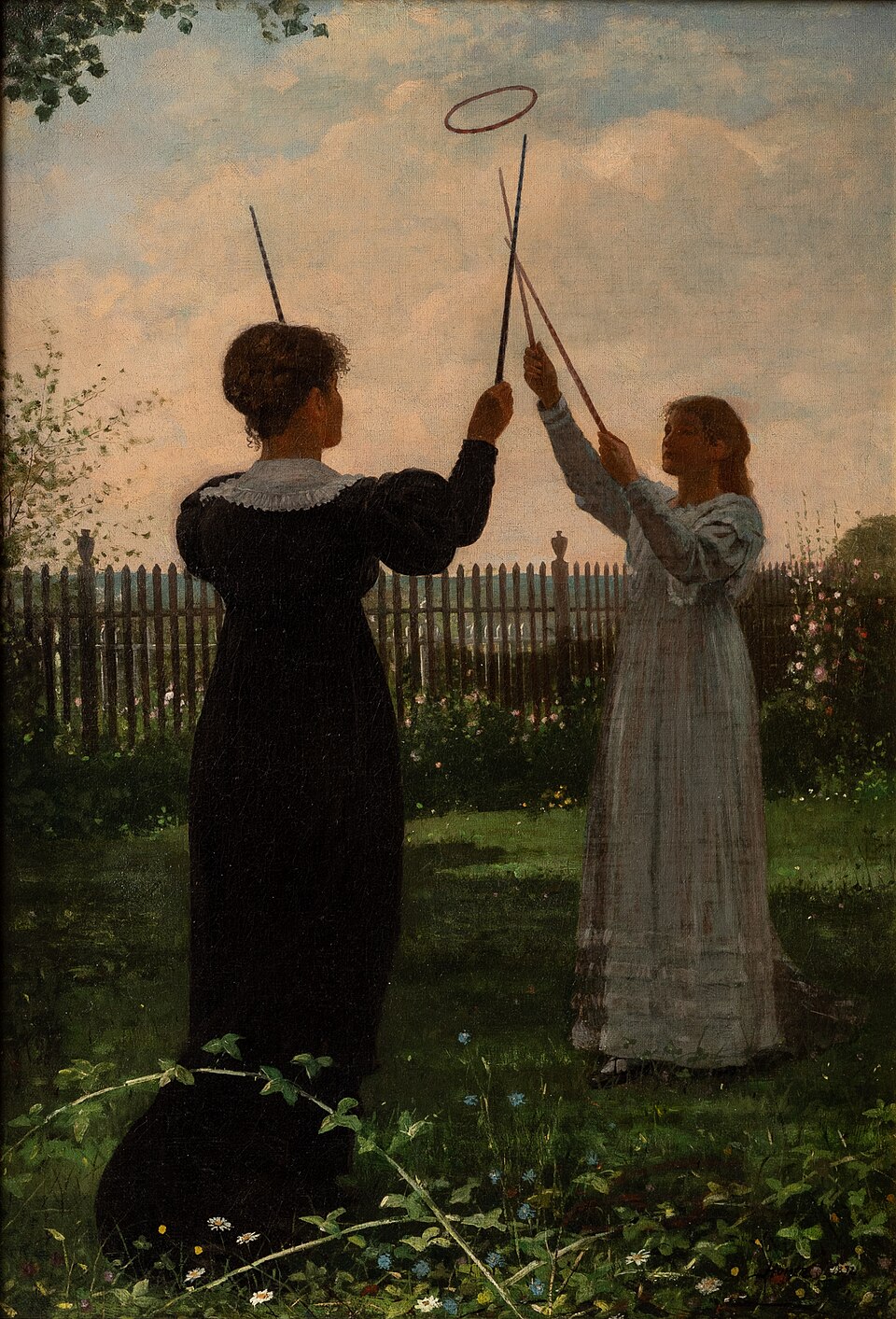
Two young women stand on tiptoe in a summer garden, chins up, watching a striped hoop fly between them. Winslow Homer froze the instant in 1872, and one critic said they had neither hoops nor grace.
The story behind the painting
In the 1870s Winslow Homer was at a turning point. Free of his Civil War work as an artist-reporter, he was focusing on painting. He had spent 1867 to 1868 in Paris, where he took an interest in peasant life and is thought to have come to appreciate loose brushwork and outdoor light. Back in a New York studio, still working as a magazine illustrator, he went through an experimental period in his thirties, painting childhood and women. Grace Hoops belongs to that series, very different from his later sea scenes. The woman in black is thought to be Grace Barret Valentine, who posed for several of his 1872 pictures.
What to look for
The game of graces came from 19th-century France and was meant to teach girls of good families to move gracefully. The sticks are held straight to catch the hoop and crossed like scissors to throw it. Here the girl in black holds blue and white sticks, the girl in white red and white ones, and the red and white hoop hangs in mid-air. A wooden fence closes the garden. Ground-ivy and daisies fill the foreground, with flowering bushes and pinkish hollyhocks behind, under bright white clouds. Note the balloon sleeves and high waists, and the lack of hats, which suggests the two are close friends.
Meaning and intent
Homer's interest in childhood was shared by artists and writers after the Civil War. In 1869 his friend Eugene Benson, writing in Appletons' Journal, called childhood in literature a special and individual presence, not an accidental one. Grace Hoops has been described as a meditation on the move from childhood to adulthood. Both girls look focused, arms bent and raised, poised in the pose the game was meant to train. One art historian suggested the painting might also be Homer reflecting on his own position as an adult at the end of his youth.
Legacy
Critics were divided. One praised a spirited picture, while the New York Daily Tribune mocked it as unworthy of Homer, saying the ladies had no hoops and certainly no grace. A looser study with the same title survives, with no fence, few flowers and a girl in pink with a blue shawl instead of white. The painting was first owned by Henry T. Chapman and sold at Leavitt's auction house to Lawson Valentine in May 1875. It was shown in Chicago, at the Museum of Fine Arts, Boston in 1944, in San Francisco in 1964 and at the Whitney in 1973, and is now at Boston College's McMullen Museum.
¿Sabías que…?
- Painted in 1872, during Homer's experimental period of women and childhood.
- Shows the French game of graces.
- The woman in black is thought to be Grace Barret Valentine.
- Now in the McMullen Museum of Art, Boston College.
Sobre el artista
Winslow Homer (1836-1910)
Más obras de Winslow Homer
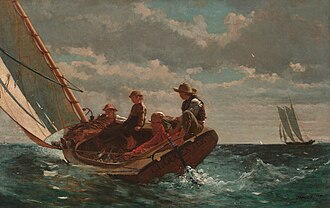 Breezing Up - Winslow Homer (1873)
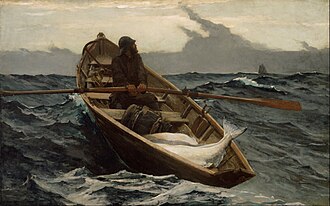 The Fog Warning - Winslow Homer (1885)
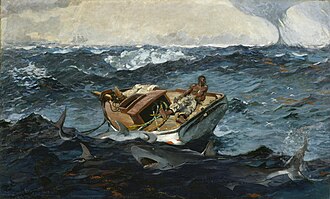 The Gulf Stream - Winslow Homer (1899)
 Fox Hunt - Winslow Homer (1893)
 The Cotton Pickers - Winslow Homer (1876)
 A Visit from the Old Mistress - Winslow Homer (1876)
 Eight Bells - Winslow Homer (1886)
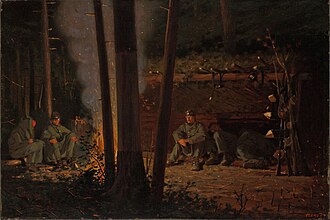 In Front of Yorktown - Winslow Homer (1860s)
Obras de artistas relacionados
 El origen del mundo - Gustave Courbet (1866)
 Entierro en Ornans - Gustave Courbet (2020)
 Almuerzo sobre la hierba - Édouard Manet (1863)
 Olympia - Édouard Manet (1863)
 La noche estrellada - Vincent van Gogh (1889)
 Terraza de café por la noche - Vincent van Gogh (1888)