In Front of Yorktown
Winslow Homer · 1860s
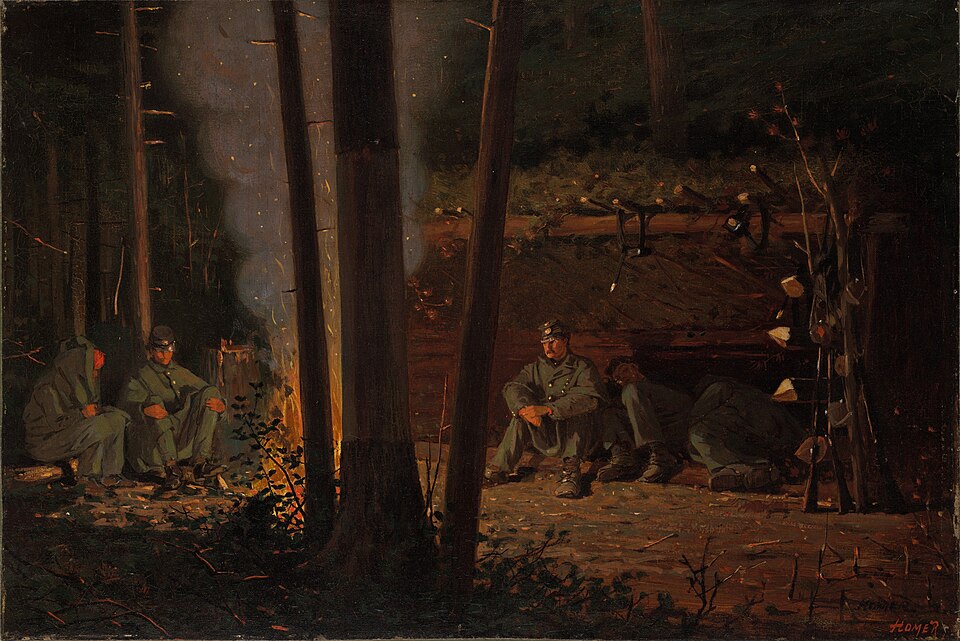
Soldiers huddle in the dark by a lean-to, staring into a fire whose sparks light up the night. There is no battle here, only waiting. Winslow Homer painted it in 1863, already knowing how the campaign had ended.
The story behind the painting
Winslow Homer began as an artist reporter for Harper's Weekly in 1861 and rose to prominence there during the American Civil War, known for a factual approach that seemed simply to observe soldiers in camp, on the march or in combat. In 1863 he began to make fully realised studio paintings, and In Front of Yorktown is one of the first. It shows men of General McClellan's Army of the Potomac before the Siege of Yorktown and the Peninsula Campaign, which ended in defeat for the Union, something Homer knew when he painted it.
What to look for
Much Civil War art shows soldiers fighting at the front. Here they gather in camp, seemingly regrouping. As the art historians Lucretia Hoover Giese and Roy Perkinson write, the soldiers wait, huddled together or alone, bivouacked before a lean-to, trying to sleep or staring at a fire whose flames and sparks light up the darkness. Officers and soldiers sit on opposite sides of the canvas, and only one face, an officer's, can be read clearly. The canvas is small, about 33.6 by 49.6 cm.
Meaning and intent
Helen Cooper describes the work as a landscape with elements of journalistic realism, and Marc Simpson notes that a night scene is technically hard, an impressive choice so early in Homer's career. Some scholars see the painting as a meditation on the uncertainty of war. Peter Carmichael asks what occupies the officer: a dream of home, the two soldiers in clean uniforms who are new to war, or the weight of leading men to the front. Others stress loneliness, waiting and misery, the blank faces showing anxiety and deep fatigue.
Legacy
In Front of Yorktown marks the moment Homer moved from illustration to painting, carrying with him the reporter's habit of watching ordinary moments of soldiers' lives rather than staging heroics. Instead of victory or glory, he chose a fire in the dark and men who cannot know what comes next. The painting is now in the collection of the Yale University Art Gallery in New Haven, where it continues to show the quiet side of a war usually remembered through its battles.
¿Sabías que…?
- Completed in 1863, one of Homer's first paintings.
- Shows the Army of the Potomac before the Siege of Yorktown.
- A night scene of waiting, not of battle.
- In the Yale University Art Gallery.
Sobre el artista
Winslow Homer (1836-1910)
Galería de Arte de la Universidad Yale
Más obras de Winslow Homer
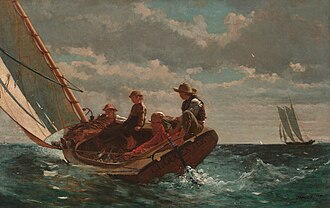 Breezing Up - Winslow Homer (1873)
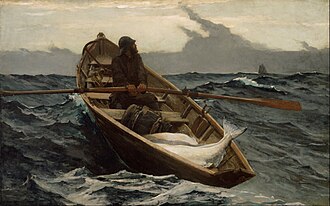 The Fog Warning - Winslow Homer (1885)
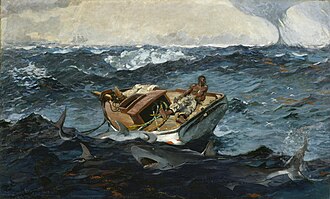 The Gulf Stream - Winslow Homer (1899)
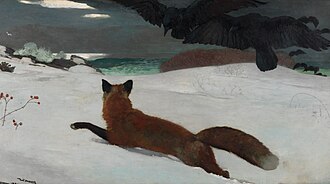 Fox Hunt - Winslow Homer (1893)
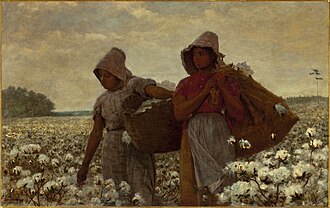 The Cotton Pickers - Winslow Homer (1876)
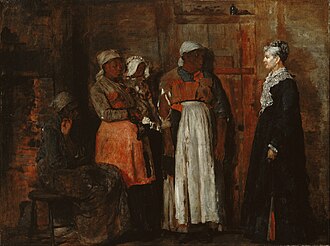 A Visit from the Old Mistress - Winslow Homer (1876)
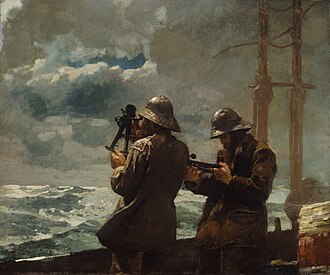 Eight Bells - Winslow Homer (1886)
 Right and Left - Winslow Homer (1909)
Obras de artistas relacionados
 El origen del mundo - Gustave Courbet (1866)
 Entierro en Ornans - Gustave Courbet (2020)
 Almuerzo sobre la hierba - Édouard Manet (1863)
 Olympia - Édouard Manet (1863)
 La noche estrellada - Vincent van Gogh (1889)
 Terraza de café por la noche - Vincent van Gogh (1888)