Glaçons à Bougival
Claude Monet · 1860s
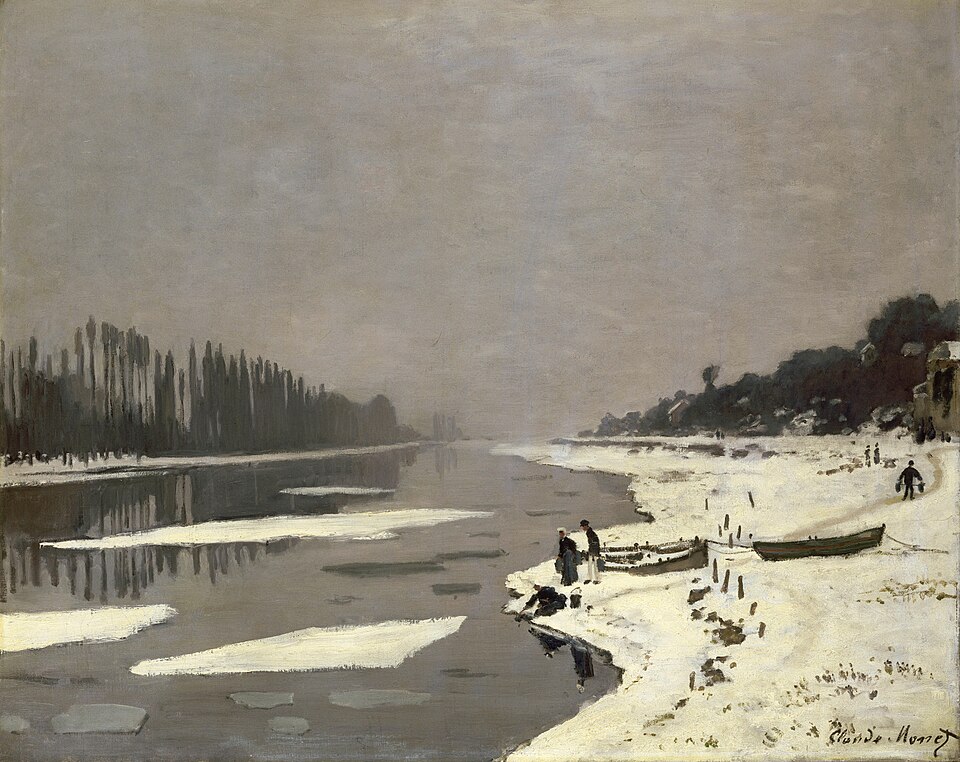
The Seine lies frozen under a grey mist, almost without colour. Monet painted it in the harsh winter of 1867 to 1868, when he was rejected, short of money and about to become a father.
The story behind the painting
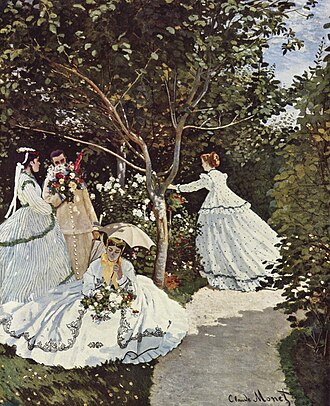
In 1866 Monet had success at the Salon with Woman in a Green Dress, and he pinned great hopes on Women in the Garden for 1867, the year of a World's Fair in Paris. The jury refused it. His son Jean was born, Camille's health was fragile, and money ran out; Monet pressed his friend Bazille so hard for funds that their friendship suffered. The winter of 1867 to 1868 was especially harsh and the Seine froze in places. Before leaving for Le Havre to seek shelter with his family, he went to Bougival.
What to look for
Monet looks upstream, with the island of Croissy on the left. It is the first time he painted the frozen Seine. A gradient of mist and an almost total absence of colour deepen the winter mood. Look at the two different techniques: the banks are painted precisely, with a sense of activity, while the river and the background are laid in with broad strokes that suggest stillness. The canvas measures about 65 by 81 cm. The French Wikipedia article dates it to the winter of 1867 to 1868.
Meaning and intent
Monet, who usually worked with a varied palette, comes close here to the style of James Whistler, whose nearly monochrome views of the Thames were shown in Paris during the 1867 World's Fair; Monet was living in Paris then and may have seen them. Whistler's The Thames in Ice was also selected for that year's Salon. The source describes the picture as a search for unity through sobriety. Painted in a time of hardship, it turns cold and scarcity into a quiet, almost silent landscape.
Legacy
The winter of 1889 to 1890 would give Monet another chance to paint similar views. This canvas passed through private collections before it was given to the French state in 1961, and it is shown at the Louvre. It has travelled to several exhibitions in France and Japan, including Turner, Whistler, Monet at the Grand Palais in 2004 to 2005, which set the styles of the three painters side by side, the very conversation this frozen river had begun.
¿Sabías que…?
- Painted in the winter of 1867-1868 at Bougival.
- Monet's first painting of the frozen Seine.
- Its near-monochrome style echoes Whistler's Thames views.
- Given to the French state in 1961; held at the Louvre.
Sobre el artista
Claude Monet (1840-1926)
pintura del paisaje · Departamento de Pinturas del Museo del Louvre · paisaje · Sena · barca · invierno · hielo · Bougival
Más obras de Claude Monet
 Impresión, sol naciente - Claude Monet (1872)
 Nenúfares - Claude Monet (1906)
 Mujer con sombrilla - Claude Monet (1875)
 La terraza de Sainte-Adresse - Claude Monet (1867)
 Mujeres en el jardín - Claude Monet (1866)
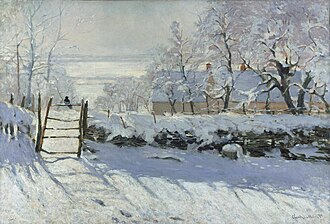 La urraca - Claude Monet (1868)
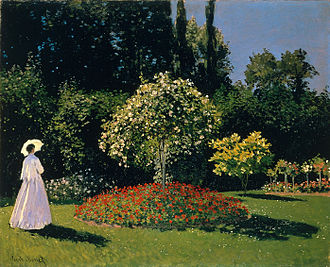 Mujer en el jardín - Claude Monet (1867)
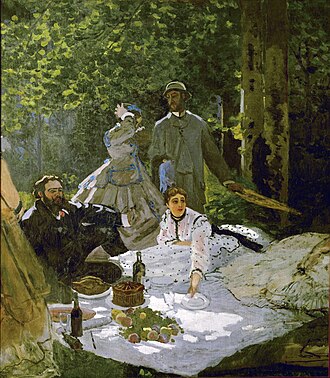 El almuerzo sobre la hierba - Claude Monet (1866)
Obras de artistas relacionados
 El Temerario remolcado - J. M. W. Turner (1839)
 Lluvia, vapor y velocidad. El gran ferrocarril del Oeste - J. M. W. Turner (1844)
 El origen del mundo - Gustave Courbet (1866)
 Entierro en Ornans - Gustave Courbet (2020)
 Almuerzo sobre la hierba - Édouard Manet (1863)
 Olympia - Édouard Manet (1863)
 Baile en el Moulin de la Galette - Pierre-Auguste Renoir (1876)
 El almuerzo de los remeros - Pierre-Auguste Renoir (1881)
 La cuna - Berthe Morisot (1872)
 Summer's Day - Berthe Morisot (1879)
 El ajenjo - Edgar Degas (1875)
 Die Bellelli Familie - Edgar Degas (1858)