Camille Monet on a Garden Bench
Claude Monet · 1873
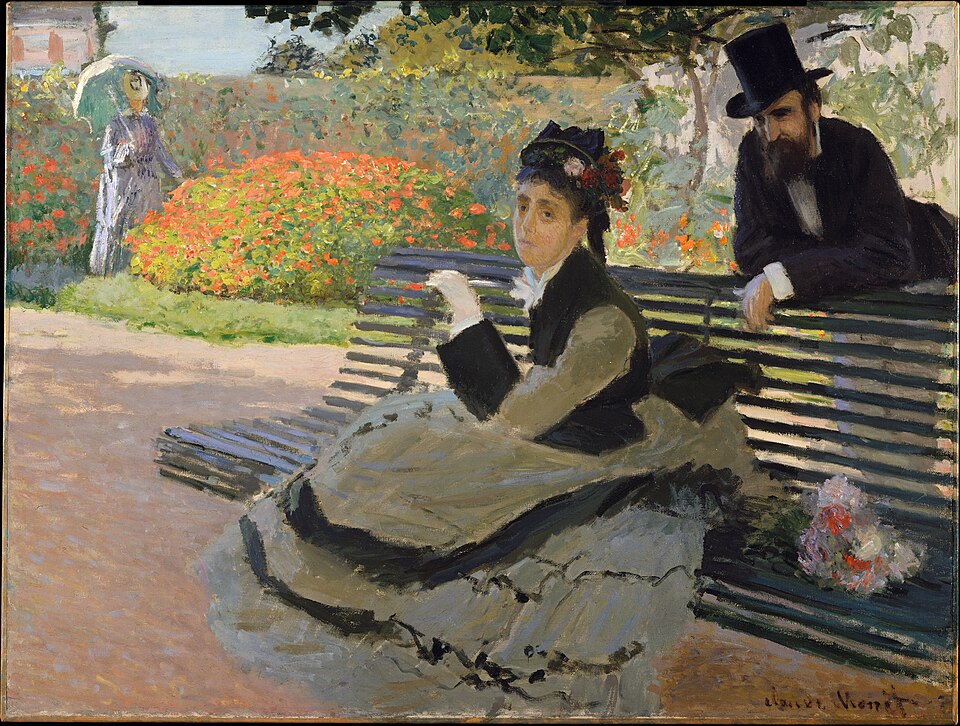
In a sunny garden at Argenteuil, Camille Monet sits on a bench holding a letter. In September 1873 she had learned that her father was dead, and this is the rare Monet garden scene that feels heavy with grief.
The story behind the painting
Monet painted this canvas in 1873. Since the end of 1871 he had lived in Argenteuil with his wife, Camille Doncieux, and their son Jean, then four years old, in a house with a garden that appears in many of his paintings. Usually that garden is bucolic and bright. But in September 1873 Camille learned that her father had died, and in her left hand she holds the letter with the news, suggested by a single horizontal stroke of white. The painting is also known simply as Le Banc, The Bench.
What to look for
The oil painting measures 60.6 by 80.3 cm and is signed Claude Monet, without a date, at lower right. Three people share the garden, but only one can be clearly identified: Camille, seated on the bench, whom Monet painted many times. Behind her stands a man in black with a top hat, leaning toward her. Further back a woman with a parasol looks at the red flowers, though she could just as well be turning toward the main figures. Look at Camille's hand and the small white mark of the letter, and at how the bright flowers surround a quiet, downcast moment.
Meaning and intent
The man has been read in different ways: as an admirer, as the messenger of death, or even as death itself. Monet himself was more prosaic. In a letter of 7 June 1921 to George Durand-Ruel, son and successor of his dealer, he wrote that the man was a neighbour, whose name we still do not know. Nothing is known of the woman with the parasol. What remains is the contrast that makes the picture unusual among Monet's Argenteuil works: a sunlit garden painted with the mood of a sorrowful day.
Legacy
The painting was with the Berlin dealers Bruno and Paul Cassirer until 1900, then belonged to the entrepreneur and patron Eduard Arnhold and his family. It was shown at the seventh Berlin Secession exhibition in 1903 as Auf der Bank. Around 1947 it was in Basel and then reached the United States, passing through several collectors, sometimes under the title In a Park. Walter and Leonore Annenberg acquired it, and after Walter Annenberg's death in 2002 it was given to the Metropolitan Museum of Art in New York, where it was shown in Impressionism, Fashion and Modernity in 2013.
¿Sabías que…?
- Painted in 1873 in Monet's garden at Argenteuil.
- Camille holds a letter announcing her father's death.
- Monet wrote in 1921 that the man in black was a neighbour.
- In the Metropolitan Museum of Art since 2002.
Sobre el artista
Claude Monet (1840-1926)
mujer · varón · impresionismo · Museo Metropolitano de Arte · jardín · banco
Más obras de Claude Monet
 Impresión, sol naciente - Claude Monet (1872)
 Nenúfares - Claude Monet (1906)
 Mujer con sombrilla - Claude Monet (1875)
 La terraza de Sainte-Adresse - Claude Monet (1867)
 Mujeres en el jardín - Claude Monet (1866)
 La urraca - Claude Monet (1868)
 Mujer en el jardín - Claude Monet (1867)
 El almuerzo sobre la hierba - Claude Monet (1866)
Obras de artistas relacionados
 El Temerario remolcado - J. M. W. Turner (1839)
 Lluvia, vapor y velocidad. El gran ferrocarril del Oeste - J. M. W. Turner (1844)
 El origen del mundo - Gustave Courbet (1866)
 Entierro en Ornans - Gustave Courbet (2020)
 Almuerzo sobre la hierba - Édouard Manet (1863)
 Olympia - Édouard Manet (1863)
 Baile en el Moulin de la Galette - Pierre-Auguste Renoir (1876)
 El almuerzo de los remeros - Pierre-Auguste Renoir (1881)
 La noche estrellada - Vincent van Gogh (1889)
.jpg) Terraza de café por la noche - Vincent van Gogh (1888)
Terraza de café por la noche - Vincent van Gogh (1888) ¿De dónde venimos? ¿Qué somos? ¿Adónde vamos? - Paul Gauguin (1897-1898)
%201889.jpg) El Cristo amarillo - Paul Gauguin (1889)
El Cristo amarillo - Paul Gauguin (1889)