Botzaris
Jean-Léon Gérôme · 1874
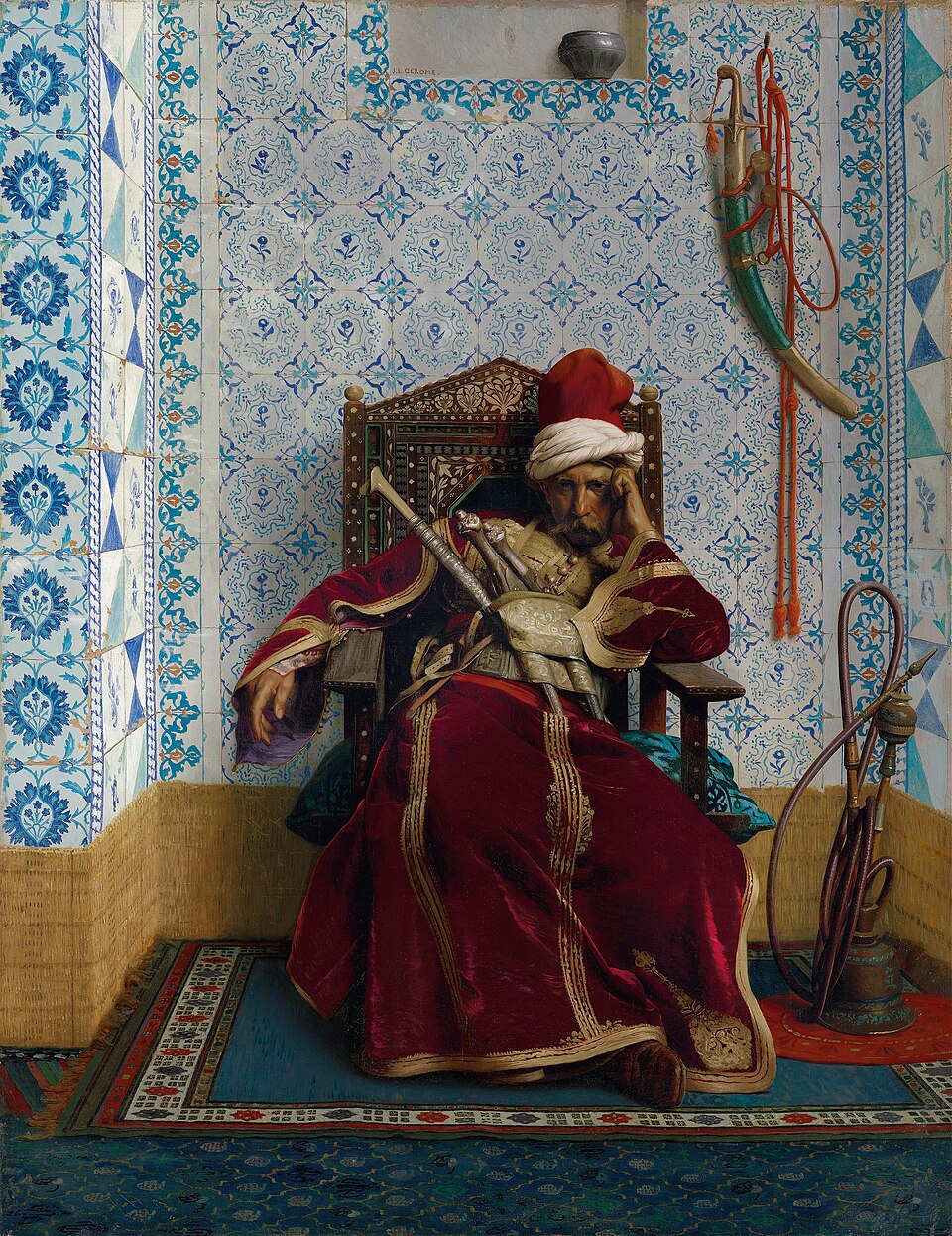
A Greek hero sits slumped in a wooden chair, lost in thought, half his face in shadow. Gérôme never saw Markos Botsaris, who died a year before the painter was born, yet this is his only known portrait of a historical figure.
The story behind the painting
Markos Botsaris is one of the most famous heroes of the Greek War of Independence against the Ottoman Empire. In 1823, leading a few hundred Souliote fighters, he launched a surprise night attack on an Ottoman force of about 3,000 men near Karpenisi, during the siege of Missolonghi. The assault inflicted heavy losses, but Botsaris was mortally wounded. He was buried with honours at Missolonghi and became a national hero; the diplomat François Pouqueville wrote that all Greece saw in him a second Leonidas. Gérôme painted him in 1874.
What to look for
The vertical canvas, 70.2 by 54.6 cm, shows Botsaris seated, slightly slumped in a wooden armchair, in a meditative pose. A carpet crosses the main horizontal plane, setting the hero back in a clearly marked space, like a stage. Iznik tiles and other objects structure the room, but the eye goes to his expression and posture. A sharp light cuts across the picture and plunges part of the face into shadow, while his intense gaze and richly decorated crimson clothing suggest resolve and gravity. The signature J. L. Gérôme sits in a niche at top centre.
Meaning and intent
The painting joins two sides of Gérôme's work, Orientalism and history painting. He deliberately cut back explicit narrative details to concentrate the drama in the hero's presence alone, using empty space to build tension. Writing about this portrait to the Knoedler gallery in 1898, Gérôme himself said that the simplest means are decidedly the best. The viewer is left to guess what the hero is pondering: his own fate, the fate of Greece, or the decision he is about to make.
Legacy
Gérôme probably had no reliable image of Botsaris's face, so he used a model, dressed in the same costume that appears in his Prayer in the Mosque at the Metropolitan Museum of Art. The identification rests mainly on the title Gérôme gave, recorded in the books of the dealer Goupil and Cie, which bought the canvas the year it was made. It is the only known portrait of a historical figure in Gérôme's work. The painting is in a private collection.
¿Sabías que…?
- Painted by Gérôme in 1874.
- Gérôme's only known portrait of a historical figure.
- Botsaris died in 1823, a year before Gérôme's birth.
- Bought by Goupil and Cie the year it was made.
Sobre el artista
Jean-Léon Gérôme (1824-1904)
sentado · pintura de historia · silla
Más obras de Jean-Léon Gérôme
 Pollice verso - Jean-Léon Gérôme (1872)
 El mercado de esclavos - Jean-Léon Gérôme (1866)
 Friné frente al Areópago - Jean-Léon Gérôme (1861)
 La verdad saliendo del pozo - Jean-Léon Gérôme (1896)
 Bonaparte ante la Esfinge - Jean-Léon Gérôme (1867)
 Cleopatra y César - Jean-Léon Gérôme (1866)
 La salida del baile de máscaras - Jean-Léon Gérôme (1857)
 La Ejecución del mariscal Ney - Jean-Léon Gérôme (1868)
Obras de artistas relacionados
 Almuerzo sobre la hierba - Édouard Manet (1863)
 Olympia - Édouard Manet (1863)
 El origen del mundo - Gustave Courbet (1866)
 Entierro en Ornans - Gustave Courbet (2020)
 Clavel, lirio, lirio, rosa - John Singer Sargent (1885-1886)
 Retrato de Madame X - John Singer Sargent (1884)
 La Libertad guiando al pueblo - Eugène Delacroix (1830)
 La muerte de Sardanápalo - Eugène Delacroix (1827)
 La muerte de Sócrates - Jacques-Louis David (1787)
 Juramento de los Horacios - Jacques-Louis David (1784)
 Las hermanas Waldgrave - Joshua Reynolds (1780)
 Capitán George K. H. Coussmaker - Joshua Reynolds (1782)