Anacreonte, Baco y Cupido
Jean-Léon Gérôme · 1848
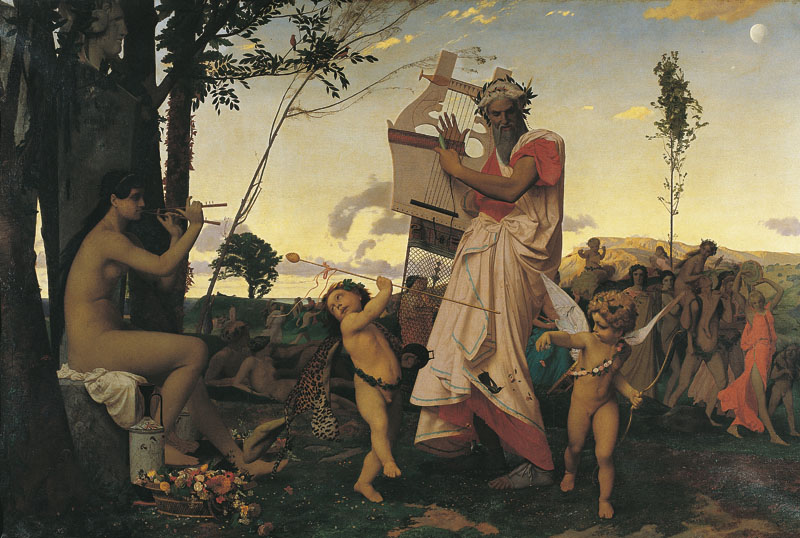
An old Greek poet plays his lyre while two child gods dance before him, one of wine and one of love. Gérôme painted this joyful feast for the Salon of 1848.
The story behind the painting
Gérôme painted Anacreon, Bacchus and Eros in oil on canvas in 1848, and it was shown at the Salon that year. It was ordered by the French ministry for the museum of Toulouse, and it is still kept in Toulouse at the Musée des Augustins. The canvas is large, 136 by 211 cm. The painter signed it GEROME 1848, at the upper left, on the base of a sculpture behind the seated maenad. The subject is the Greek poet Anacreon, remembered for his love of wine and music, joined by two gods shown as children.
What to look for
Anacreon plays the lyre as Bacchus and Cupid dance in front of him. Bacchus holds a thyrsus in one hand and a kylix, a drinking cup, in the other, with a leopard skin over his shoulder and vine leaves in his hair and around his chest. Cupid holds his bow, his quiver slung on his back by a garland of flowers, and scatters petals with his free hand. To the poet's left a nude bacchante or maenad plays a double flute. At their feet lie lekythoi and baskets of flowers, and in the background a crowd, clothed and unclothed, seems gathered for a bacchanal.
Meaning and intent
The picture joins the two passions Anacreon was known for: wine, in the person of Bacchus, and love, in the person of Cupid. Making the gods children gives the scene a playful lightness, as if the poet's songs themselves had come to life and started dancing. Music runs through everything, from the lyre to the double flute. Gérôme also borrowed from the past: the nude couple in the background is inspired by The Triumph of Flora by Nicolas Poussin, linking his Salon picture to the great French classical tradition.
Legacy
Gérôme did not leave the subject on canvas alone. A sculpted version of the group is held at the Musée Jean-Léon Gérôme in Vesoul, and another at the Art Institute of Chicago, so the dancing children and the old poet exist in three dimensions too. The painting itself has stayed where the ministry meant it to go, in Toulouse, where visitors to the Musée des Augustins can still see this sunny scene of music, wine and love, painted in the same year it first met the public.
¿Sabías que…?
- Painted in 1848 and shown at the Salon that year.
- Ordered by the French ministry for the Toulouse museum.
- Signed GEROME 1848 on a sculpture base.
- Sculpted versions exist in Vesoul and Chicago.
Sobre el artista
Jean-Léon Gérôme (1824-1904)
pintura mitológica · academicismo · Cupido · Museo de los Agustinos · Baco · Dioniso · Eros
Más obras de Jean-Léon Gérôme
 Pollice verso - Jean-Léon Gérôme (1872)
 El mercado de esclavos - Jean-Léon Gérôme (1866)
 Friné frente al Areópago - Jean-Léon Gérôme (1861)
 La verdad saliendo del pozo - Jean-Léon Gérôme (1896)
 Bonaparte ante la Esfinge - Jean-Léon Gérôme (1867)
 Cleopatra y César - Jean-Léon Gérôme (1866)
 La salida del baile de máscaras - Jean-Léon Gérôme (1857)
 La Ejecución del mariscal Ney - Jean-Léon Gérôme (1868)
Obras de artistas relacionados
 Almuerzo sobre la hierba - Édouard Manet (1863)
 Olympia - Édouard Manet (1863)
 El origen del mundo - Gustave Courbet (1866)
 Entierro en Ornans - Gustave Courbet (2020)
 Clavel, lirio, lirio, rosa - John Singer Sargent (1885-1886)
 Retrato de Madame X - John Singer Sargent (1884)
 La Libertad guiando al pueblo - Eugène Delacroix (1830)
 La muerte de Sardanápalo - Eugène Delacroix (1827)
 La muerte de Sócrates - Jacques-Louis David (1787)
 Juramento de los Horacios - Jacques-Louis David (1784)
 Las hermanas Waldgrave - Joshua Reynolds (1780)
 Capitán George K. H. Coussmaker - Joshua Reynolds (1782)