Mujer con una cesta de judías en un huerto
Pieter de Hooch · 1651
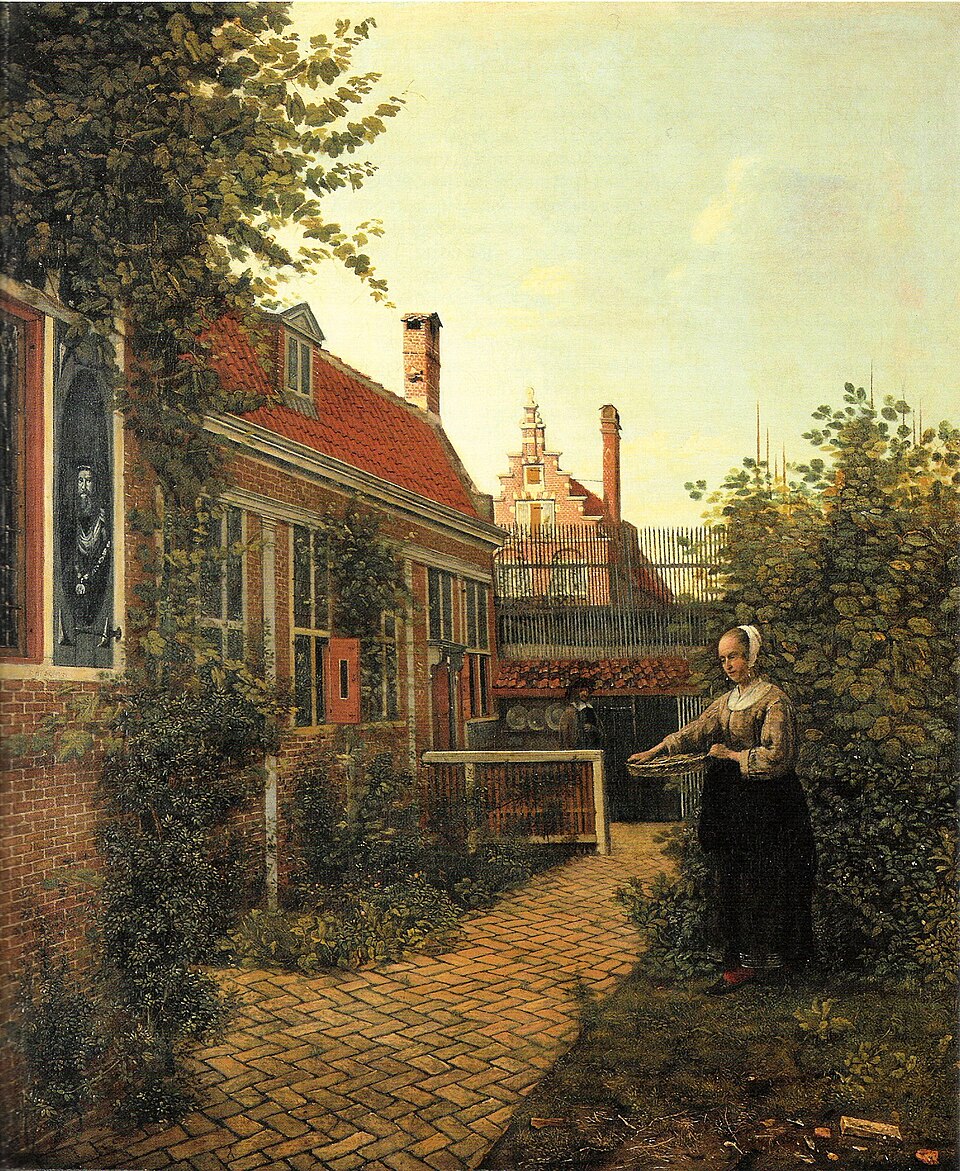
A woman holds a basket of freshly picked beans in a sunny kitchen garden. On a red shutter behind her, de Hooch once painted the face of an emperor, and then that face was blotted out.
The story behind the painting
The painting is dated 1651 on the canvas, and Wikidata keeps that date, but the scholar Peter C. Sutton argued in 1980 that 1651 was too early. He found the 5 written suspiciously heavily and tentatively dated the work to 1661, comparing it with other garden scenes de Hooch made in the early 1660s, in his Amsterdam period. The architecture seems to come from the Eva van Hoogeveenshofje, an almshouse in Leiden designed by Arent van 's-Gravesande in the 1650s, which suggests de Hooch also painted in Leiden, where he had a brother in law.
What to look for
The woman stands at the right edge on a patch of lawn mixed with weeds, a basket of beans in her hands, probably picked from the bush behind her. Her simple dress suggests a servant, yet her pearl earrings could mark the mistress of the house. A nobly dressed gentleman appears in the background. On the left, wild vines climb a brick wall broken by thin stone pilasters, small windows with red shutters and a door with a canopy. Most of the picture is sky with a single cloud. The main lines run to a point just right of centre, and shades of red and green dominate.
Meaning and intent
On the shutter in the foreground was a portrait of a nobleman, later identified as the Emperor Charles V, wearing the chain of the Order of the Golden Fleece. It is unique in de Hooch's work. One reading is that he was mocking the hofjes, almshouses built for the poor but used by the rich to show off and display loyalty to the ruling dynasty, with a pun on the Dutch word hof, meaning court. The grand building beside a humble servant picking beans sharpens the contrast. The portrait was later blotted out, perhaps by a later owner, perhaps by de Hooch himself.
Legacy
If the painter removed it, his dependence on wealthy patrons may explain why. Without the emperor the picture became a more conventional celebration of Leiden's new architecture, and its success shows in two later variants of the same building without the portrait. After moving to Amsterdam de Hooch focused on rich interiors for the ruling classes. This canvas passed through dealers and collectors including Duveen, Sedelmeyer and Sir Alfred Mond, was shown in Paris, Detroit, London and Dutch cities, and was given to the Kunstmuseum Basel in 1958 by the collector Max Geldner.
¿Sabías que…?
- Inscribed 1651, though Peter Sutton proposed 1661.
- The building is thought to be based on a Leiden almshouse.
- A portrait of Charles V on the shutter was later blotted out.
- Given to the Kunstmuseum Basel in 1958.
Sobre el artista
Pieter de Hooch (1629-1684)
escena de género · jardín · Museo de Arte de Basilea
Más obras de Pieter de Hooch
 Patio de una casa de Delft - Pieter de Hooch (1658)
 Mujer pelando manzanas - Pieter de Hooch (1663)
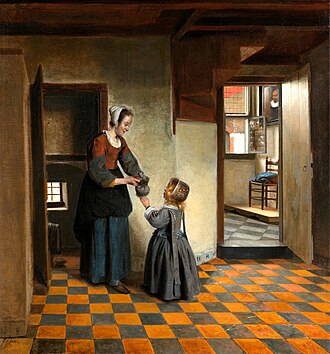 Mujer con una niña en la despensa - Pieter de Hooch
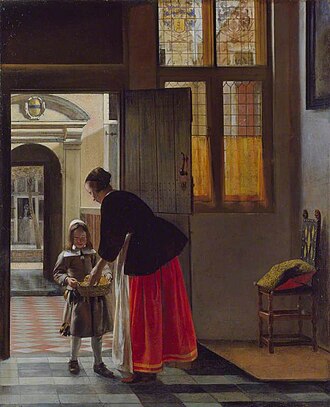 Niño trayendo pan - Pieter de Hooch (1663)
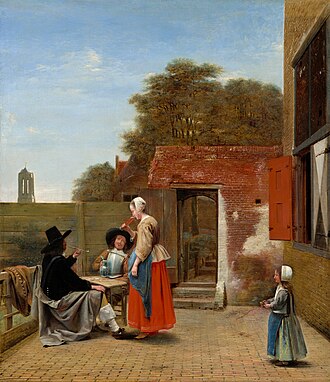 A Dutch Courtyard - Pieter de Hooch (1658)
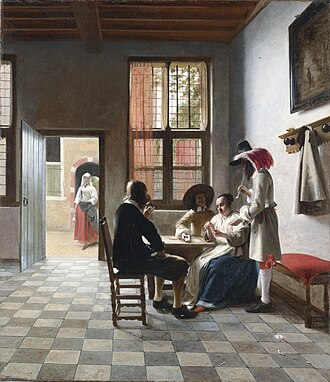 Jugadores de cartas en una habitación soleada - Pieter de Hooch (1658)
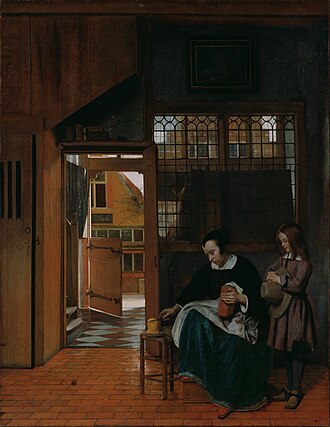 Mujer preparando pan con mantequilla para un niño - Pieter de Hooch (1661)
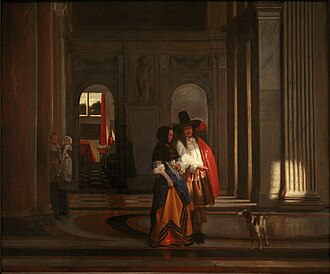 A Couple Walking in the Amsterdam Town Hall - Pieter de Hooch (1660s)