Truth, Time and History
Francisco Goya · 1797
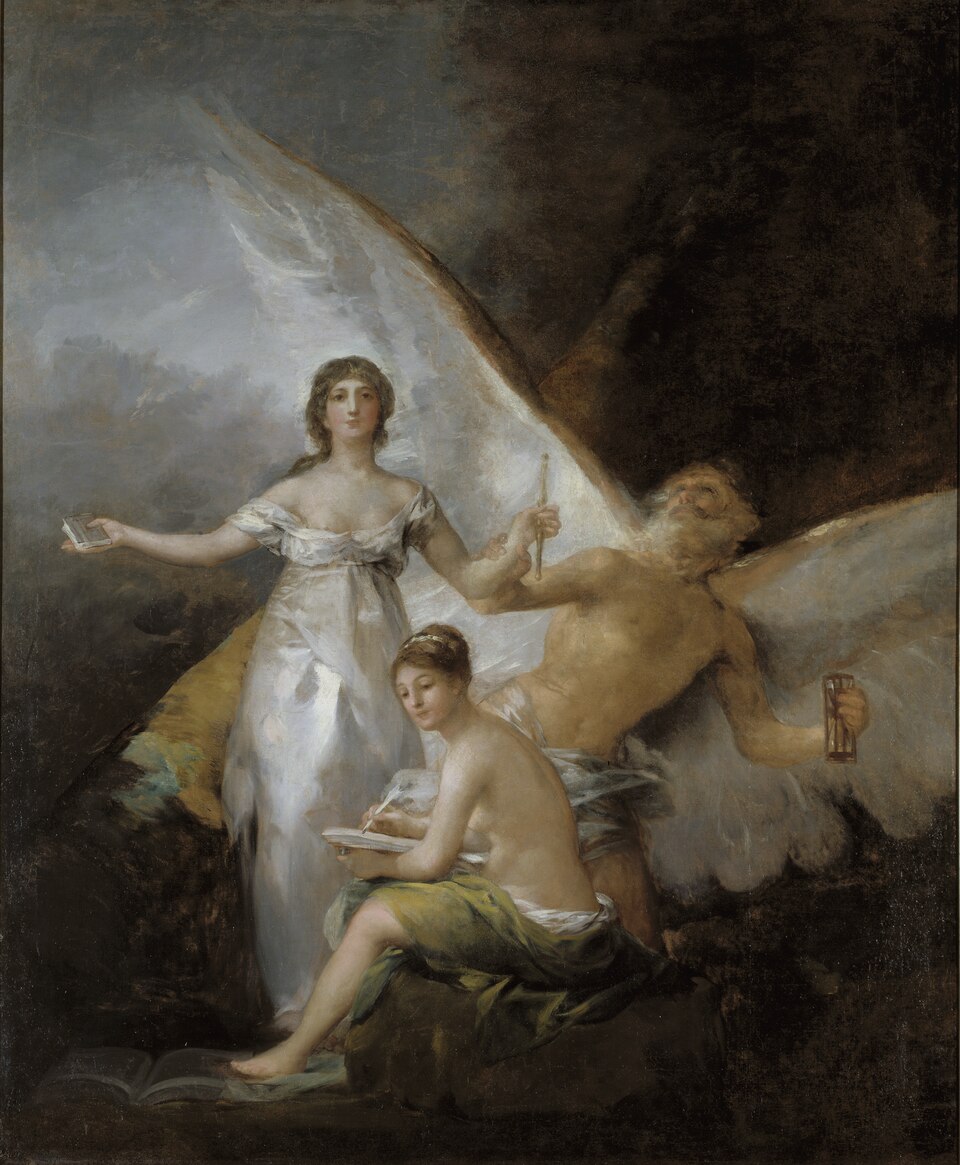
An old winged man with an hourglass pulls a woman in white into the light, while a nude figure writes in a book. Goya never explained who she is, and historians have named her Truth, Spain, Philosophy and even the law.
The story behind the painting
Goya's large canvas, about 294 by 244 cm, has been dated anywhere from 1797 to 1812, though most often between 1804 and 1808. Wikidata gives 1797. It is often thought to have been commissioned with a companion piece, Poetry, for Manuel Godoy, then First Secretary of State of Spain, perhaps to decorate his palace in Madrid. Yet the first reliable record dates only from 1867, when both works belonged to Juan Duncan Shaw, Austrian consul in Cádiz, and the historian Janis A. Tomlinson writes that they cannot be traced to Godoy's collection.
What to look for
History sits nude on a rock at the front, a white quill in her hand, an open book in her lap, a green cloth around her waist and another book open at her feet. Behind her stands Time, an old bearded man with an hourglass, his face turned upward, his huge white wings running off the canvas. He grips the arm of a woman in white who faces you, holding a scepter and a grey book. The background is light behind her and dark around Time.
Meaning and intent
Martin S. Soria called the work Spain, Time, and History, saw the influence of Cesare Ripa's Iconologia, and read the woman as Spain pulled by Time into a brighter future. Others object that Spain was then shown crowned, and Folke Nordström compares her to Philosophy, who also carries a book and scepter. Eleanor Sayre dated the painting 1812 and titled it Allegory of the Constitution of 1812, with the hourglass just turned over for a new era. Juan Luna, for the Stockholm catalogue, sees her as both Spain and Truth.
Legacy
A rough oil sketch of 1797 to 1799, or 1804 by some accounts, shows winged Time leading a nude Truth by the hand under bats and owls; it is in the Museum of Fine Arts, Boston. A red chalk drawing in the Prado, from a sketchbook Goya began in Italy, shows Time and Truth fleeing dark owls. After Shaw's death in 1878 the painting passed to Luis de Navas, then to Charles Deering, then to E. and A. Silberman Galleries, and in 1961 to the Nationalmuseum in Stockholm.
Did you know?
- Also known as Spain, Time, and History or Allegory of the Constitution of 1812.
- Dated between 1797 and 1812, most often 1804-1808.
- Possibly a companion to Poetry, made for Manuel Godoy.
- In the Nationalmuseum, Stockholm, since 1961.
About the artist
Francisco Goya (1746-1828)
woman · man · sitting · standing · allegory · Nationalmuseum · kneeling
More by Francisco Goya
 The Third of May 1808 - Francisco Goya (1814)
 La Maja nue - Francisco Goya (1800)
 Saturn Devouring His Son - Francisco Goya (1819)
 Charles IV of Spain and His Family - Francisco Goya (1800)
 The Clothed Maja - Francisco Goya (1800)
 The Second of May 1808 - Francisco Goya (1814)
 The Dog - Francisco Goya (1819)
 Witches' Sabbath - Francisco Goya (1820s)
Paintings by related artists
 Wanderer above the Sea of Fog - Caspar David Friedrich (c. 1818)
 The Abbey in the Oakwood - Caspar David Friedrich (1800s)
 Liberty Leading the People - Eugène Delacroix (1830)
 Death of Sardanapalus - Eugène Delacroix (1827)
 The Fighting Temeraire - J. M. W. Turner (1839)
 Rain, Steam and Speed - The Great Western Railway - J. M. W. Turner (1844)
 The Blue Boy - Thomas Gainsborough (1770)
 Mr and Mrs Andrews - Thomas Gainsborough (1748)