The Terrace of the Seraglio
Jean-Léon Gérôme · 1886
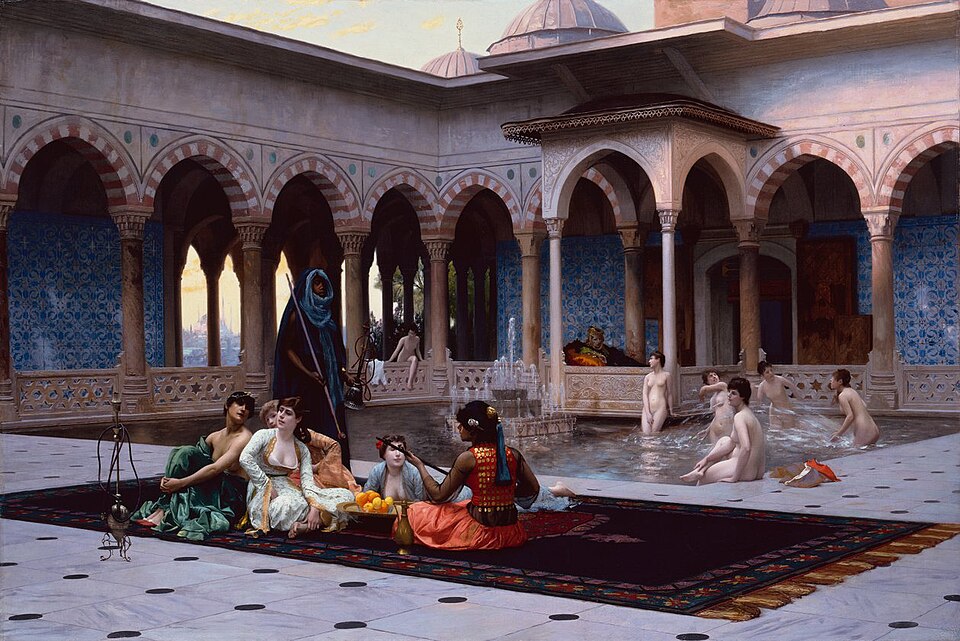
Women rest on a terrace in rosy evening light, music drifts from a stringed instrument and bathers glide in a fountain pool below. Gérôme built this imagined harem from the architecture of Topkapı Palace.
The story behind the painting
The Terrace of the Seraglio, also called The Harem on the Terrace, is an oil on canvas painted in 1886 by the French artist Jean-Léon Gérôme. It belongs to a private English collection. It is one of a group of harem and bath scenes Gérôme made, and the French Wikipedia article compares it with his Woman Lighting a Narghile, Woman at the Bath and Truth Coming Out of Her Well. The sources disagree on its size: Wikipedia gives 82 by 122 cm, while Wikidata gives 81.9 by 96.5 cm. The signature J. L. GEROME is placed at the lower centre.
What to look for
On a terrace open to the sky, three women sit while a fourth lies on a carpet. They listen to a fifth woman playing a stringed instrument. A servant brings them a pipe and a narghile. In the middle ground, a pool with a fountain holds several nude women bathing, among them Emma Dupont, one of Gérôme's recurring models. Above the water, the sultan sits on a projecting balcony and dominates the scene. Behind the figures, arcades reveal blue mosaic corridors, a second row opens onto a garden and a distant mosque, and domes crown the top.
Meaning and intent
Monumental architecture inspired by Topkapı Palace in Istanbul structures the picture. The richly decorated arcades frame the figures, organise the space and deepen the perspective, while also giving the place a sense of enclosure. Light and shadow play over marble floors and tiled walls, and a rosy tone suggests sunset. The composition sets the cool, closed space of the seraglio against the apparent freedom of the women who move within it, watched from above by the sultan.
Legacy
The painting sums up a theme Gérôme returned to again and again: the imagined private world of the harem, rendered with precise detail of tiles, marble and light. Its placement in a private English collection means it is rarely seen in public. It was sold at Christie's in 1998. For viewers today, the picture shows both the skill of academic painting at its height and the way European artists of the time constructed a dreamlike East from real buildings and studio models.
Did you know?
- Painted by Jean-Léon Gérôme in 1886.
- Architecture inspired by Topkapı Palace, Istanbul.
- Gérôme's model Emma Dupont appears among the bathers.
- Sources disagree on its size.
About the artist
Jean-Léon Gérôme (1824-1904)
woman · genre art · nude · nudity · academic art · Black people · courtyard · nude swimming
More by Jean-Léon Gérôme
 Pollice Verso - Jean-Léon Gérôme (1872)
 The Slave Market - Jean-Léon Gérôme (1866)
 Phryne before the Areopagus - Jean-Léon Gérôme (1861)
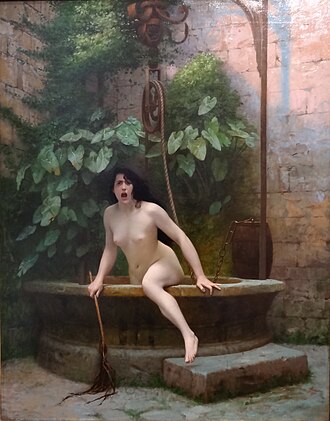 Truth Coming Out of Her Well - Jean-Léon Gérôme (1896)
 Bonaparte Before the Sphinx - Jean-Léon Gérôme (1867)
 Cleopatra and Caesar - Jean-Léon Gérôme (1866)
 The Duel After the Masquerade - Jean-Léon Gérôme (1857)
 The Execution of Marshal Ney - Jean-Léon Gérôme (1868)
Paintings by related artists
 Luncheon on the Grass - Édouard Manet (1863)
 Olympia - Édouard Manet (1863)
 L'Origine du monde - Gustave Courbet (1866)
 A Burial at Ornans - Gustave Courbet (2020)
 Carnation, Lily, Lily, Rose - John Singer Sargent (1885-1886)
 Madame X - John Singer Sargent (1884)
 Liberty Leading the People - Eugène Delacroix (1830)
 Death of Sardanapalus - Eugène Delacroix (1827)
 The Death of Socrates - Jacques-Louis David (1787)
 The Oath of the Horatii - Jacques-Louis David (1784)
 The Ladies Waldegrave - Joshua Reynolds (1780)
 Captain George K. H. Coussmaker - Joshua Reynolds (1782)