Pollice Verso
Jean-Léon Gérôme · 1872
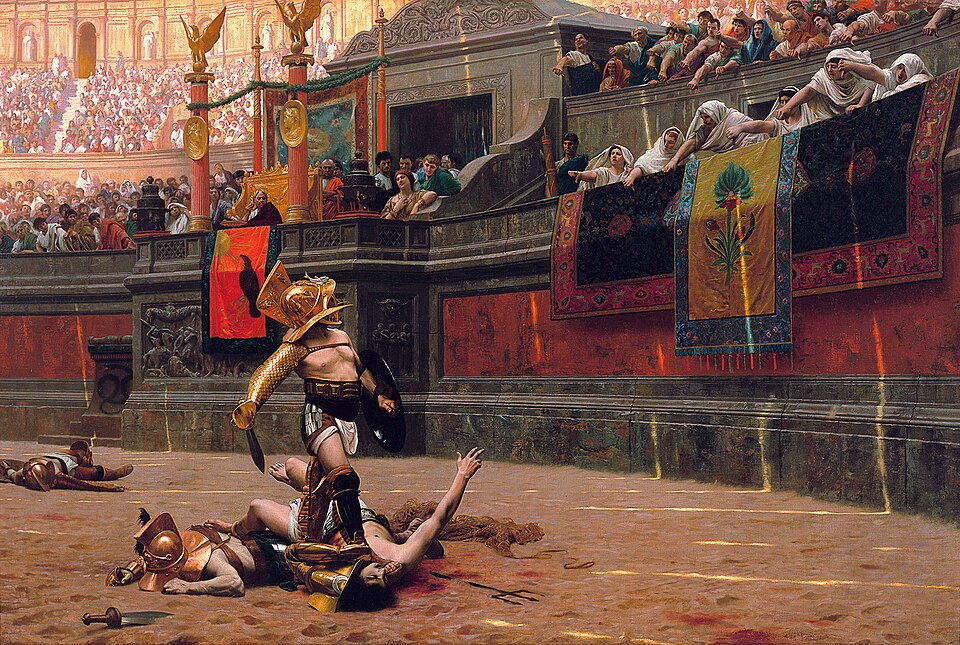
In the Colosseum a victorious gladiator stands over his fallen opponent, and the crowd, Vestal Virgins among them, turn their thumbs down. Gérôme's picture fixed that gesture in our imagination and later hooked Ridley Scott on Gladiator.
The story behind the painting
Pollice verso is Latin for with a turned thumb. Gérôme painted the scene in 1872, imagining the moment when the spectators of the Colosseum decide the fate of a defeated gladiator. The painter took care over the setting: his architecture of the Colosseum is based on accurate drawings, and the gladiators' armour follows examples found at Pompeii, though there are some inaccuracies in the murmillo's armour. The American merchant Alexander Turney Stewart bought the painting directly from Gérôme, setting a new record for the artist, and exhibited it in New York City.
What to look for
A victorious murmillo stands over a defeated retiarius, the net fighter, who raises two fingers to plead for mercy. In the stands, spectators including the Vestal Virgins thrust their thumbs down towards the winner. The emperor sits in his box above the arena. Look at the Vestals: priestesses of purity, they lean forward eagerly, demanding death. That choice may come from the Christian poet Prudentius, who described a Vestal in the arena calling the victor her pet and, with a turn of her thumb, ordering him to pierce the breast of his fallen foe.
Meaning and intent
The picture made thumbs up mean life and thumbs down mean death for a defeated gladiator, but whether Rome worked that way is unknown. Almost at once a controversy began. A 26-page pamphlet of 1879 reprinted evidence for and against Gérôme's gesture, including a letter from the painter himself dated 8 December 1878. The question remains open: historical, archaeological and literary records leave it uncertain whether the thumb was turned up, down, held sideways or hidden in the hand. The painting is a powerful image of cruelty as spectacle, built on an uncertain detail.
Legacy
Gérôme took up sculpture and made a large bronze gladiator with his foot on his victim, based on this painting, shown at the Paris Universal Exhibition of 1878. After his death his son-in-law Aimé Morot made a monument showing Gérôme sculpting it, now in the Musée d'Orsay. This picture and Ave Caesar! Morituri te Salutant shaped how filmmakers showed ancient Rome from silent movies on. Shown a reproduction before reading the script of Gladiator, Ridley Scott said the image spoke of Rome in all its glory and wickedness and he was hooked. The painting is now in the Phoenix Art Museum.
Did you know?
- Painted by Gérôme in 1872.
- The Vestal Virgins give the thumbs-down gesture.
- Whether Romans used thumbs down for death is still uncertain.
- Now in the Phoenix Art Museum, Arizona.
About the artist
Jean-Léon Gérôme (1824-1904)
history painting · academic art
More by Jean-Léon Gérôme
 The Slave Market - Jean-Léon Gérôme (1866)
%20-%2001.jpg) Phryne before the Areopagus - Jean-Léon Gérôme (1861)
Phryne before the Areopagus - Jean-Léon Gérôme (1861)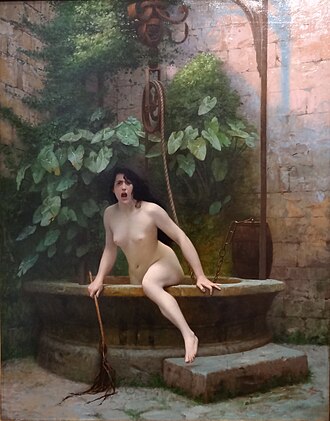 Truth Coming Out of Her Well - Jean-Léon Gérôme (1896)
 Bonaparte Before the Sphinx - Jean-Léon Gérôme (1867)
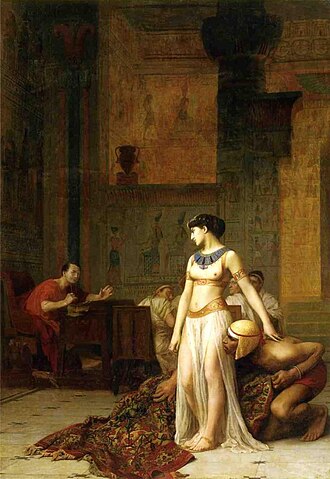 Cleopatra and Caesar - Jean-Léon Gérôme (1866)
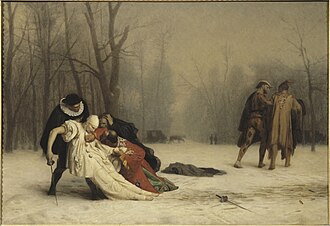 The Duel After the Masquerade - Jean-Léon Gérôme (1857)
.jpg) The Execution of Marshal Ney - Jean-Léon Gérôme (1868)
The Execution of Marshal Ney - Jean-Léon Gérôme (1868)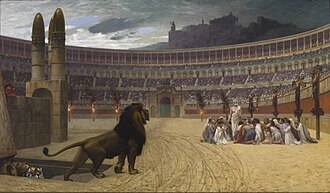 The Christian Martyrs' Last Prayer - Jean-Léon Gérôme (1883)
Paintings by related artists
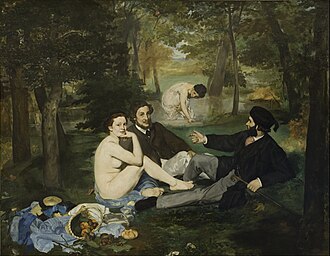 Luncheon on the Grass - Édouard Manet (1863)
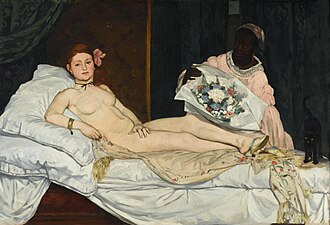 Olympia - Édouard Manet (1863)
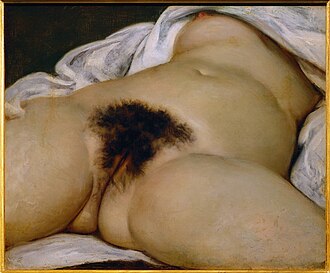 L'Origine du monde - Gustave Courbet (1866)
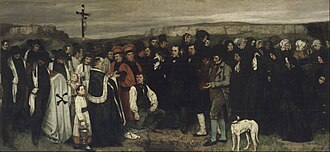 A Burial at Ornans - Gustave Courbet (2020)
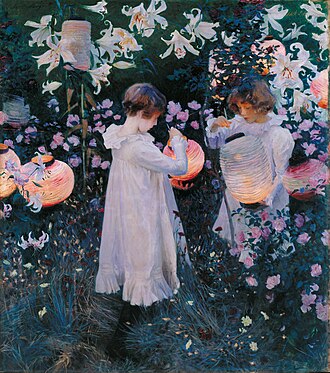 Carnation, Lily, Lily, Rose - John Singer Sargent (1885-1886)
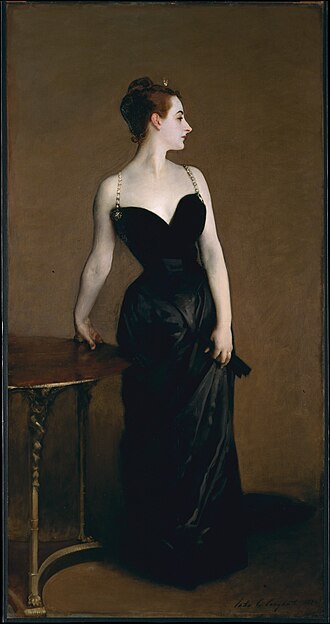 Madame X - John Singer Sargent (1884)
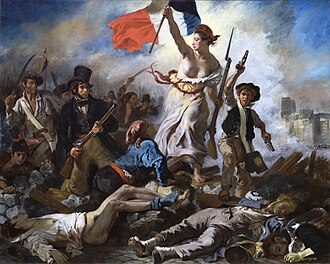 Liberty Leading the People - Eugène Delacroix (1830)
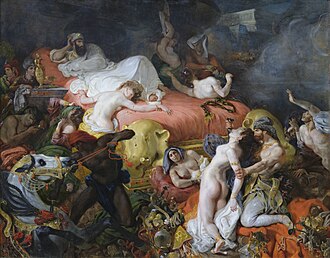 Death of Sardanapalus - Eugène Delacroix (1827)
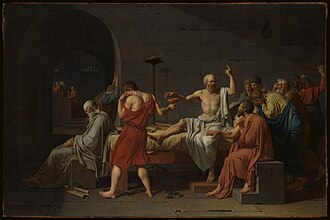 The Death of Socrates - Jacques-Louis David (1787)
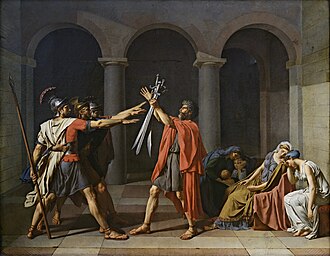 The Oath of the Horatii - Jacques-Louis David (1784)
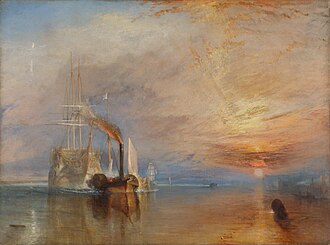 The Fighting Temeraire - J. M. W. Turner (1839)
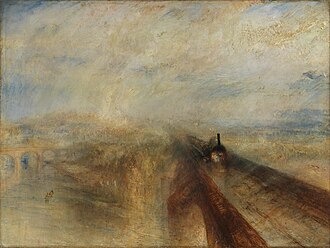 Rain, Steam and Speed - The Great Western Railway - J. M. W. Turner (1844)