The seller of acerola
Francisco Goya · 1778
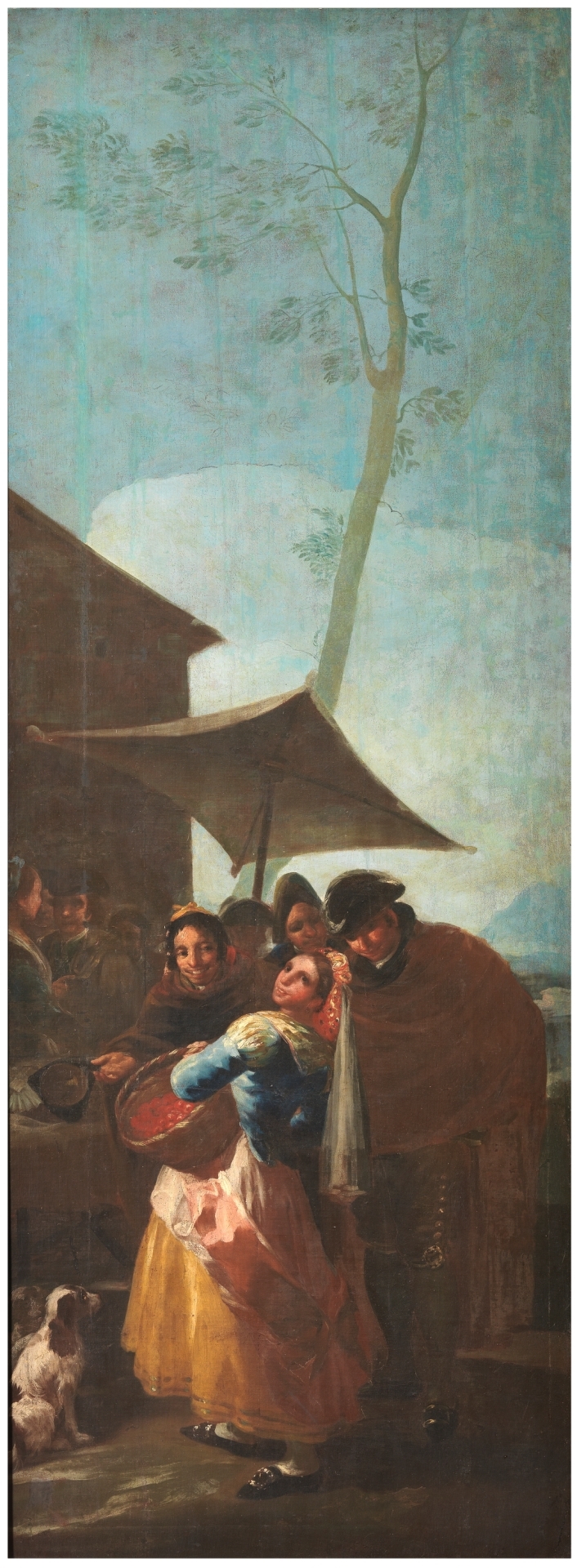
A street seller with a basket of fruit on her arm looks out at us, holding back a laugh, while a group watches her and a dog sits at her feet. Goya painted her for a royal bedroom tapestry, and the canvas then lay forgotten for decades.
The story behind the painting
The Seller of Acerola, La acerolera in Spanish, was painted between 1778 and 1779 as part of Goya's third series of tapestry cartoons. All the pictures of this series were meant for the bedroom of the Prince of Asturias, the future Charles IV, and his wife Maria Luisa of Parma, at the Palace of El Pardo. The canvas was delivered to the Royal Tapestry Factory on 6 January 1779. The series also included The Fair of Madrid, The Crockery Seller, The Soldier and the Lady, Boys Playing at Soldiers and The Game of Pelota.
What to look for
The format is tall and narrow, about 259 by 100 cm, which shows that the tapestry was meant to hang between two windows or doorways. The seller holds a basket of azarole fruit on her arm and looks at the viewer with a stifled laugh. A group of people observe her, and a dog at her feet completes the scene. Goya places the figures under an awning, the faces lit in the half-shadow, and the background contrasts with the warm colours of the main figures. The woman wears no jewellery, and the composition avoids too many details.
Meaning and intent
Goya plays with the image of the woman in a scene that evokes a market. As in The Soldier and the Lady, from the same series, there are two women, and one of them flirts openly with the men. Women who sold goods this way were a common sight in Madrid at the end of the eighteenth century. By keeping the details sparse and the light on the faces, Goya makes a passing street moment into a lively portrait of everyday Madrid, made for the private rooms of a future king.
Legacy
Like many of Goya's cartoons, the canvas was considered lost until 1869, when Gregorio Cruzada Villaamil found it in the basement of the Royal Palace in Madrid. By orders of 19 January and 9 February 1870 it was handed over to the Museo del Prado, and it first appears in the museum's catalogue in 1876. It is displayed in the Prado today. Wikidata gives the date as 1778, while the French Wikipedia article places it between 1778 and 1779, the year the cartoon was delivered.
Did you know?
- A tapestry cartoon from Goya's third series, 1778-1779.
- Delivered to the Royal Tapestry Factory on 6 January 1779.
- Its tall format suited a space between windows.
- Found in the Royal Palace basement in 1869; in the Prado since 1870.
About the artist
Francisco Goya (1746-1828)
More by Francisco Goya
 The Third of May 1808 - Francisco Goya (1814)
 La Maja nue - Francisco Goya (1800)
 Saturn Devouring His Son - Francisco Goya (1819)
 Charles IV of Spain and His Family - Francisco Goya (1800)
 The Clothed Maja - Francisco Goya (1800)
 The Second of May 1808 - Francisco Goya (1814)
 The Dog - Francisco Goya (1819)
 Witches' Sabbath - Francisco Goya (1820s)
Paintings by related artists
 Wanderer above the Sea of Fog - Caspar David Friedrich (c. 1818)
 The Abbey in the Oakwood - Caspar David Friedrich (1800s)
 Liberty Leading the People - Eugène Delacroix (1830)
 Death of Sardanapalus - Eugène Delacroix (1827)
 The Fighting Temeraire - J. M. W. Turner (1839)
 Rain, Steam and Speed - The Great Western Railway - J. M. W. Turner (1844)
 The Blue Boy - Thomas Gainsborough (1770)
 Mr and Mrs Andrews - Thomas Gainsborough (1748)