the Rendezvous
Francisco Goya · 1779
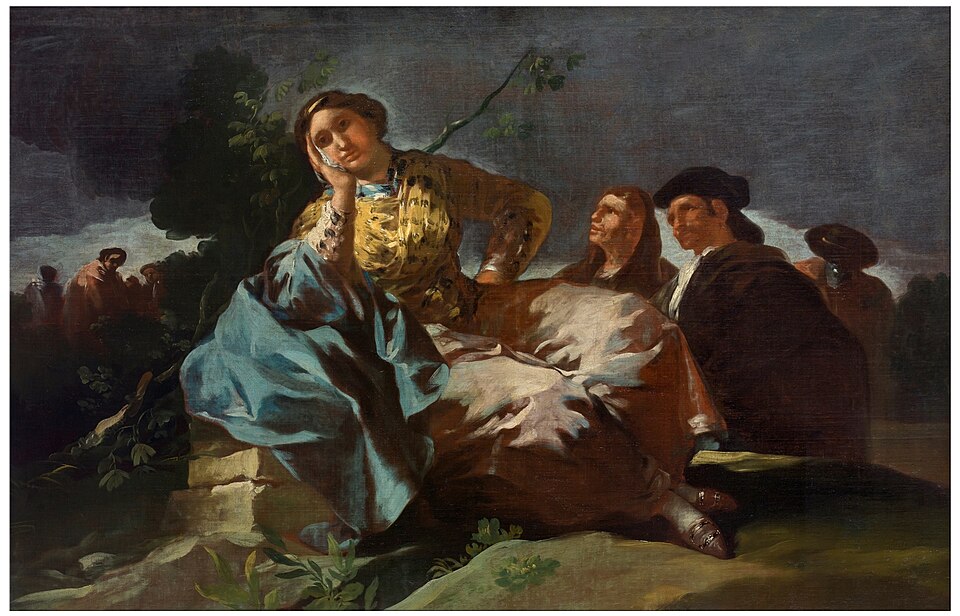
A young woman sits in the foreground, head resting on her hand, a handkerchief in her fingers, while young men further off try to charm her. Goya painted this quiet, melancholy scene as a design for a royal tapestry, and then it vanished for almost ninety years.
The story behind the painting
The Rendezvous, La cita in Spanish, belongs to Goya's fourth series of tapestry cartoons, painted in 1779 and 1780. Every picture in that series was meant for the antechamber of the Prince of Asturias, the future Charles IV, and his wife Maria Luisa of Parma, at the Palace of El Pardo. Goya delivered this canvas to the Royal Tapestry Factory on 24 January 1780. Wikidata dates the work 1779, while the French Wikipedia article gives 1779 to 1780, the span of the whole commission.
What to look for
Look first at the woman in front. She wears a headscarf, leans her head on her hand and holds a handkerchief, and she seems disenchanted. Behind her, other majos offer her a gallant scene that she does not seem to want. The long horizontal shape, about 100 by 151 cm, shows that the tapestry woven from it was meant to hang above a door. The brushwork is quick and summary, with strong strokes that work over the red preparation of the canvas without hiding it.
Meaning and intent
The source reads the painting as a possible image of melancholy, carried by the young woman's expression and the dark colours. At the same time the colour is applied in a lively way that recalls Velazquez. Like the rest of the series, the cartoon shows a French manner. Perspective was by then a sure skill for Goya, which mattered for pictures seen high above a doorway. The result is a small drama of mood: a courtship scene in which the person at its centre turns inward instead of joining in.
Legacy
The canvas was considered lost until 1869, when Gregorio Cruzada Villaamil found it in the basement of the Royal Palace in Madrid. By orders of 19 January and 9 February 1870 it was handed to the Museo del Prado, and it first appeared in the museum's catalogue in 1876. It hangs there today. It belongs to a series that also included The Blind Guitarist, The Washerwomen, The Woodcutters and The Doctor, as well as two cartoons that are still lost, The Dog and The Fountain.
Did you know?
- A tapestry cartoon from Goya's fourth series, 1779-1780.
- Delivered to the Royal Tapestry Factory on 24 January 1780.
- Rediscovered in the Royal Palace basement in 1869.
- In the Museo del Prado since 1870.
About the artist
Francisco Goya (1746-1828)
More by Francisco Goya
 The Third of May 1808 - Francisco Goya (1814)
 La Maja nue - Francisco Goya (1800)
 Saturn Devouring His Son - Francisco Goya (1819)
 Charles IV of Spain and His Family - Francisco Goya (1800)
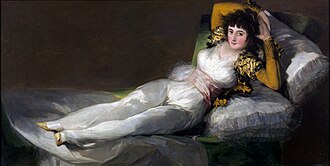 The Clothed Maja - Francisco Goya (1800)
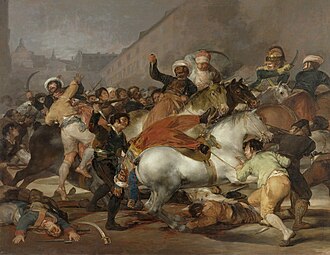 The Second of May 1808 - Francisco Goya (1814)
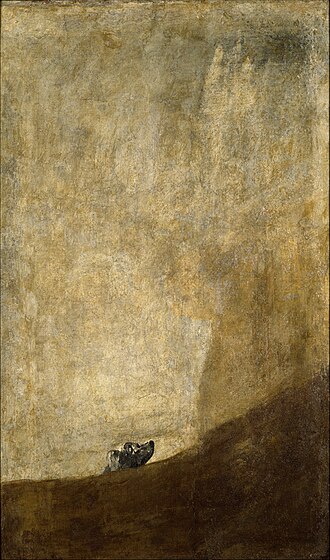 The Dog - Francisco Goya (1819)
 Witches' Sabbath - Francisco Goya (1820s)
Paintings by related artists
 Wanderer above the Sea of Fog - Caspar David Friedrich (c. 1818)
 The Abbey in the Oakwood - Caspar David Friedrich (1800s)
 Liberty Leading the People - Eugène Delacroix (1830)
 Death of Sardanapalus - Eugène Delacroix (1827)
 The Fighting Temeraire - J. M. W. Turner (1839)
 Rain, Steam and Speed - The Great Western Railway - J. M. W. Turner (1844)
 The Blue Boy - Thomas Gainsborough (1770)
 Mr and Mrs Andrews - Thomas Gainsborough (1748)