The Guitar Player
Johannes Vermeer · 1672
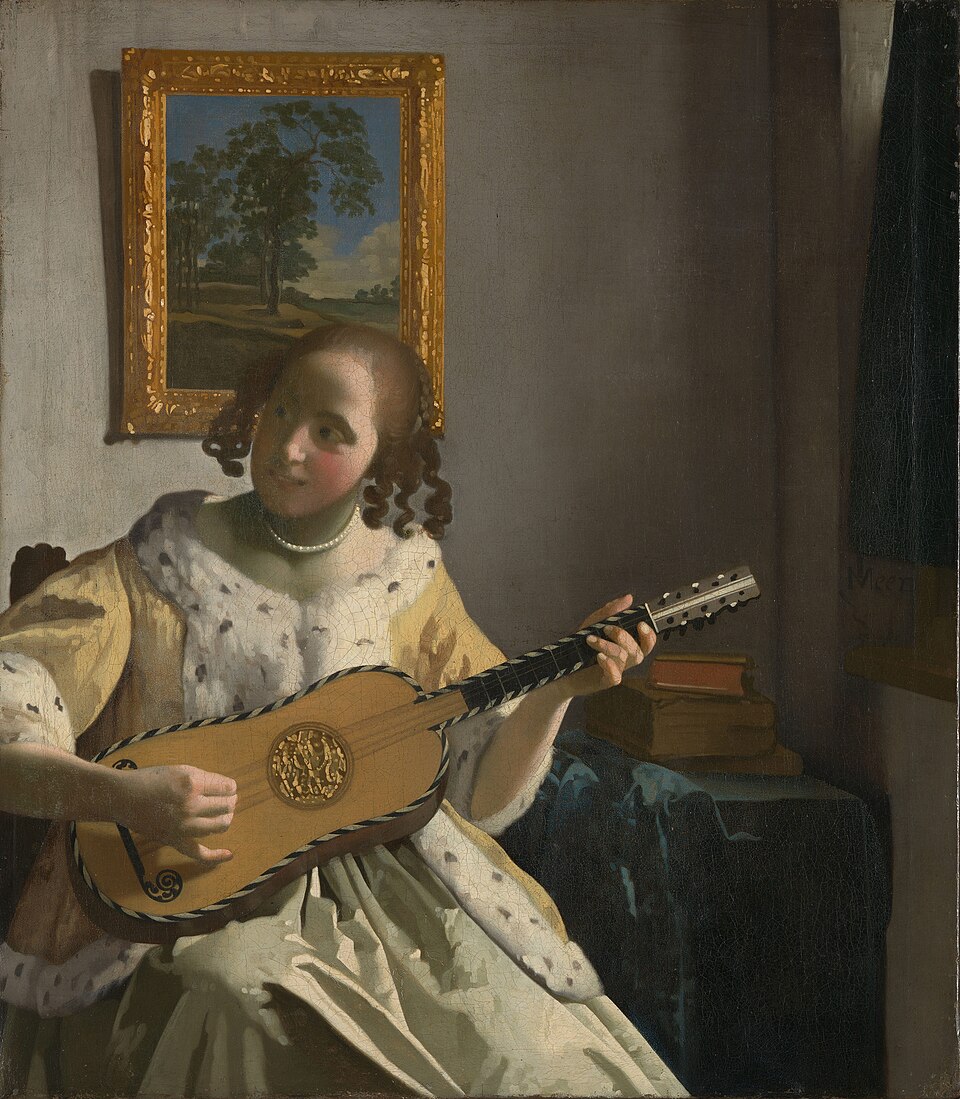
A young woman in a yellow jacket strums a guitar and smiles at someone we cannot see, and some of the strings are blurred as if still ringing. One of Vermeer's last paintings, it was stolen and held for ransom in 1974 before coming home to Kenwood House.
The story behind the painting
The Guitar Player is dated around 1672 and belongs to Vermeer's final years of work, so it gives an insight into the techniques he had mastered. His paintings of the mid-1660s show quiet, self-contained worlds. This one is different: it shows the energy of his late style, with poses and actions that imply movement, or here, sound. It is often compared with his Woman with a Lute. Wikidata dates it to 1672, the source says about 1672. The painting has been displayed at Kenwood House in London since the 1920s as part of the Iveagh Bequest. In 1974 it was stolen and held for ransom, and after its recovery it returned to Kenwood.
What to look for
The woman sits in the corner of a room near a window, the guitar on her lap. She wears an ermine-bordered yellow jacket, an ivory satin dress and a pearl necklace. Look at the jacket: its folds are made of thin patches of grey and lead-tin yellow, and historians think the fur was not ermine but cat, squirrel or mouse with painted spots. The pearls are not individual beads but hazy white highlights over a dark grey shadow. On the guitar, the gold rose of the sound hole is built from blobs of impasto paint, and some strings are blurred, as if just strummed. Behind her hangs a pastoral landscape in a heavy frame, and three books lie on a table with a blue cloth.
Meaning and intent
Vermeer here breaks his own rules of balance. He pushes the player far to the left and fills the right half with light and shadow, with the light coming from the right instead of the usual left. The imbalance gives a sense of change and movement. Unlike his earlier figures with veiled expressions, she has an open, joyous, flirtatious face, head tipped, gaze fixed on someone outside the picture: she plays not for us but for an unseen listener. Even the instrument matters. The guitar, from Spain and sought after in the Dutch Republic, was cheaper and easier than the lute, and its choice suggests a move into the modern world of music.
Legacy
The painting is seen as a new direction in Vermeer's art, where detail gives way to abstraction: diffused light, simplified pearls and blurred strings that turn a still image into a moment of sound. The yellow morning jacket appears, with variations, in several other Vermeer paintings, including A Lady Writing a Letter, Mistress and Maid and Woman with a Pearl Necklace, and the source calls it one of the few surviving records of such seventeenth century overcoats. The landscape behind her head was identified by the art historian Gregor Weber. Today the young musician still plays at Kenwood House, part of the Iveagh Bequest given in 1929.
Did you know?
- Dated about 1672, one of Vermeer's last works.
- At Kenwood House, London, since the 1920s, part of the Iveagh Bequest.
- Stolen and held for ransom in 1974, then recovered.
- Shows a five-course guitar with blurred, vibrating strings.
About the artist
Johannes Vermeer (1632-1675)
genre art · Dutch Golden Age painting
More by Johannes Vermeer
 Girl with a Pearl Earring - Johannes Vermeer (1665)
 The Milkmaid - Johannes Vermeer (c. 1658)
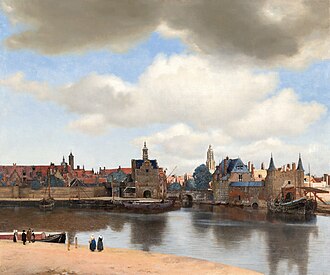 View of Delft - Johannes Vermeer (1660s)
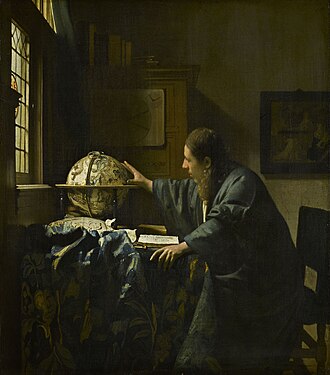 The Astronomer - Johannes Vermeer (1664)
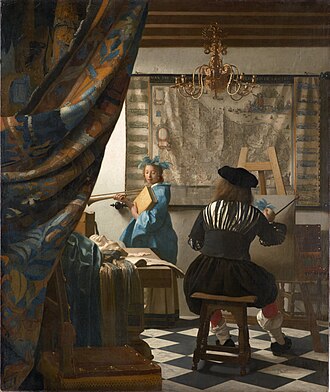 The Art of Painting - Johannes Vermeer (1660s)
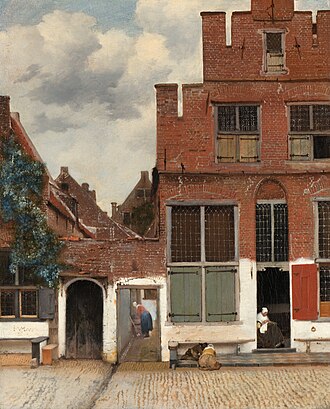 The Little Street - Johannes Vermeer (1658)
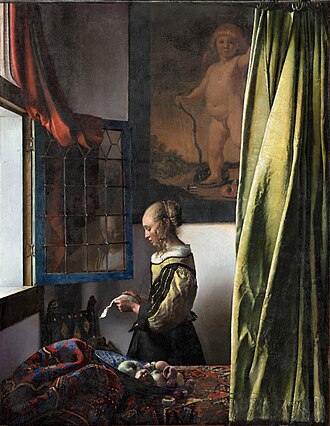 Girl Reading a Letter at an Open Window - Johannes Vermeer (1650s)
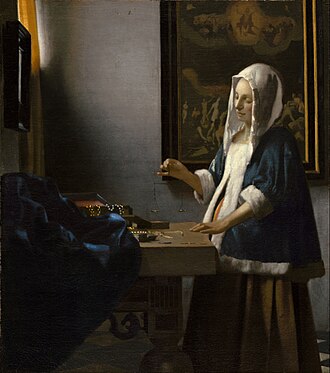 Woman Holding a Balance - Johannes Vermeer (1665)
Paintings by related artists
 The Night Watch - Rembrandt van Rijn (1642)
 Self-Portrait - Rembrandt van Rijn (1659)
 The Feast of Saint Nicholas - Jan Steen (1660s)
 Girl eating oysters - Jan Steen (1658)
 A Militiaman Holding a Berkemeyer, Known as the ‘Merry Drinker’ - Frans Hals (1620s)
 Laughing Cavalier - Frans Hals (1624)
 The Windmill at Wijk bij Duurstede - Jacob van Ruisdael (1670)
 The Jewish Cemetery - Jacob van Ruisdael (1650s)
 The Courtyard of a House in Delft - Pieter de Hooch (1658)
 A Woman Peeling Apples - Pieter de Hooch (1663)