The Grape Harvest
Francisco Goya · 1786
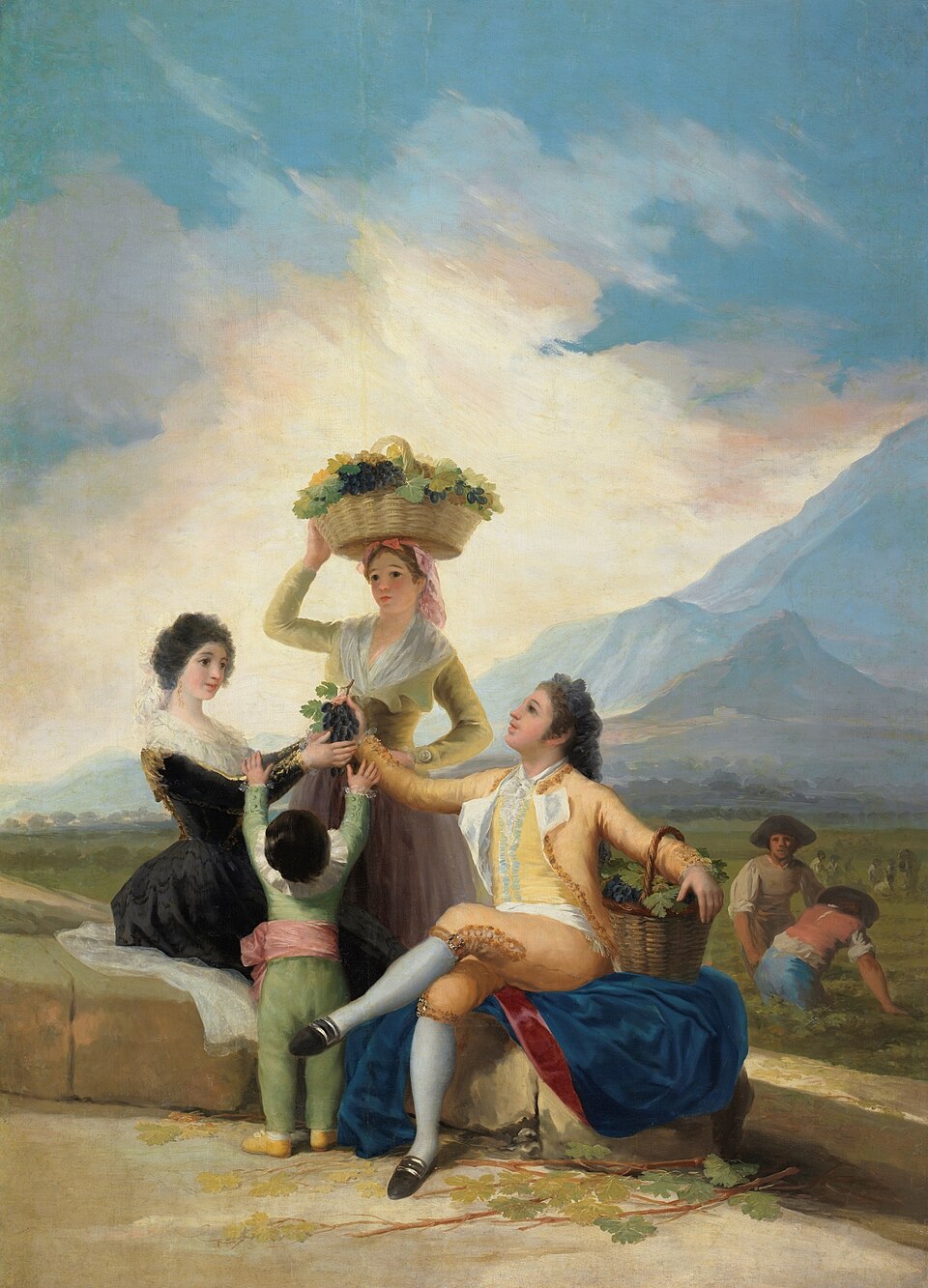
A man offers a woman a bunch of grapes, a child reaches for it, and a harvester stands above them with a full basket. Goya painted autumn for a royal dining room, and the canvas then vanished into a palace basement for decades.
The story behind the painting
Goya painted this canvas in the autumn of 1786 as part of his fifth series of cartoons for tapestries. The whole series was meant for the dining room of the Prince of Asturias, the future Charles IV, and his wife Maria Luisa of Parma, at the Palace of El Pardo. The cartoons served as models for weavers producing luxury tapestries worked with gold and silver thread. This one, also called Autumn, was to hang in the centre of a side wall, paired with The Flower Girls. The series also included The Threshing Floor, The Snowstorm, The Injured Mason and other scenes.
What to look for
The main scene sits in the foreground, built as a neoclassical pyramid. A man offers a woman a bunch of grapes, which she accepts, while a child at her feet tries to grab it. At the top of the triangle a harvester waits with a basket of grapes on her head, painted like a still life. Behind them, workers gather the harvest, and beyond are mountains and a cloudy sky. The colours are bright and the tones delicate, and despite quick brushstrokes the clothes are detailed. Because it was a model for weaving, it needed flat, vivid colours in clearly bounded areas. Rarely for Goya, the main figures are not common people.
Meaning and intent
For this series Goya took up an old theme of Western art, the four seasons, which was a favourite of Rococo taste and of tapestries for dining rooms. He made it his own by turning allegories into pastoral scenes typical of each time of year, and here the grape harvest stands for autumn. The landscape seems to recall the harvests of La Rioja, though the source notes the painter was more probably inspired by the town of Piedrahíta in Ávila, a claim it marks as needing a citation. Its calm and serenity contrast with the winter scene, The Snowstorm.
Legacy
The canvas was considered lost until 1869, when Gregorio Cruzada Villaamil found it in the basement of the Royal Palace of Madrid. It went to the Museo del Prado in 1870 by orders of 19 January and 9 February that year, and it first appears in the museum's catalogue in 1876. It measures about 267.5 by 190.5 cm. Today it hangs in the Prado, in room 94 according to the source, a design once meant only to guide weavers that is now admired as a painting in its own right.
Did you know?
- Painted in autumn 1786 as a tapestry cartoon for El Pardo.
- One of four seasons, standing for autumn.
- Rediscovered in 1869 in the basement of the Royal Palace of Madrid.
- In the Museo del Prado since 1870.
About the artist
Francisco Goya (1746-1828)
More by Francisco Goya
 The Third of May 1808 - Francisco Goya (1814)
 La Maja nue - Francisco Goya (1800)
 Saturn Devouring His Son - Francisco Goya (1819)
 Charles IV of Spain and His Family - Francisco Goya (1800)
 The Clothed Maja - Francisco Goya (1800)
 The Second of May 1808 - Francisco Goya (1814)
 The Dog - Francisco Goya (1819)
 Witches' Sabbath - Francisco Goya (1820s)
Paintings by related artists
 Wanderer above the Sea of Fog - Caspar David Friedrich (c. 1818)
 The Abbey in the Oakwood - Caspar David Friedrich (1800s)
 Liberty Leading the People - Eugène Delacroix (1830)
 Death of Sardanapalus - Eugène Delacroix (1827)
 The Fighting Temeraire - J. M. W. Turner (1839)
 Rain, Steam and Speed - The Great Western Railway - J. M. W. Turner (1844)
 The Blue Boy - Thomas Gainsborough (1770)
 Mr and Mrs Andrews - Thomas Gainsborough (1748)