Self-portrait with dishevelled hair
Rembrandt van Rijn · 1628
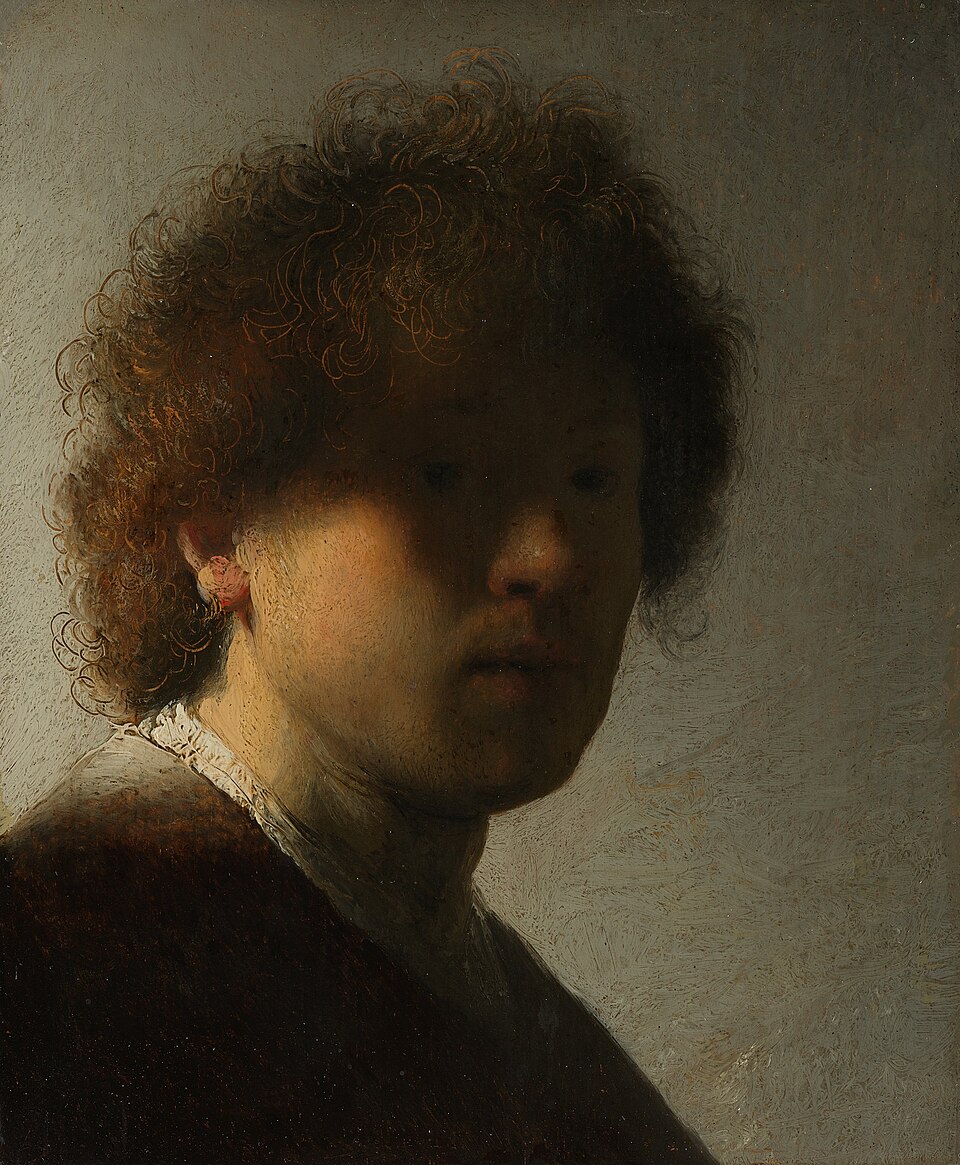
At twenty-two, Rembrandt hid his own eyes in shadow and let light catch only his neck, ear and a wild halo of curls. It is a tiny panel, and one of the earliest faces of the painter we know.
The story behind the painting
Also called Self-Portrait at an Early Age, this small painting of 1628 measures about 22.6 by 18.7 cm. It is among the earliest of Rembrandt's more than forty painted self-portraits, and the Wikipedia article also calls it the earliest known. No seventeenth-century painter is known to have made more self-portraits: about forty in paint, thirty-one etchings and dozens of drawings. Many were studies, tronies in which he tried out expressions for larger works. This one shows him relaxed, not pulling a face, and is above all an exercise in chiaroscuro, in how light falls on skin, cloth and a wall.
What to look for
The light comes from behind, an unusual angle. It touches only part of the shoulder, the neck, the right ear and the jaw, then a little of the mouth and the tip of the nose. The eyes and forehead are in full shadow, so at first you hardly notice he is looking straight at you. Where the light is strongest, at the neck, the paint is thickest; towards the shadows it grows thinner. With the back of the brush he scratched into the wet paint to lift single hairs, and short thick touches suggest a plastered wall behind him.
Meaning and intent
The painting shows how early Rembrandt turned to his own face as a place to study light. Rather than a likeness or a show of status, it is a test of what paint can do, varying its texture with the strength of the light and approaching reality with great accuracy. At only twenty-two he already shows extraordinary technical skill. A year later, in 1629, he painted a similar self-portrait with the face lit slightly differently, now in the Alte Pinakothek in Munich, and a copy made by his workshop belongs to the National Trust.
Legacy
On 27 May 1959 the painting was sold at Sotheby's in London to the art dealer Daan H. Cevat. In 1960 it was lent to the Rijksmuseum in Amsterdam, which bought it in 1977 with support from the Rembrandt Foundation, the Prince Bernhard Fund, the Ministry of Culture and others. It has been part of the museum's collection ever since, a small and intimate beginning to one of the longest conversations a painter ever held with his own reflection.
Did you know?
- Painted in 1628, when Rembrandt was twenty-two.
- Among his earliest known self-portraits.
- An exercise in chiaroscuro, lit from behind.
- In the Rijksmuseum since 1960.
About the artist
Rembrandt van Rijn (1606-1669)
man · Dutch Golden Age painting · self-portrait · Rijksmuseum · Rembrandt
More by Rembrandt van Rijn
 The Night Watch - Rembrandt van Rijn (1642)
 Self-Portrait - Rembrandt van Rijn (1659)
 The Anatomy Lesson of Dr. Nicolaes Tulp - Rembrandt van Rijn (1632)
 The Jewish Bride - Rembrandt van Rijn (1660s)
 The Storm on the Sea of Galilee - Rembrandt van Rijn (1633)
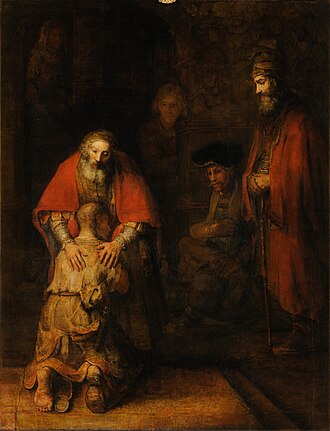 Return of the Prodigal Son - Rembrandt van Rijn (1668)
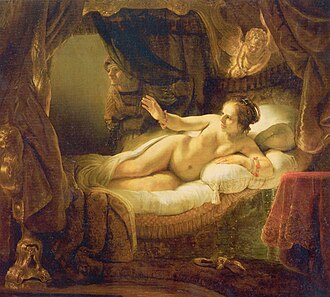 Danaë - Rembrandt van Rijn (1636)
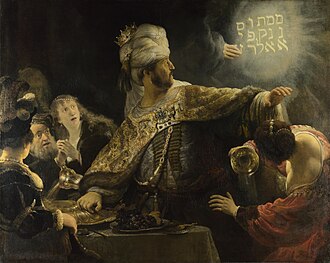 Belshazzar's Feast - Rembrandt van Rijn (1636)
Paintings by related artists
 Girl with a Pearl Earring - Johannes Vermeer (1665)
 The Milkmaid - Johannes Vermeer (c. 1658)
 The Feast of Saint Nicholas - Jan Steen (1660s)
 Girl eating oysters - Jan Steen (1658)
 A Militiaman Holding a Berkemeyer, Known as the ‘Merry Drinker’ - Frans Hals (1620s)
 Laughing Cavalier - Frans Hals (1624)
 The Windmill at Wijk bij Duurstede - Jacob van Ruisdael (1670)
 The Jewish Cemetery - Jacob van Ruisdael (1650s)
 The Courtyard of a House in Delft - Pieter de Hooch (1658)
 A Woman Peeling Apples - Pieter de Hooch (1663)