Portrait of the Poet Moratín
Francisco Goya · 1824
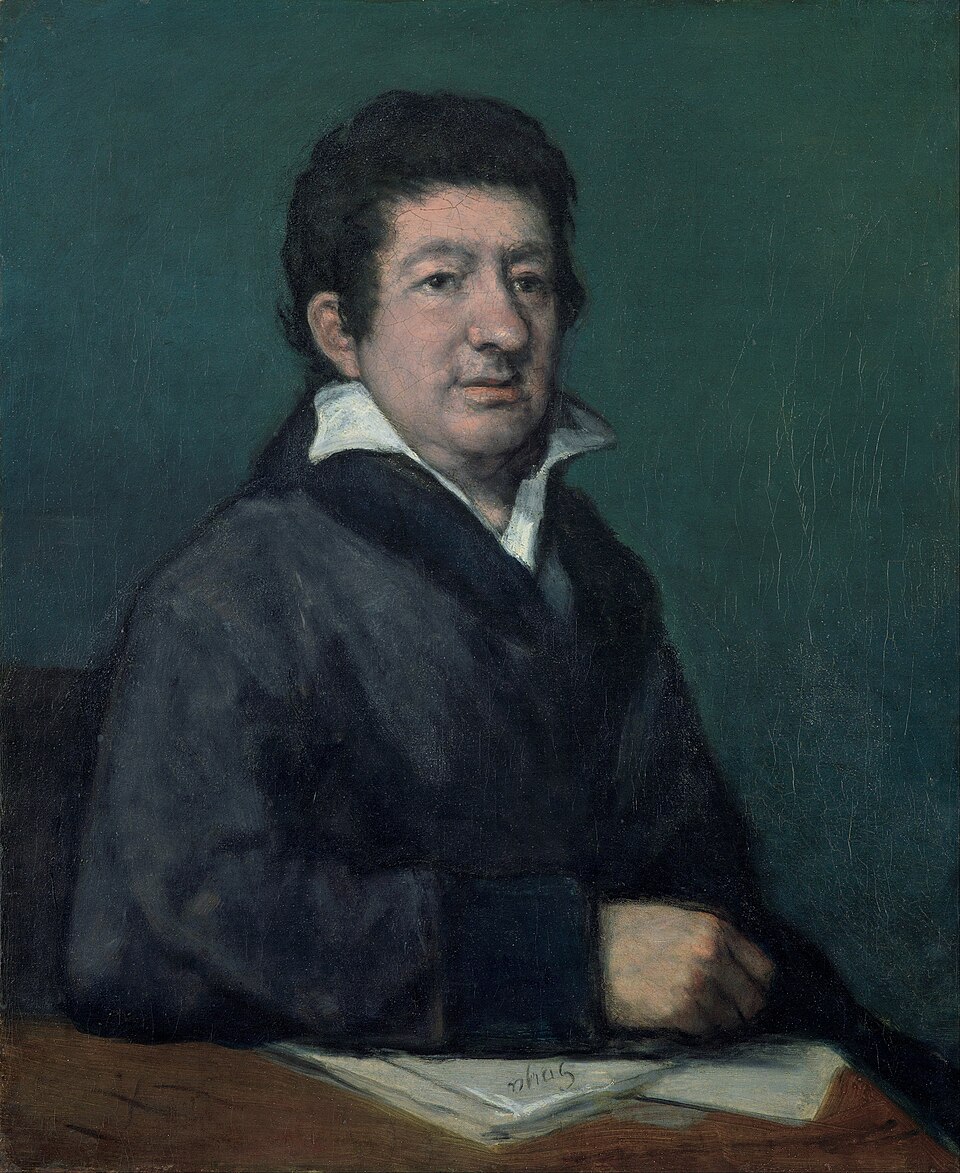
Two old friends, both in exile, meet again in Bordeaux. In 1824 Goya painted the poet Leandro Fernández de Moratín in dark tones, his eyes turned down and away, twenty-five years after his first portrait of him.
The story behind the painting
After the Spanish war of independence against Napoleon and the restoration of absolute monarchy, liberals and supporters of a constitutional monarchy, the afrancesados, were persecuted in Spain. Goya shared these progressive ideas and had French friends, and fearing persecution he took refuge in 1824 in Bordeaux, where part of the Spanish bourgeoisie lived in exile. There he renewed ties with many compatriots, among them his old friend, the poet and playwright Leandro Fernández de Moratín. Goya had already painted Moratín once in Madrid, in 1799.
What to look for
The canvas is about 60 by 49.5 cm, a close bust portrait. Goya used dark tones throughout. Look at the folds of the jacket and the fine lines on the face, which the French Wikipedia analysis reads as exaggerated to show pain. The background is blurred. The pose is slightly twisted and leaning, which creates visual tension, and the gaze is directed downward and to the right rather than at us. Light and shadow give the face its depth: the shadows trace its contours and, in that reading, deepen the sense of sadness.
Meaning and intent
The source sees Moratín presented as a sad, melancholy man, the dark palette creating a gloomy mood, the blurred background standing for an outside world indifferent to his pain, and the lowered gaze suggesting helplessness. Moratín himself took the sitting more lightly. In a letter of 10 September 1824 to his friend, the priest and writer Juan Antonio Melón, he joked that his looks must be very good indeed if the maestro wanted to reproduce them. That letter is also what fixes the date of the painting.
Legacy
The portrait was once in the collection of Manuel Silva and now belongs to the Bilbao Fine Arts Museum. It records a late chapter in the lives of two Spanish men of the Enlightenment, both far from home: Goya, then in his last years, and the friend he had first painted a quarter of a century earlier in Madrid. Set beside the 1799 portrait, it shows how exile and time had changed the way Goya saw the same face.
Did you know?
- Painted in Bordeaux in 1824, where Goya had gone into exile.
- Dated by Moratín's letter of 10 September 1824.
- Goya's second portrait of Moratín, after one from 1799.
- In the Bilbao Fine Arts Museum.
About the artist
Francisco Goya (1746-1828)
More by Francisco Goya
 The Third of May 1808 - Francisco Goya (1814)
 La Maja nue - Francisco Goya (1800)
 Saturn Devouring His Son - Francisco Goya (1819)
 Charles IV of Spain and His Family - Francisco Goya (1800)
 The Clothed Maja - Francisco Goya (1800)
 The Second of May 1808 - Francisco Goya (1814)
 The Dog - Francisco Goya (1819)
 Witches' Sabbath - Francisco Goya (1820s)
Paintings by related artists
 Wanderer above the Sea of Fog - Caspar David Friedrich (c. 1818)
 The Abbey in the Oakwood - Caspar David Friedrich (1800s)
 Liberty Leading the People - Eugène Delacroix (1830)
 Death of Sardanapalus - Eugène Delacroix (1827)
 The Fighting Temeraire - J. M. W. Turner (1839)
 Rain, Steam and Speed - The Great Western Railway - J. M. W. Turner (1844)
 The Blue Boy - Thomas Gainsborough (1770)
 Mr and Mrs Andrews - Thomas Gainsborough (1748)