Portrait of Francisco del Mazo
Francisco Goya · 1810s
%20Portrait%20de%20Francisco%20del%20Mazo%2C%20Francisco%20de%20Goya%20y%20Lucientes%2C%20Mus%C3%A9e%20Goya.jpg)
A businessman in a black coat turns from his desk with an open letter in hand. Goya painted Francisco del Mazo without flattery, and probably only because he needed the money.
The story behind the painting
The portrait dates from about 1815 to 1820 and belongs to a series Goya made of merchants and art-loving members of the middle class. Francisco del Mazo, born near Santander in 1772, was a first cousin of Manuel García de la Prada, a friend of Leandro Fernández de Moratín and a collector of Goya's work. Del Mazo had also been a household agent of the Duchess of Alba in 1793, another possible link to Goya's circle. Yet he served as chief bailiff of the Inquisition tribunal of Logroño, a role opposed to Goya's liberal, Enlightenment ideas.
What to look for
Del Mazo is shown half length, in three-quarter view, seated at a desk and holding an open letter. On the desk lies a book of drawings and prints, which suggests he studied art or loved it. He wears a black jacket with clearly visible white buttons, but his hands are not shown, a sign, according to the source, that he did not want to pay to have them painted. His features are coarse, with a broad flat nose, thick lips, heavy lashes and thick hair running into wide sideburns. A plain background, almost standard for Goya after 1815, sets him forward.
Meaning and intent
Nigel Glendinning thinks there was no personal contact between the two men and that the work came only from the artist's financial needs. Del Mazo's cousin, linked to the government of Joseph Bonaparte, had to go into exile when Ferdinand VII returned, while del Mazo kept his post. Goya seems not to have tried to soften his sitter's face. Still, Jean-Louis Augé, chief curator of the museums of Castres, sees in the quick handling, the narrow palette and the subtly varied blacks a very lively image of an energetic and shrewd personality.
Legacy
The letter holds a small mystery. Its text cannot be read clearly, but the word in red seems to be Santander. Glendinning notes that no Madrid street had that name, so the letter may show that del Mazo was moving at the time, and since he bought a house in Madrid in 1815, the painting could date from that year. The high English-style collar of his frock coat, fashionable after Napoleon's fall, also points to about 1815-1820. The painter Marcel Briguiboul bought it in Madrid in 1881, and his son Pierre left it to the Goya Museum in Castres in 1893-1894.
Did you know?
- Painted about 1815-1820.
- Part of a series of portraits of merchants and art lovers.
- The sitter was chief bailiff of the Inquisition in Logroño.
- In the Goya Museum, Castres, since 1893-1894.
About the artist
Francisco Goya (1746-1828)
portrait · man · sitting · Romanticism · chair · letter · shirt · frock coat
More by Francisco Goya
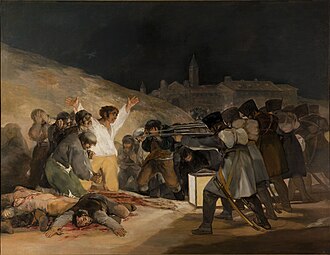 The Third of May 1808 - Francisco Goya (1814)
.jpg) La Maja nue - Francisco Goya (1800)
La Maja nue - Francisco Goya (1800).jpg) Saturn Devouring His Son - Francisco Goya (1819)
Saturn Devouring His Son - Francisco Goya (1819)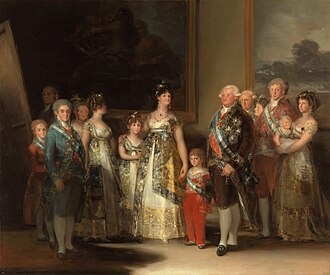 Charles IV of Spain and His Family - Francisco Goya (1800)
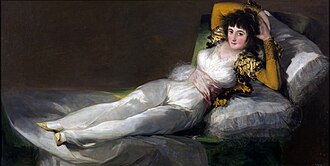 The Clothed Maja - Francisco Goya (1800)
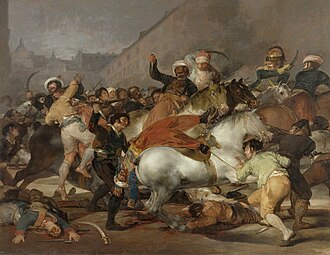 The Second of May 1808 - Francisco Goya (1814)
 The Dog - Francisco Goya (1819)
 Witches' Sabbath - Francisco Goya (1820s)
Paintings by related artists
 Wanderer above the Sea of Fog - Caspar David Friedrich (c. 1818)
 The Abbey in the Oakwood - Caspar David Friedrich (1800s)
 The Fighting Temeraire - J. M. W. Turner (1839)
 Rain, Steam and Speed - The Great Western Railway - J. M. W. Turner (1844)