Portrait of Don Ramón Satué
Francisco Goya · 1823
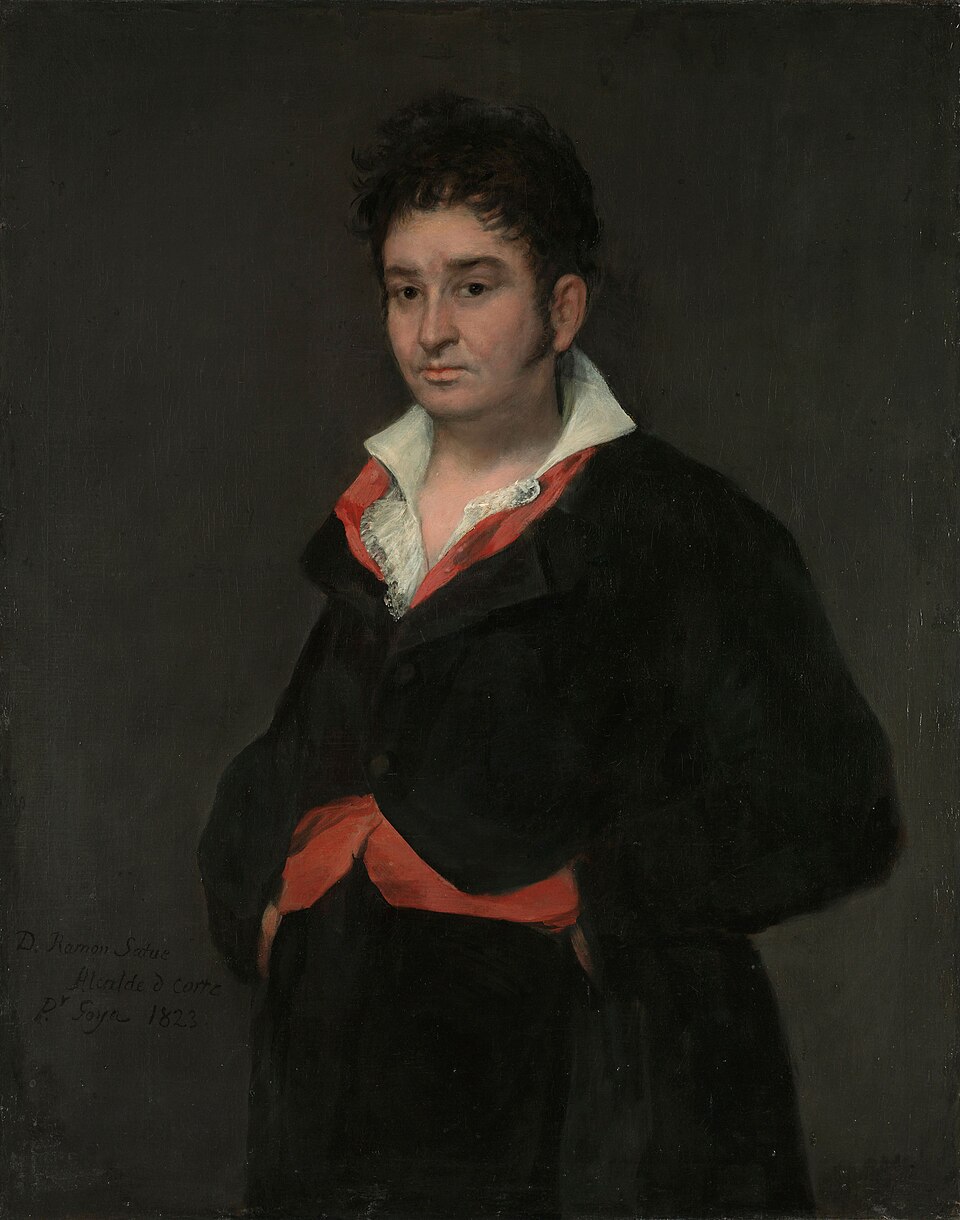
A judge stands with his hands in his pockets, shirt open at the neck, looking at us with easy carelessness. Under him, X-rays found another man: a French official in medals, perhaps even Joseph Bonaparte.
The story behind the painting
The visible portrait shows Judge Ramon Satue, a member of the court of Madrid called the Sala de Alcaldes de Corte. It was painted in 1823. Experts had long suspected another composition beneath it, and the researchers Joris Dik and Koen Janssens, using X-ray technology they developed, confirmed it: an earlier portrait of a man in the dress of a senior French official, medals on his chest, a general or possibly Joseph Bonaparte, the French king of Spain. That hidden picture would have been painted around 1810, during the Peninsular War.
What to look for
The painting, about 104 by 81 cm, is oil on panel according to Wikipedia. Satue stands at half length, his body turned toward the left while he turns his head to look at the viewer. He wears a black suit with a red vest and a white shirt casually open at the neck. He is dishevelled, and his hands rest in his trouser pockets. Notice how relaxed and unceremonious he looks for a judge, a man caught at ease rather than posed in the dignity of office.
Meaning and intent
The layers tell a story about survival. Goya, as Joris Dik put it, managed to live through both political turns, the handover of Spain to the French and its return to Spanish rule. After 1820, Dik suggests, a portrait of a French official could have been dangerous to keep, and that is when the researchers believe it was painted over with the judge we see now. Behind the casual pose of a Spanish magistrate lies a buried image of the occupation, hidden by the painter himself.
Legacy
The portrait first belonged to the Marquis de Heredia of Madrid and was sold at auction at the Hotel Drouot in Paris in 1890, then again there in 1902, when it went to Dr. Joachim Carvalho for his Chateau de Villandry in France. In 1922 the Vereniging Rembrandt bought it and gave it to the Rijksmuseum in Amsterdam. It has appeared in every Highlights of the Rijksmuseum catalogue since, and it is the only Goya in a public collection in the Netherlands.
Did you know?
- Painted by Goya in 1823.
- X-rays reveal a hidden portrait of a French official from about 1810.
- The only publicly held Goya in the Netherlands.
- Given to the Rijksmuseum by the Vereniging Rembrandt in 1922.
About the artist
Francisco Goya (1746-1828)
portrait · man · Rijksmuseum · judge
More by Francisco Goya
 The Third of May 1808 - Francisco Goya (1814)
 La Maja nue - Francisco Goya (1800)
 Saturn Devouring His Son - Francisco Goya (1819)
 Charles IV of Spain and His Family - Francisco Goya (1800)
 The Clothed Maja - Francisco Goya (1800)
 The Second of May 1808 - Francisco Goya (1814)
 The Dog - Francisco Goya (1819)
 Witches' Sabbath - Francisco Goya (1820s)
Paintings by related artists
 Wanderer above the Sea of Fog - Caspar David Friedrich (c. 1818)
 The Abbey in the Oakwood - Caspar David Friedrich (1800s)
 Liberty Leading the People - Eugène Delacroix (1830)
 Death of Sardanapalus - Eugène Delacroix (1827)
 The Fighting Temeraire - J. M. W. Turner (1839)
 Rain, Steam and Speed - The Great Western Railway - J. M. W. Turner (1844)
 The Blue Boy - Thomas Gainsborough (1770)
 Mr and Mrs Andrews - Thomas Gainsborough (1748)