Philosopher in Meditation
Rembrandt van Rijn · 1632
.jpg)
An old man sits by a window, head bowed, hands folded, while a spiral staircase winds up into the shadows. For two centuries France called him a philosopher. He may instead be the blind Tobit, waiting for his son to come home.
The story behind the painting
The painting is signed RHL-van Rijn and dated 163_, the last digit a tiny blob that could be 0, 1 or 2. Rembrandt used this kind of signature only in 1632, the year of his move from Leiden to Amsterdam, so it is dated 1632, though it may have been painted earlier. The earliest clear record is a 1738 sale catalogue in Brussels that describes a composition with Tobit and a winding stair. Recent scholarship therefore suggests the true subject is Tobit and Anna waiting for their son Tobias, rather than a philosopher.
What to look for
On a small oak panel, about 28 by 34 cm, two figures sit in a partly vaulted interior dominated by a wooden spiral staircase. The architecture of stone, brick and wood is full of arches, and the picture is one of Rembrandt's most graphic, full of straight, curved and radiating lines, from the flagstones to the window and the stairs. The old man sits at a table before the window; an old woman tends a fire in the hearth. A third woman on the stairs, visible in old engravings, has almost disappeared, and the yellowed varnish keeps the light warm and subdued.
Meaning and intent
The title Philosopher in Meditation made the painting famous, but Wikipedia calls it iconographically untenable: there are no globes, instruments or rows of books, and a woman doing housework breaks the solitude of study. The philosophical reading came from the marquis d'Argenson, who owned it from 1748 and paired it with a similar small interior of a scholar, now attributed to Salomon Koninck. Sold together as two Philosophers, the pair made the rounds of aristocratic collections. What remains is a meditation of light and shadow that many viewers still read as an image of inward thought.
Legacy
The two paintings entered the royal collection of Louis XVI in 1784 and were later separated, in 1955. The Louvre has recently renamed this one Philosopher in Contemplation. Its finely graded chiaroscuro and intricate composition were widely admired in France, and it appears in the writings of George Sand, Théophile Gautier, Jules Michelet, Marcel Proust, Paul Valéry, Gaston Bachelard, Paul Claudel and Aldous Huxley. Engravings shown at the Salon of 1755 began a long series of reproductions. Today it is often used online as an emblem of philosophy, or read along esoteric lines.
Did you know?
- Signed RHL-van Rijn and dated 1632 from the signature type.
- A 1738 catalogue describes it as a scene with Tobit.
- In the French royal collection from 1784.
- Cited by Proust, Valéry, Bachelard and Huxley.
About the artist
Rembrandt van Rijn (1606-1669)
woman · man · genre art · Dutch Golden Age painting · Department of Paintings of the Louvre · table · window · book · door
More by Rembrandt van Rijn
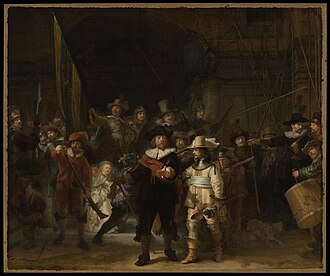 The Night Watch - Rembrandt van Rijn (1642)
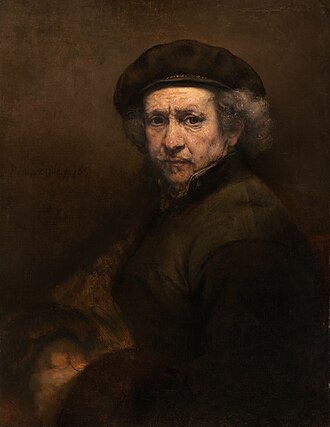 Self-Portrait - Rembrandt van Rijn (1659)
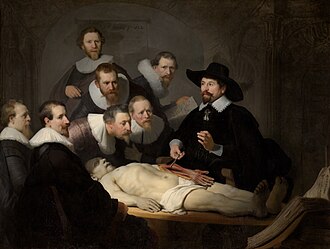 The Anatomy Lesson of Dr. Nicolaes Tulp - Rembrandt van Rijn (1632)
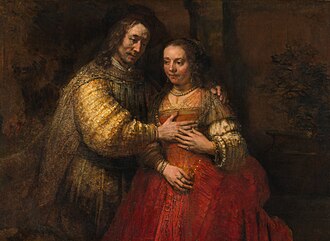 The Jewish Bride - Rembrandt van Rijn (1660s)
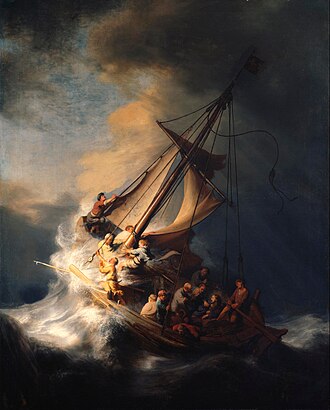 The Storm on the Sea of Galilee - Rembrandt van Rijn (1633)
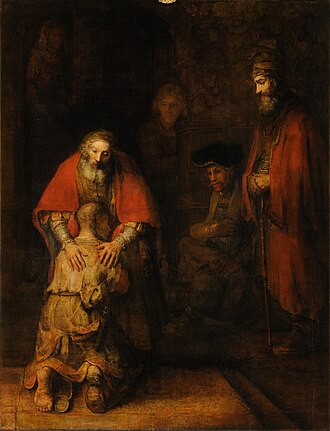 Return of the Prodigal Son - Rembrandt van Rijn (1668)
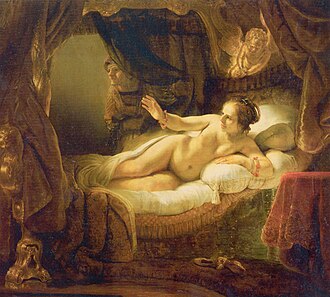 Danaë - Rembrandt van Rijn (1636)
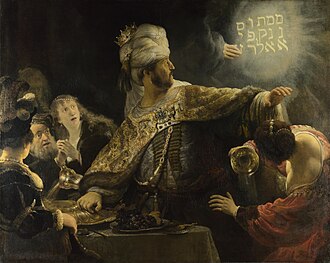 Belshazzar's Feast - Rembrandt van Rijn (1636)
Paintings by related artists
 Girl with a Pearl Earring - Johannes Vermeer (1665)
 The Milkmaid - Johannes Vermeer (c. 1658)