Painting Breathes Life into Sculpture
Jean-Léon Gérôme · 1893
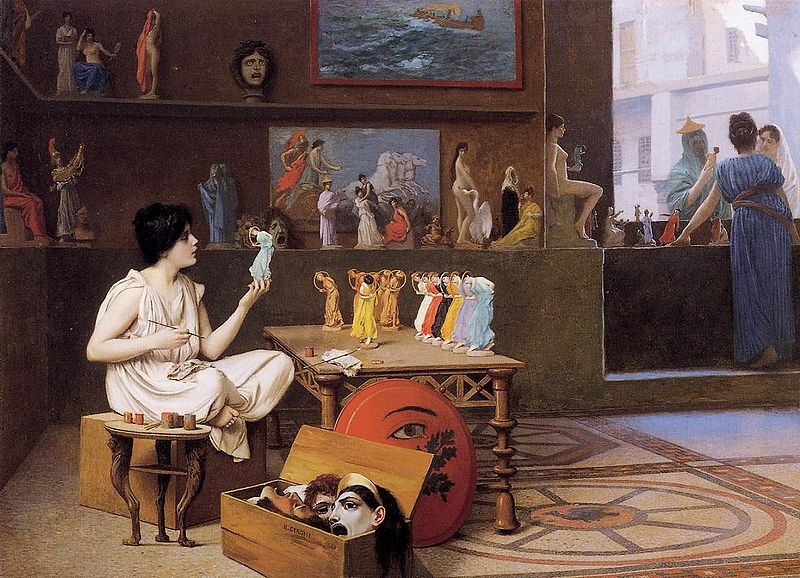
In an imagined workshop in ancient Tanagra, a young woman touches a tiny clay dancer with a fine brush, and colour seems to wake it. Gérôme painted the scene in 1893 and gave it a Latin motto: painting breathes life into sculpture.
The story behind the painting
In December 1870 archaeologists at Tanagra in Greece uncovered a large group of Hellenistic terracotta figurines still bearing traces of paint. The find excited scholars because it confirmed that ancient sculpture had originally been coloured. The figurines showed not gods or heroes but people of daily life, usually elegantly draped women. Shown at the 1878 Universal Exhibition in Paris, they were a great success, inspired many fakes, and appear in Oscar Wilde and Marcel Proust. Gérôme, fascinated, made a sculpture called Tanagra in 1890 and a Hoop Dancer in 1891, and in 1893 painted this canvas, 50.1 by 68.8 cm.
What to look for
On the left a seated young woman, probably a craftswoman or painter, holds a small terracotta of the Hoop Dancer in one hand and a fine brush in the other. On the table before her stand about a dozen identical figurines, some brightly painted, some still bare. On the right another woman stands at a wide opening, showing works to buyers in a sunlit courtyard. Gérôme filled the shop with his own works: his Tanagra near the doorway, a figure from King Candaules, a Bellona with raised arms, Leda and the swan, a Medusa mask. His signature is on the side of a chest of theatre masks.
Meaning and intent
The scene illustrates its Latin title literally. By laying colour on clay, the young woman seems to animate dead matter, which recalls the myth of Pygmalion and Galatea. The women in the bright courtyard wear the same kind of clothes as the excavated figurines, so living people and painted statuettes mirror each other. The picture is a learned reflection on antiquity, on the polychromy of Greek sculpture and on the illusionist power of art, a theme that runs through Gérôme's work.
Legacy
The painting sits at the meeting point of Gérôme's two crafts. By the 1890s he was working as both painter and sculptor, and here his own statues become props in an ancient shop, quoted again and again on the work table. It also records a moment when an archaeological find changed how people imagined antiquity, no longer white marble but colour. The canvas is today in the Art Gallery of Ontario in Toronto, Canada.
Did you know?
- Painted in 1893 by Jean-Léon Gérôme.
- Inspired by the Tanagra figurines found in 1870.
- Includes Gérôme's own sculptures Tanagra and the Hoop Dancer.
- Now in the Art Gallery of Ontario, Toronto.
About the artist
Jean-Léon Gérôme (1824-1904)
woman · allegory · table · sculpture · Art Gallery of Ontario
More by Jean-Léon Gérôme
 Pollice Verso - Jean-Léon Gérôme (1872)
 The Slave Market - Jean-Léon Gérôme (1866)
 Phryne before the Areopagus - Jean-Léon Gérôme (1861)
 Truth Coming Out of Her Well - Jean-Léon Gérôme (1896)
 Bonaparte Before the Sphinx - Jean-Léon Gérôme (1867)
 Cleopatra and Caesar - Jean-Léon Gérôme (1866)
 The Duel After the Masquerade - Jean-Léon Gérôme (1857)
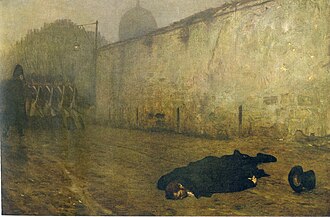 The Execution of Marshal Ney - Jean-Léon Gérôme (1868)
Paintings by related artists
 Luncheon on the Grass - Édouard Manet (1863)
 Olympia - Édouard Manet (1863)
 L'Origine du monde - Gustave Courbet (1866)
 A Burial at Ornans - Gustave Courbet (2020)
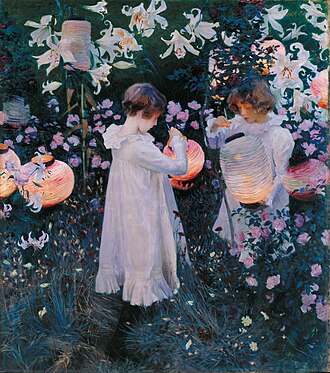 Carnation, Lily, Lily, Rose - John Singer Sargent (1885-1886)
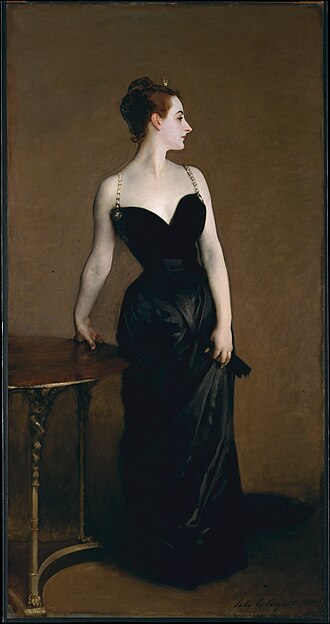 Madame X - John Singer Sargent (1884)
 Liberty Leading the People - Eugène Delacroix (1830)
 Death of Sardanapalus - Eugène Delacroix (1827)
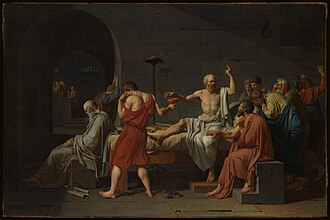 The Death of Socrates - Jacques-Louis David (1787)
 The Oath of the Horatii - Jacques-Louis David (1784)
 The Ladies Waldegrave - Joshua Reynolds (1780)
 Captain George K. H. Coussmaker - Joshua Reynolds (1782)