Heliodorus Driven from the Temple
Eugène Delacroix · 1861
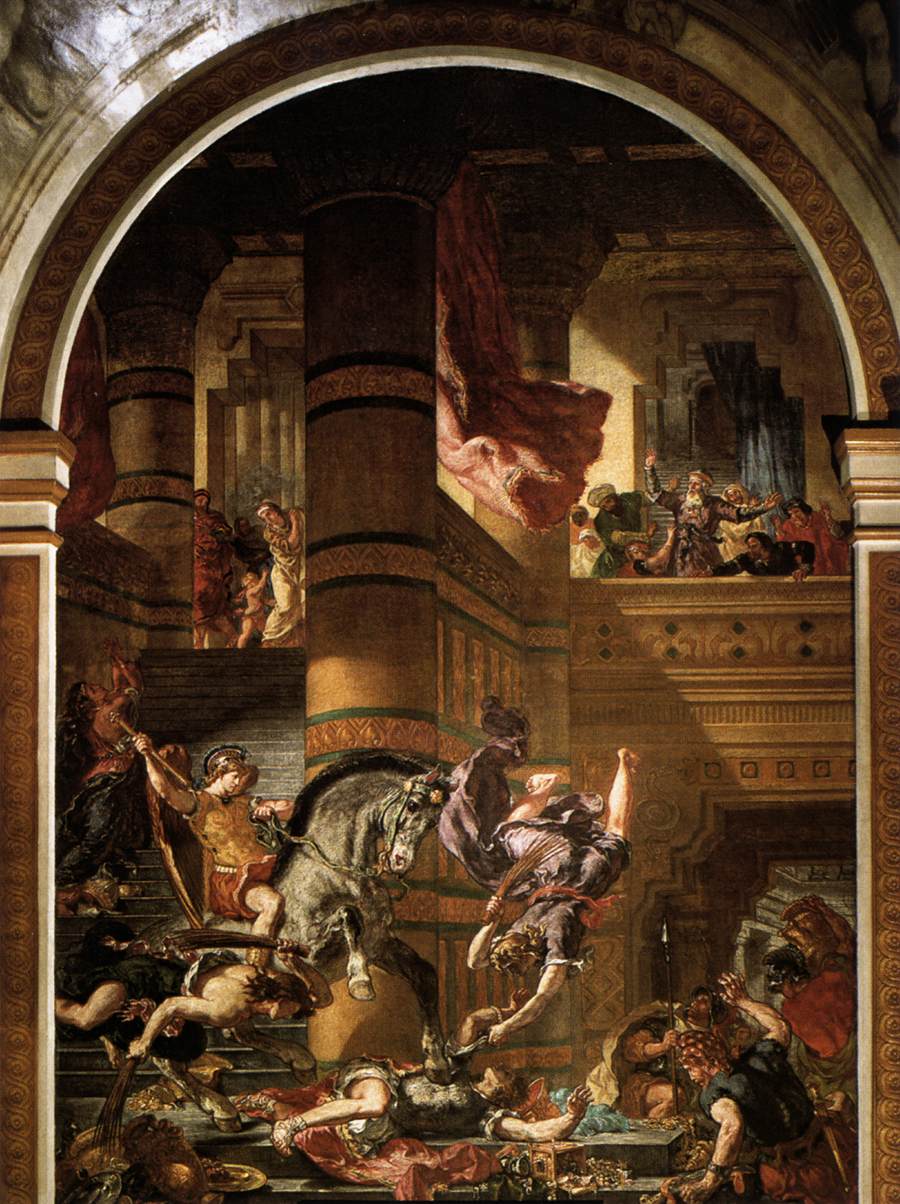
A heavenly rider strikes down a thief inside the Temple of Jerusalem while priests watch from the stairs above. Delacroix finished this huge wall painting in Paris a few months before his death.
The story behind the painting
In 1849 the French state commissioned Eugène Delacroix to decorate a chapel in the church of Saint-Sulpice in Paris, first meant as a baptistery, then dedicated to the Holy Angels. Delacroix chose the subjects himself. He drew sketches in 1850 at Champrosay and began painting in 1855, slowed by illness and by other large projects, the Galerie d'Apollon in the Louvre and the Salon de la Paix of the Paris city hall. He finished in July 1861, a few months before his death. Andrieu helped with the angels and Boulange with decorative details.
What to look for
The wall, about 751 by 485 cm, is a square below and a half circle above, painted in oil and wax on the wall. A thick column divides it: a broken arch with a balustrade on the right, a great staircase on the left. Priests and onlookers watch from above; below, a winged angel on horseback and two figures flying in bold foreshortening strike Heliodorus as he falls violently. See the moving curtain, the high priest Onias with open arms, and the violet, yellow and red. Kemp notes greenish shadows on the skin, edged with strokes of intense red.
Meaning and intent
The story comes from the Second Book of Maccabees: Heliodorus, minister of the Seleucid king Seleucus IV, tries to seize the treasure kept in the Temple of Jerusalem by the high priest Onias and is struck down by divine envoys. The source suggests a parallel with church property seized during the French Revolution. Facing Jacob Wrestling with the Angel in the same chapel, it shows a body-to-body struggle between two forces, good and evil, matter and spirit, an idea that obsessed Delacroix, and perhaps his own lifelong fight to be understood.
Legacy
This is one of Delacroix's last works, part of a cycle with Saint Michael Defeating the Demon on the ceiling, Jacob Wrestling with the Angel on the opposite wall, and four angel figures in the pendentives. Raphael had painted the same moment in the Vatican Stanze, but left the centre empty, grouping figures at the sides; Delacroix put the action in the middle. María Teresa Maiorana wrote that the painting hollows out a flat surface into an illusion of depth, so we look for the right place to stand and keep looking.
Did you know?
- Painted for the Chapel of the Holy Angels in Saint-Sulpice, Paris.
- Begun in 1855 and finished in July 1861, months before Delacroix died.
- Oil and wax on the wall, about 751 by 485 cm.
- The story is from the Second Book of Maccabees.
About the artist
Eugène Delacroix (1798-1863)
More by Eugène Delacroix
 Liberty Leading the People - Eugène Delacroix (1830)
 Death of Sardanapalus - Eugène Delacroix (1827)
 The Massacre at Chios - Eugène Delacroix (1824)
 The Barque of Dante - Eugène Delacroix (1822)
 The Women of Algiers - Eugène Delacroix (1834)
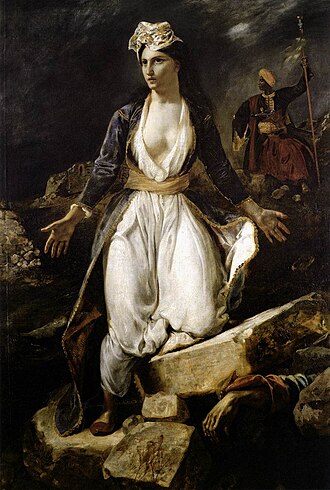 Greece on the Ruins of Missolonghi - Eugène Delacroix (1826)
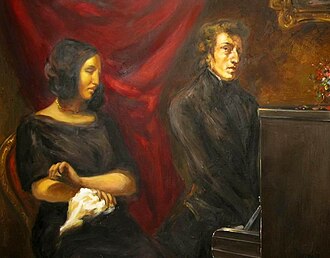 Portrait of Frédéric Chopin and George Sand - Eugène Delacroix (1837)
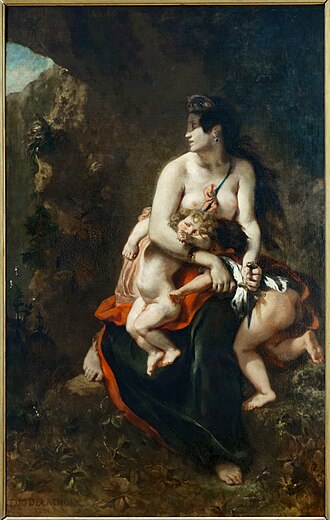 Medea - Eugène Delacroix (1836)
Paintings by related artists
 The Third of May 1808 - Francisco Goya (1814)
 La Maja nue - Francisco Goya (1800)
 Wanderer above the Sea of Fog - Caspar David Friedrich (c. 1818)
 The Abbey in the Oakwood - Caspar David Friedrich (1800s)
 The Fighting Temeraire - J. M. W. Turner (1839)
 Rain, Steam and Speed - The Great Western Railway - J. M. W. Turner (1844)
 The Blue Boy - Thomas Gainsborough (1770)
 Mr and Mrs Andrews - Thomas Gainsborough (1748)