Head of Christ
Rembrandt van Rijn · 1600s
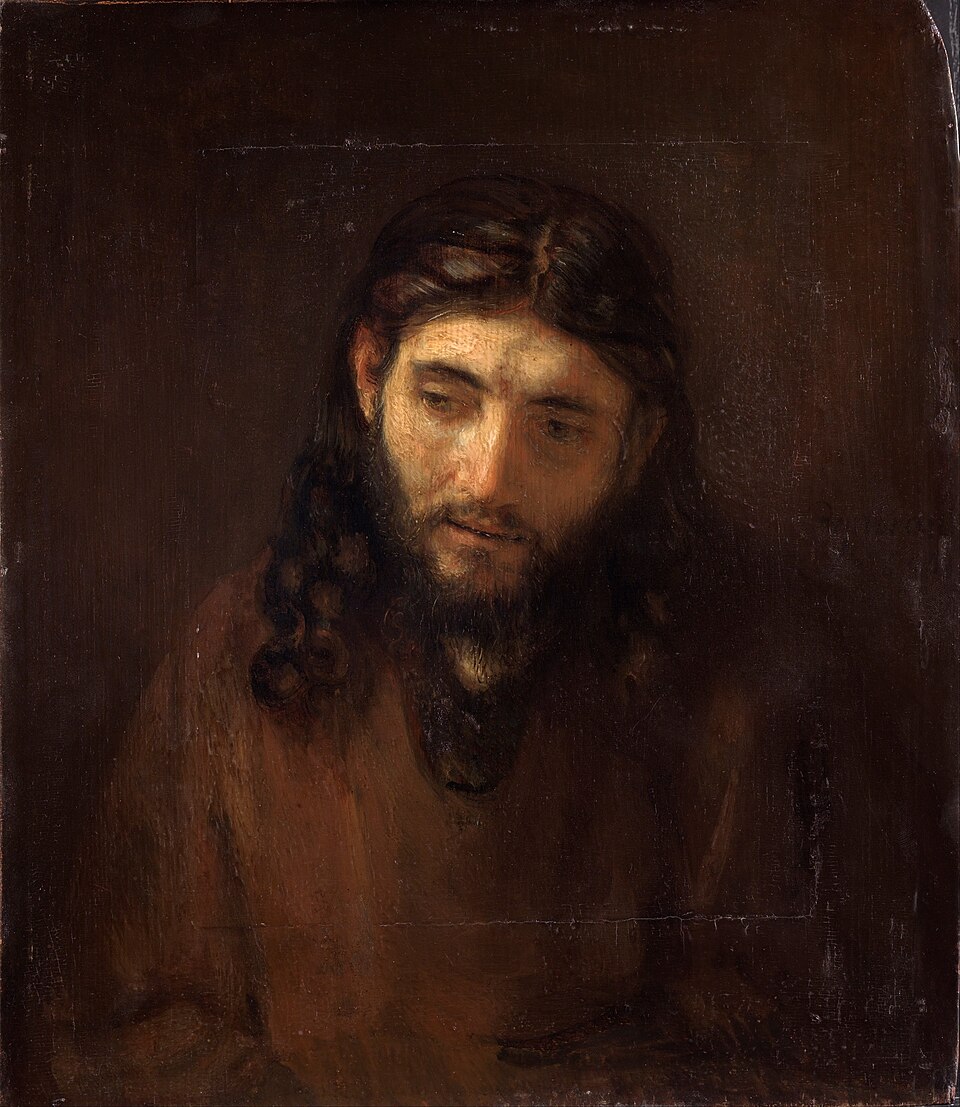
Christ faces us almost straight on, with long dark curls and a thin beard. Once counted among Rembrandt's own works, this small oak panel in Philadelphia is now given to his workshop.
The story behind the painting
Rembrandt made several similar heads of Christ in varying poses, possibly as devotional objects, and about a dozen are known today. This one is a seventeenth-century painting now credited to Rembrandt's workshop, in the Philadelphia Museum of Art. In 1914 Hofstede de Groot recorded its earlier owners: Madame de Saulcy in Paris, the Comte de la Bégassière, the Paris dealer Charles Sedelmeyer, and finally the collector John G. Johnson of Philadelphia, whose bequest brought it into the museum.
What to look for
Hofstede de Groot described the picture almost in full face, with long dark curls and a thin full beard, in a reddish-brown cloak, half-length and about half life size. It is painted on an oak panel, about 13 by 11.5 inches in his measure, 35.8 by 31.2 cm in Wikidata. Notice how directly the face meets you: there is no story around it, no gesture of blessing, only the head and shoulders of a quiet, real-looking man, the kind of image meant for private contemplation.
Meaning and intent
The source notes that this face relates very closely to Christ in two of Rembrandt's prints, where he preaches to an attentive audience. So the head carries an echo of a teacher speaking to listeners. Painted as one of a family of similar heads, it shows how Rembrandt's studio explored the human face of Jesus again and again, turning the same features this way and that. The dates conflict: Hofstede de Groot thought it was painted about 1656 to 1658, while tree-ring analysis gives a date of 1628 or later.
Legacy
The painting appeared in most twentieth-century Rembrandt catalogues, and only recently did the Rembrandt Research Project reject it as autograph, keeping it with the workshop and grouping it with all the other versions. In 2004 dendrochronology traced the oak of the panel to the Baltic and Polish regions. It was shown as number 40 in the 2011 to 2012 exhibition Rembrandt and the Face of Jesus, held in Detroit, Philadelphia and at the Louvre in Paris.
Did you know?
- Now attributed to Rembrandt's workshop.
- Came to Philadelphia through the John G. Johnson bequest.
- Tree-ring dating: 1628 or later; Hofstede de Groot said about 1656-1658.
- Shown in Rembrandt and the Face of Jesus, 2011-2012.
About the artist
Rembrandt van Rijn (1606-1669)
religious art · Jesus Christ · Philadelphia Museum of Art · Charles Sedelmeyer collection
More by Rembrandt van Rijn
 The Night Watch - Rembrandt van Rijn (1642)
 Self-Portrait - Rembrandt van Rijn (1659)
 The Anatomy Lesson of Dr. Nicolaes Tulp - Rembrandt van Rijn (1632)
 The Jewish Bride - Rembrandt van Rijn (1660s)
 The Storm on the Sea of Galilee - Rembrandt van Rijn (1633)
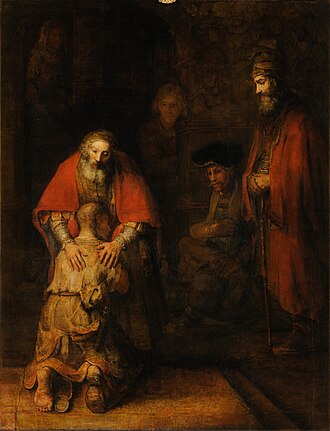 Return of the Prodigal Son - Rembrandt van Rijn (1668)
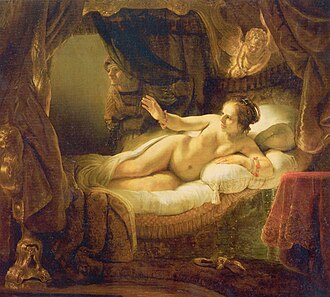 Danaë - Rembrandt van Rijn (1636)
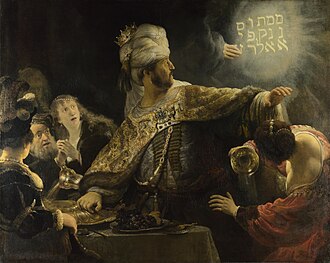 Belshazzar's Feast - Rembrandt van Rijn (1636)
Paintings by related artists
 Girl with a Pearl Earring - Johannes Vermeer (1665)
 The Milkmaid - Johannes Vermeer (c. 1658)
 The Feast of Saint Nicholas - Jan Steen (1660s)
 Girl eating oysters - Jan Steen (1658)
 A Militiaman Holding a Berkemeyer, Known as the ‘Merry Drinker’ - Frans Hals (1620s)
 Laughing Cavalier - Frans Hals (1624)
 The Windmill at Wijk bij Duurstede - Jacob van Ruisdael (1670)
 The Jewish Cemetery - Jacob van Ruisdael (1650s)
 The Courtyard of a House in Delft - Pieter de Hooch (1658)
 A Woman Peeling Apples - Pieter de Hooch (1663)