Dead turkey
Francisco Goya · 1808
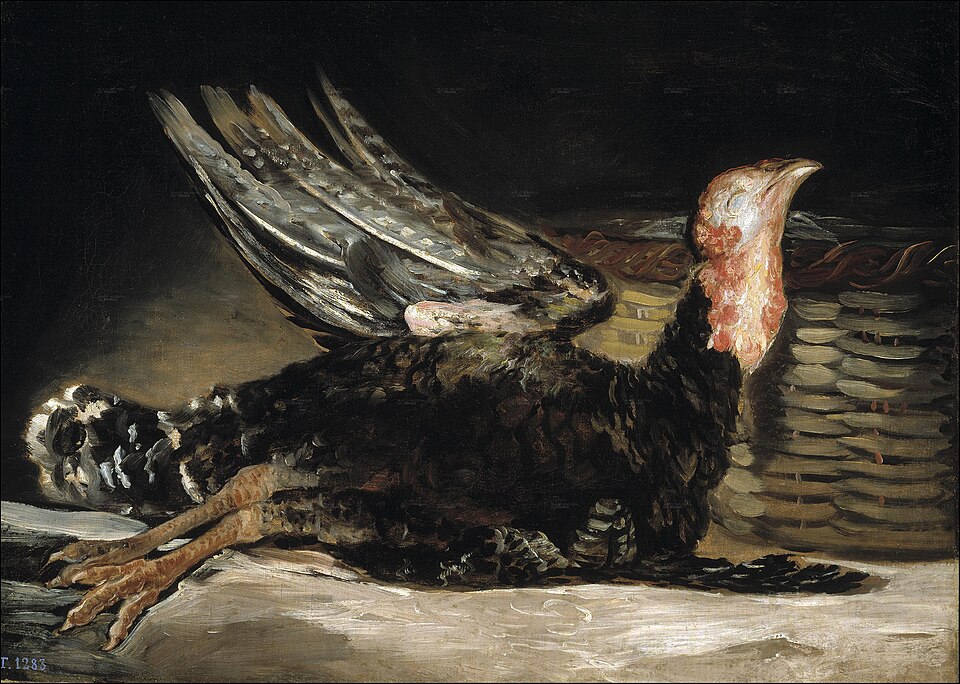
A dead turkey lies against a wicker basket in the dark, its red head the only bright note, one wing stiffly raised. Goya painted it in the years of war, and it asks us not to admire the bird but to feel for it.
The story behind the painting
Still life was not a common theme for Goya, and at the time the genre ranked below portraits and religious or historical painting. He painted a series of still lifes during the Spanish War of Independence and later in exile in Bordeaux. Their exact origin cannot be determined, but art historians place this group between 1808 and 1812 because of their likeness to The Disasters of War; Wikidata gives 1808. Dead Turkey forms a pair with Dead Birds, also in the Prado.
What to look for
The turkey leans against a wicker basket, the only point of reference in the space, before a dark, even background that draws the eye to the bird. The paint is laid on in rapid strokes, each ridge of the basket made with one thick stroke. The palette is limited to four colours, ochre, white, black and red, and the red of the head against the dark gives the work a dramatic realism. The canvas is small, about 45 by 62 cm.
Meaning and intent
The leading Spanish still life painters of the time, Luis Paret y Alcázar and Luis Meléndez, worked in a detailed rococo manner. Goya's still lifes are far from that: thick brushwork, few colours, and death shown starkly, the animals treated as victims. Paintings of birds traditionally celebrated life with rich colour, but this one provokes something closer to empathy. The corpse-like stiffness of the raised wing and the joined feet deepen the drama.
Legacy
By focusing everything on the recent death of a single bird, the painting has often been read as a reference to the War of Independence and its victims. In that light a humble kitchen subject becomes a quiet echo of the violence Goya recorded in The Disasters of War. It remains in the Museo del Prado in Madrid, beside its companion, Dead Birds. It is a small picture with a heavy silence.
Did you know?
- Painted around 1808 to 1812, during the Spanish War of Independence.
- Pairs with Dead Birds, also in the Prado.
- Painted with only four colours: ochre, white, black and red.
- Often read as a reference to the victims of the war.
About the artist
Francisco Goya (1746-1828)
More by Francisco Goya
 The Third of May 1808 - Francisco Goya (1814)
 La Maja nue - Francisco Goya (1800)
 Saturn Devouring His Son - Francisco Goya (1819)
 Charles IV of Spain and His Family - Francisco Goya (1800)
 The Clothed Maja - Francisco Goya (1800)
 The Second of May 1808 - Francisco Goya (1814)
 The Dog - Francisco Goya (1819)
 Witches' Sabbath - Francisco Goya (1820s)
Paintings by related artists
 Wanderer above the Sea of Fog - Caspar David Friedrich (c. 1818)
 The Abbey in the Oakwood - Caspar David Friedrich (1800s)
 Liberty Leading the People - Eugène Delacroix (1830)
 Death of Sardanapalus - Eugène Delacroix (1827)
 The Fighting Temeraire - J. M. W. Turner (1839)
 Rain, Steam and Speed - The Great Western Railway - J. M. W. Turner (1844)
 The Blue Boy - Thomas Gainsborough (1770)
 Mr and Mrs Andrews - Thomas Gainsborough (1748)