A Young Woman seated at a Virginal
Johannes Vermeer · 1670s
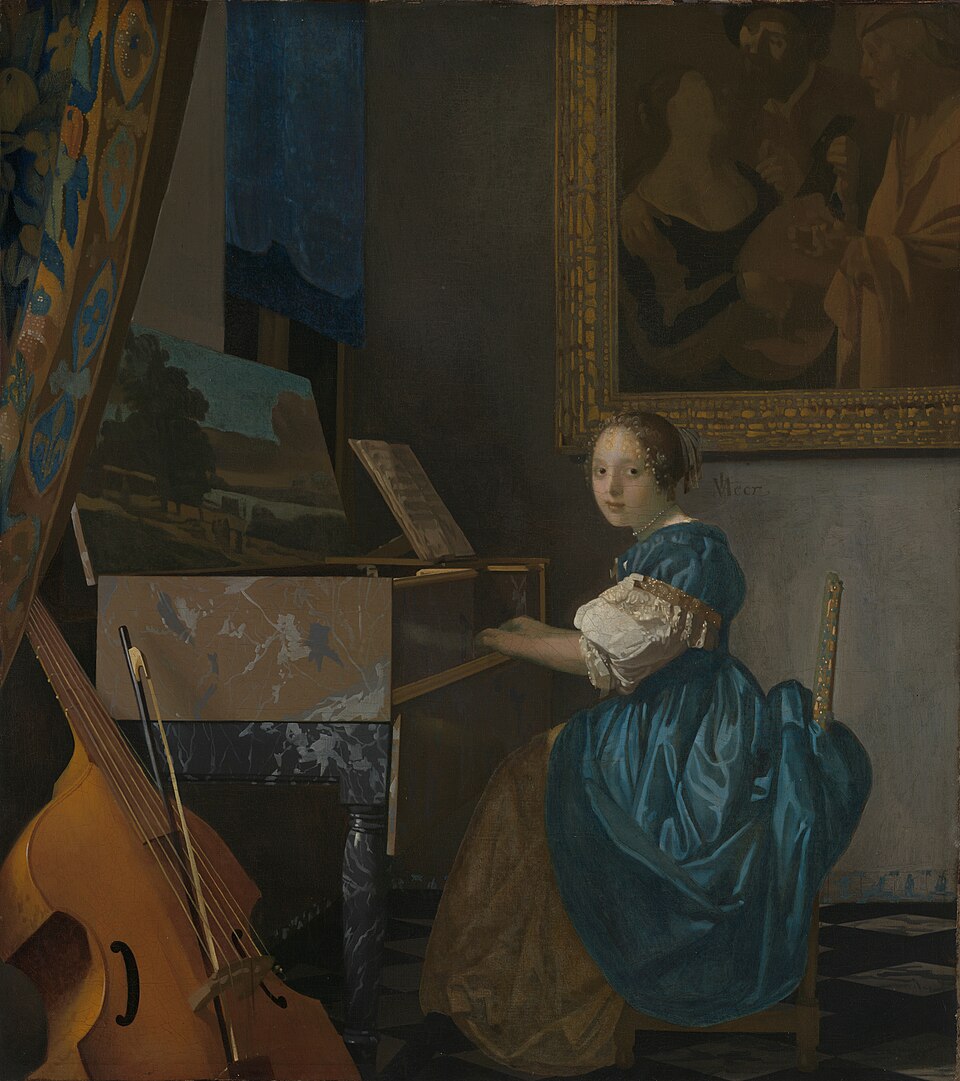
A young woman sits playing a virginal, a viola da gamba resting in the foreground. Behind her hangs a picture of a brothel scene that once belonged to Vermeer's own mother-in-law.
The story behind the painting
Johannes Vermeer painted this genre scene around 1670 to 1672; it is dated on grounds of style. It is often called Young Woman Seated at a Virginal, and it is easy to confuse with another painting, probably also by Vermeer, known as A Young Woman Seated at the Virginals, now in New York. The two are quite separate works. This one, 51.5 by 45.5 cm, is in the National Gallery in London, which also owns Vermeer's Lady Standing at a Virginal, a picture of almost the same size.
What to look for
The woman faces left as she plays the virginal. In the left foreground a viola da gamba leans with its bow between its strings, as if waiting for a second player. A landscape is painted on the inside of the instrument's lid. On the wall hangs either the original or a copy of The Procuress by Dirck van Baburen, painted around 1622 and now in the Museum of Fine Arts in Boston, a work that belonged to Vermeer's mother-in-law. The instrument itself appears in several of his paintings.
Meaning and intent
It has been suggested that this picture and Lady Standing at a Virginal were made as pendants, a matching pair: their sizes, dates and subjects are all close. A recent study showed that the canvas for both came from the same bolt, and the ground layer appears identical to that of the standing lady and of the New York seated young woman. Yet their histories before the nineteenth century differ, and Vermeer sometimes varied a theme in otherwise unrelated works, so the question of a pair stays open.
Legacy
The painting is one of several by Vermeer showing keyboard instruments, with The Music Lesson, The Concert and Lady Standing at a Virginal, and scholars believe they may all be based on the same instrument, built by Johannes Ruckers. In the nineteenth century both London virginal pictures belonged to the critic Theophile Thore, whose writings sparked a revival of interest in Vermeer from 1866. This one entered the National Gallery with the Salting Bequest in 1910.
Did you know?
- Painted around 1670 to 1672, dated on grounds of style.
- On the wall: The Procuress by Dirck van Baburen, owned by Vermeer's mother-in-law.
- May be a pendant to Lady Standing at a Virginal; both canvases come from the same bolt.
- In the National Gallery, London, since 1910.
About the artist
Johannes Vermeer (1632-1675)
genre art · National Gallery · Dutch Golden Age painting · Charles Sedelmeyer collection
More by Johannes Vermeer
 Girl with a Pearl Earring - Johannes Vermeer (1665)
 The Milkmaid - Johannes Vermeer (c. 1658)
 View of Delft - Johannes Vermeer (1660s)
 The Astronomer - Johannes Vermeer (1664)
 The Art of Painting - Johannes Vermeer (1660s)
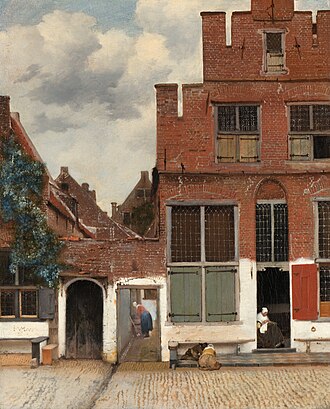 The Little Street - Johannes Vermeer (1658)
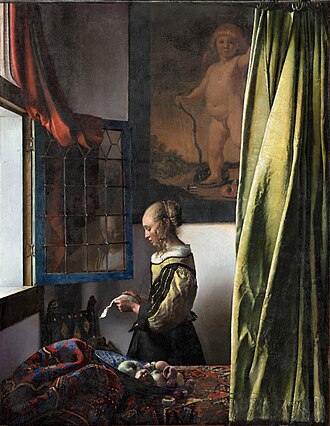 Girl Reading a Letter at an Open Window - Johannes Vermeer (1650s)
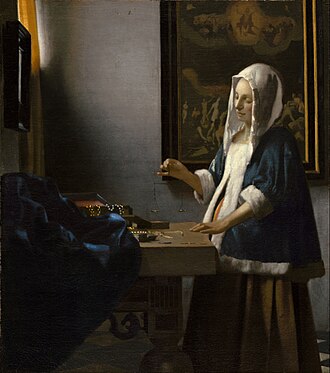 Woman Holding a Balance - Johannes Vermeer (1665)
Paintings by related artists
 The Night Watch - Rembrandt van Rijn (1642)
 Self-Portrait - Rembrandt van Rijn (1659)
 The Feast of Saint Nicholas - Jan Steen (1660s)
 Girl eating oysters - Jan Steen (1658)
 A Militiaman Holding a Berkemeyer, Known as the ‘Merry Drinker’ - Frans Hals (1620s)
 Laughing Cavalier - Frans Hals (1624)
 The Windmill at Wijk bij Duurstede - Jacob van Ruisdael (1670)
 The Jewish Cemetery - Jacob van Ruisdael (1650s)
 The Courtyard of a House in Delft - Pieter de Hooch (1658)
 A Woman Peeling Apples - Pieter de Hooch (1663)